What Is Auction Theory in Economics?
TL;DR
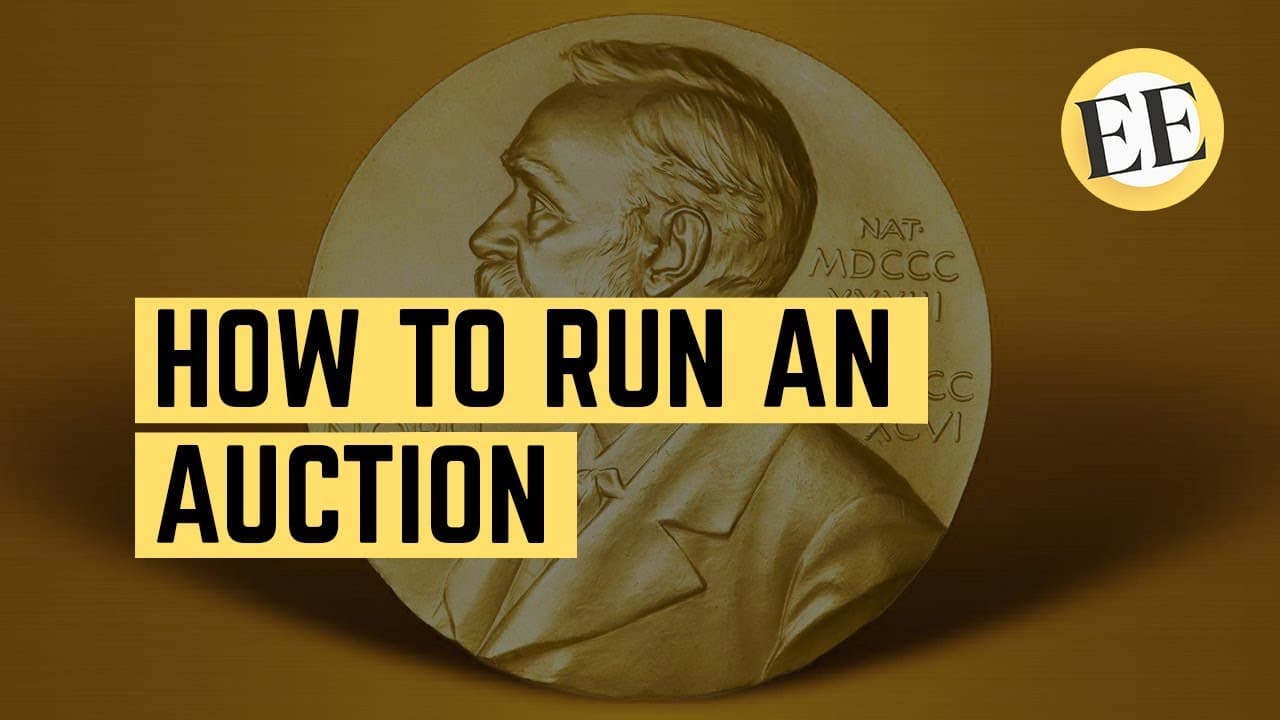
Auction Theory is a critical aspect of economics that optimizes how items are valued and markets are built. The 2020 Nobel Prize in Economics was awarded to Paul Milgrom and Robert Wilson for their advancements in this field, including the development of the Simultaneous Multiple Round Auction, which enhances the allocation of resources like radio frequencies.
Transcript
The Sveriges Riksbank Prize in Economic sciences in memory of Alfred Nobel, or simply the Nobel Prize in Economics is an award given every year to thought leaders in the field. This is one of 6 prizes given out the others recognizing similarly high achievers in literature, physics, medicine, chemistry and of course the peace prize awarded for furth... Read More
Key Insights
- Auction Theory is essential for understanding market dynamics and valuation of items.
- Paul Milgrom and Robert Wilson won the 2020 Nobel Prize for their work on Auction Theory.
- The English auction system is widely used but has limitations in achieving the highest possible price.
- Dutch auctions start with high prices and decrease until a bid is made, but are less popular due to ethical concerns.
- The winner's curse occurs when the winning bid exceeds the intrinsic value of the item.
- Collusion among bidders can undermine the fairness and efficiency of auctions.
- Simultaneous Multiple Round Auctions allow for complex bidding scenarios, improving resource allocation.
- This auction format has been successfully implemented in various countries for selling public assets.
Install to Summarize YouTube Videos and Get Transcripts
Explore YouTube Video Summarizer or Get YouTube Transcript Extractor
Questions & Answers
Q: What is Auction Theory in economics?
Auction Theory is a branch of economics that studies how auction design affects the allocation and pricing of goods and services. It examines different auction formats, such as English and Dutch auctions, and their efficiency in discovering market value, maximizing seller revenue, and ensuring fair competition among bidders.
Q: How do English and Dutch auctions differ?
English auctions start with a low price, allowing bidders to incrementally increase their offers until no higher bids are made. In contrast, Dutch auctions begin with a high price that decreases until a bidder accepts the current price. While English auctions are more popular, Dutch auctions can lead to quicker sales but may be perceived as less ethical by bidders.
Q: What is the winner's curse in auctions?
The winner's curse refers to the situation where the winning bidder pays more than the intrinsic value of the item, often due to incomplete information or overestimation of the item's worth. This can lead to regret and financial loss for the winner, highlighting the importance of accurate valuation and information in auctions.
Q: How does bidder collusion affect auctions?
Bidder collusion occurs when participants in an auction conspire to manipulate the bidding process, often by agreeing not to compete against each other. This practice can lead to artificially low prices, undermining the auction's fairness and efficiency. Collusion is illegal in many jurisdictions but can be challenging to detect and prevent.
Q: What is the Simultaneous Multiple Round Auction?
The Simultaneous Multiple Round Auction is an auction format where all items are offered simultaneously, and bidders can place bids over several rounds. After each round, current highest bids are revealed, allowing bidders to adjust their offers. This format reduces the risk of incomplete asset acquisition and encourages competitive bidding, improving resource allocation.
Q: Why was the Simultaneous Multiple Round Auction developed?
The Simultaneous Multiple Round Auction was developed to address the limitations of traditional auction formats, such as suboptimal pricing and bidder collusion. It was designed to handle complex bidding scenarios, like the allocation of radio frequencies, where both private and common values influence bidder decisions, ensuring efficient and fair outcomes.
Q: How has the Simultaneous Multiple Round Auction been implemented?
The Simultaneous Multiple Round Auction has been implemented in various countries for selling public assets, such as radio frequencies. It was first used by the FCC in the USA in 1994, generating significant revenue by ensuring competitive and transparent bidding. Many countries have since adopted this format for similar purposes, enhancing public resource management.
Q: What impact did Milgrom and Wilson's work have on auction theory?
Milgrom and Wilson's work revolutionized auction theory by introducing new formats that address traditional auction limitations. Their research on bidder behavior and auction design has improved market efficiency and resource allocation, benefiting both sellers and buyers. Their contributions have been widely recognized and implemented globally, significantly impacting economic policy and practice.
Summary & Key Takeaways
-
Auction Theory plays a pivotal role in economics by providing a framework for understanding how markets function and items are valued. Paul Milgrom and Robert Wilson's contributions to this field, recognized by the 2020 Nobel Prize in Economics, include innovative auction formats that improve resource allocation and market efficiency.
-
Traditional auction formats, like the English and Dutch auctions, have inherent limitations, such as not achieving the highest possible prices and being susceptible to bidder collusion. These issues highlight the need for more sophisticated auction designs to ensure fair and optimal outcomes.
-
The Simultaneous Multiple Round Auction, developed by Milgrom and Wilson, addresses many challenges associated with traditional auctions. By allowing for multiple rounds of bidding and revealing current bids, this format encourages competitive participation and reduces the risks of collusion and overbidding, leading to better resource distribution.
Read in Other Languages (beta)
Share This Summary 📚
Summarize YouTube Videos and Get Video Transcripts with 1-Click
Try YouTube Summary with ChatGPT & Claude or YouTube Transcript Generator
Explore More Summaries from Economics Explained 📚





Summarize YouTube Videos and Get Video Transcripts with 1-Click
Try YouTube Summary with ChatGPT & Claude or YouTube Transcript Generator