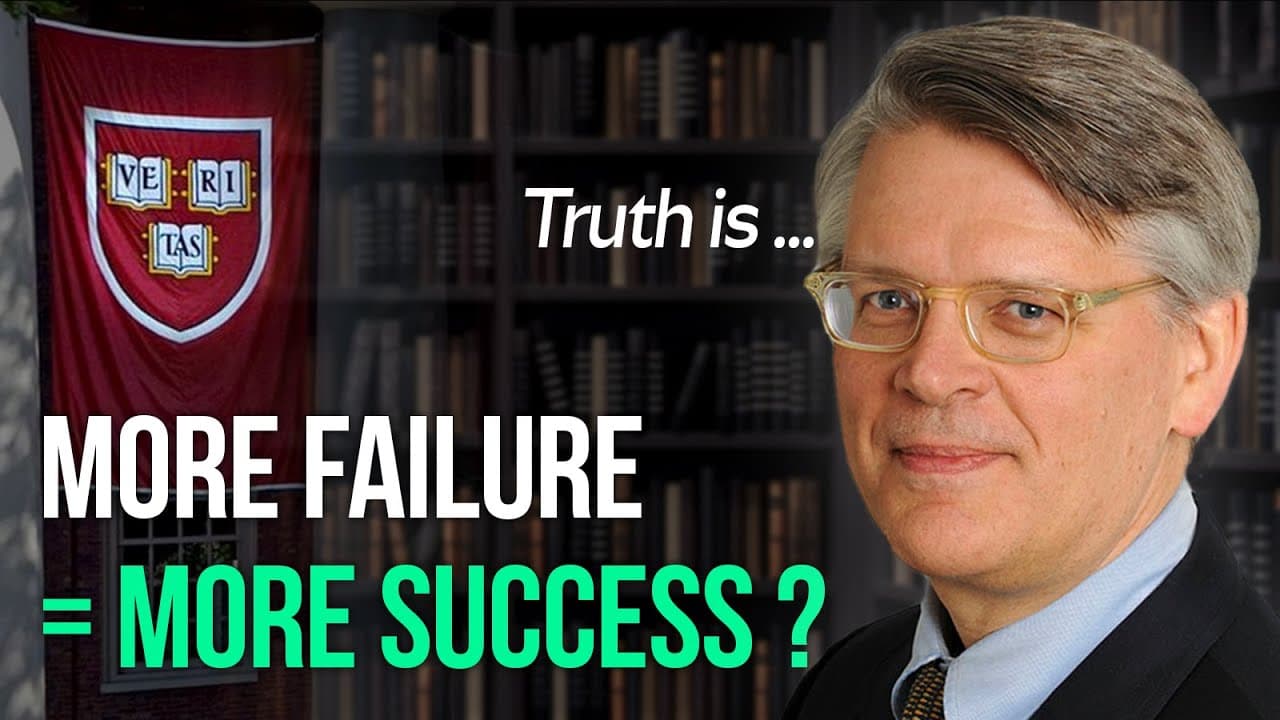
What I learned about Failure after 26 Years of Research at Harvard |Tom Eisenmann
TL;DR
Learn why startups fail and how to avoid common pitfalls.
Transcript
I'm going to put it into the world rigorously and quickly without wasting resources testing an idea That's the soul of entrepreneurship If you skip it and just start building and selling, you've wasted four months on a bad first version of the product in order to save four weeks. If you made a mistake, I think you weren't trying hard enough or you... Read More
Key Insights
- Tom Eisenmann emphasizes the importance of rigorously testing ideas quickly to avoid wasting resources and time in entrepreneurship.
- Failure is often a result of false starts, where entrepreneurs rush into building without thorough customer discovery and opportunity analysis.
- Understanding the difference between early adopters and mainstream customers is crucial for a startup's long-term success.
- The Lean Startup methodology emphasizes not just building a minimum viable product, but also thorough customer discovery to avoid false starts.
- Entrepreneurs often face 'false positives' where initial success can mask underlying issues, leading to misguided investments.
- Learning from failures involves balancing between quick adaptation and stubbornness, testing assumptions rigorously.
- Emotional distance and reflection are necessary to objectively evaluate failures and avoid the fundamental attribution error.
- A significant percentage of first-time entrepreneurs fail, but those who try again have slightly higher success rates, indicating the value of persistence and learning.
Install to Summarize YouTube Videos and Get Transcripts
Explore YouTube Video Summarizer or Get YouTube Transcript Extractor
Questions & Answers
Q: What is the main cause of failure for early-stage startups according to Tom Eisenmann?
The main cause of failure for early-stage startups, as highlighted by Tom Eisenmann, is a false start. This occurs when entrepreneurs rush into building and selling their product without thoroughly studying the opportunity or understanding the needs of potential customers. This eagerness often leads to launching a product that doesn't meet market needs, resulting in wasted resources and time.
Q: How does the Lean Startup methodology help prevent startup failures?
The Lean Startup methodology helps prevent startup failures by emphasizing two key components: building a minimum viable product and conducting thorough customer discovery. This approach encourages entrepreneurs to quickly test their product ideas in the market, gather customer feedback, and iterate based on real-world data. This process helps avoid the trap of false starts by ensuring that products are developed based on validated customer needs.
Q: Why is it important to differentiate between early adopters and mainstream customers?
Differentiating between early adopters and mainstream customers is important because their needs can significantly differ. Early adopters might embrace a product for its novelty or specific features, while mainstream customers may prioritize ease of use or reliability. Understanding these differences helps entrepreneurs tailor their product development and marketing strategies to cater to both groups effectively, ensuring long-term success and market penetration.
Q: What role does emotional reflection play in learning from failures?
Emotional reflection plays a crucial role in learning from failures as it allows entrepreneurs to objectively assess their mistakes without being clouded by immediate emotional reactions. By giving themselves time to distance from the failure, entrepreneurs can analyze the situation more rationally, identify the true causes of failure, and develop strategies to avoid repeating the same mistakes in future ventures.
Q: What is the fundamental attribution error, and how does it relate to entrepreneurship?
The fundamental attribution error is the tendency to attribute others' failures to their character while attributing our own failures to external factors. In entrepreneurship, this bias can prevent entrepreneurs from taking responsibility for their mistakes, leading to repeated failures. Recognizing and overcoming this bias is essential for entrepreneurs to learn from their experiences and improve their decision-making processes.
Q: How does the success rate of first-time entrepreneurs compare to those who try again?
The success rate for first-time entrepreneurs is relatively low, with only about 21% achieving financial success. However, those who try again after a failure have a slightly higher success rate of 22% on their second venture. This suggests that persistence and learning from past experiences can marginally improve the chances of success in entrepreneurship.
Q: What is the significance of testing assumptions in entrepreneurship?
Testing assumptions is critical in entrepreneurship because it helps validate or invalidate the foundational beliefs about a product, market, or customer needs. By rigorously testing these assumptions, entrepreneurs can make informed decisions, pivot when necessary, and avoid investing time and resources into flawed ideas. This scientific approach to entrepreneurship reduces the risk of failure by ensuring that business strategies are based on proven insights.
Q: Can startups have a positive impact on the world despite high failure rates?
Yes, startups can have a positive impact on the world despite high failure rates. They drive innovation, create new products and services, and contribute to economic growth. Even failed startups often lead to valuable lessons, new networks, and skills for entrepreneurs, which can be applied to future ventures. The potential for significant positive change makes the risk of failure worthwhile for many entrepreneurs.
Summary & Key Takeaways
-
Tom Eisenmann, a Harvard Business School professor, discusses the common patterns leading to startup failures and emphasizes the importance of learning from these failures. His research suggests that false starts and inadequate customer discovery are major contributors to failure.
-
The Lean Startup methodology is highlighted as a means to avoid false starts by focusing on both building a minimum viable product and thorough customer discovery. Understanding customer needs and testing assumptions are crucial for avoiding costly mistakes.
-
Eisenmann also stresses the need for entrepreneurs to learn from their failures by reflecting on their experiences, avoiding the fundamental attribution error, and balancing between being too reactive and too stubborn in their strategies.
Read in Other Languages (beta)
Share This Summary 📚
Summarize YouTube Videos and Get Video Transcripts with 1-Click
Try YouTube Summary with ChatGPT & Claude or YouTube Transcript Generator
Explore More Summaries from EO 📚


Summarize YouTube Videos and Get Video Transcripts with 1-Click
Try YouTube Summary with ChatGPT & Claude or YouTube Transcript Generator