Facts about Human Evolution
TL;DR
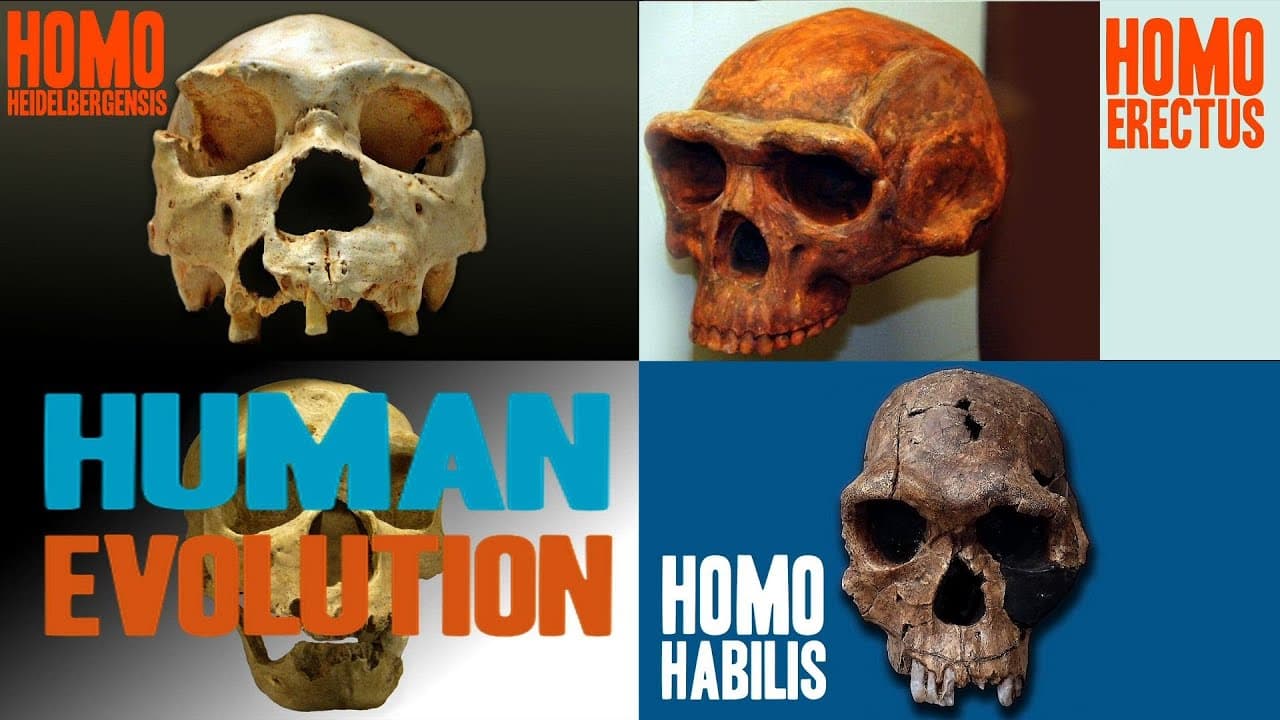
Charles Darwin proposed that humans descended from African apes, a theory that took several decades to be supported by fossil evidence. Over time, our ancestors achieved key evolutionary breakthroughs including bipedalism, tool use, and social behavior, leading to the emergence of Homo Habilis, Homo Ergaster, Homo Heidelbergensis, Neanderthals, and eventually modern humans.
Transcript
Imagine the scene it was 1871 and Charles Darwin had just suggested that we humans did not in fact walk fully formed, out of the primordial sludge at the beginning of time instead, in his book "The Descent of Man", He proposed that humans descended from African apes. Naturally, his Victorian contemporaries were all "Ooooo... Fetch me my smelling sa... Read More
Key Insights
- 🫢 Charles Darwin's theory of human evolution from African apes shocked his Victorian contemporaries and took several decades to be supported by fossil evidence.
- 🌍 The Out of Africa Hypothesis suggests that modern humans evolved exclusively in Africa and migrated to other parts of the world in two waves.
- 🤩 Bipedalism, tool use, and complex social behavior were key evolutionary breakthroughs that contributed to the emergence of modern humans.
- 🖐️ Homo Habilis, Homo Ergaster, Homo Heidelbergensis, and Neanderthals played significant roles in the evolution of humans.
- ❓ Interbreeding between modern humans and Neanderthals may be responsible for the presence of Neanderthal DNA in modern human populations.
- ❓ Recent discoveries, such as Homo Floresiensis and the Denisovans, continue to expand our understanding of human evolution.
Install to Summarize YouTube Videos and Get Transcripts
Explore YouTube Video Summarizer or Get YouTube Transcript Extractor
Questions & Answers
Q: How did Charles Darwin's theory of human evolution challenge the beliefs of his Victorian contemporaries?
Charles Darwin's theory proposed that humans descended from African apes, which contradicted the belief that humans were created fully formed. His theory shocked many of his Victorian contemporaries and challenged religious beliefs about human origins.
Q: What is the Out of Africa Hypothesis?
The Out of Africa Hypothesis suggests that anatomically modern humans evolved exclusively in Africa and then migrated to other parts of the world in two waves. Genetic evidence and the discovery of the oldest hominin fossils in Africa support this hypothesis.
Q: How did bipedalism contribute to human evolution?
Bipedalism, or the ability to walk upright on two feet, was a game-changing evolutionary milestone. It allowed our early ancestors to spot predators, travel longer distances, and access food sources such as fruits. Bipedalism also freed up hands for tool use.
Q: What were the key characteristics of Homo Habilis?
Homo Habilis, also known as handy man, was the earliest member of the Homo genus. They had dexterous hands and ate meat, which led to encephalization and an increase in brain size. Homo Habilis is believed to be the direct descendant of the australopithecines.
Summary & Key Takeaways
-
Charles Darwin proposed the theory of human evolution from African apes, but fossil evidence took several decades to support this idea.
-
From the genus Australopithecus to the genus Homo, our ape-like ancestors achieved significant evolutionary milestones, such as bipedalism and tool use.
-
Homo Habilis was the earliest member of the Homo genus, acquiring dexterous hands and the ability to eat meat, which led to encephalization and an increase in brain size.
Read in Other Languages (beta)
Share This Summary 📚
Summarize YouTube Videos and Get Video Transcripts with 1-Click
Try YouTube Summary with ChatGPT & Claude or YouTube Transcript Generator
Explore More Summaries from SciShow 📚

Summarize YouTube Videos and Get Video Transcripts with 1-Click
Try YouTube Summary with ChatGPT & Claude or YouTube Transcript Generator