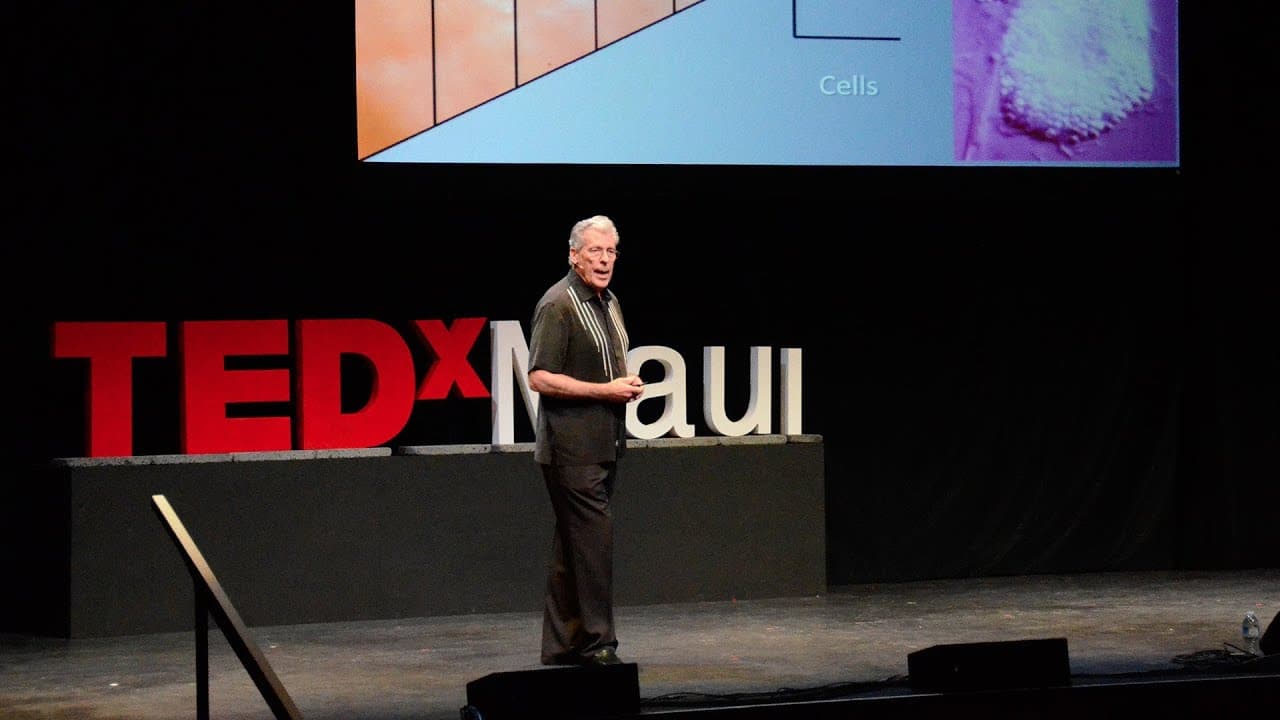
Gary Greenberg: The beautiful nano details of our world
TL;DR
In this talk, the speaker discusses the magical and unique world of the micro world, showcasing the hidden beauty of objects such as bees, cells, sand, and even lunar sand.
Transcript
Translator: Joseph Geni Reviewer: Morton Bast So I want to talk a little bit about seeing the world from a totally unique point of view, and this world I'm going to talk about is the micro world. I've found, after doing this for many, many years, that there's a magical world behind reality. And that can be seen directly through a microscope, and I'... Read More
Key Insights
- 🔎 Seeing the world from a micro world perspective reveals a magical hidden reality that can be observed through a microscope.
- 🐝 Bees have thousands of individual eyes called ommatidia, allowing them to sense objects up close.
- 🔬 Living cells, like immune cells, are constantly moving and searching for foreign objects to engulf and eat.
- 💓 Heart cells have the mission of moving blood around our bodies and beat in a rhythmic manner.
- 🔬 Microscopes can see individual atoms, revealing a whole world within the micro world called the nano world.
- 🌸 Viewing a flower from the perspective of a tiny bug reveals a different terrain and structures like nectar spurs.
- 🏝️ Sand is not just ordinary; it contains microshells, coral fragments, volcano bits, and an array of incredible things.
- ⭐ The uniqueness and diversity of sand grains depict millions of years of biological and geological history and are found throughout the universe.
Install to Summarize YouTube Videos and Get Transcripts
Explore YouTube Video Summarizer or Get YouTube Transcript Extractor
Questions & Answers
Q: What is the speaker's main topic in the video?
The speaker's main topic is the fascinating world that can be seen through a microscope, specifically focusing on the micro world.
Q: What can be seen when looking at a bee under a microscope?
When looking at a bee under a microscope, thousands of individual eyes called ommatidia can be seen, along with sensory hairs in their eyes that help them navigate and perceive objects up close.
Q: What is the size of a human hair and how does it compare to a cell?
A human hair is about a tenth of a millimeter in size, and a cell is about ten times smaller than that, meaning 10 human cells can fit across the diameter of a human hair.
Q: What is the purpose of heart cells and what do they do?
Heart cells have the mission of moving blood around the body. They beat in a dish, and their job is to continuously pump blood throughout the body. Each cell in the body has its own unique mission.
Q: How small can microscopes today see?
Microscopes today can see individual atoms, with the ability to visualize the nano world, which encompasses the world of molecules and atoms. Microscopes can even capture images of individual atoms and atomic structures.
Summary & Key Takeaways
-
The speaker discusses the magical world that can be seen through a microscope, showcasing the intricate details of objects such as bees, cells, and atoms.
-
The diversity and uniqueness of sand is explored, including sand from different locations on Earth, as well as sand found on the Moon that has been shaped by micrometeorite impacts.
-
The overall message emphasizes the importance of looking closely and from different perspectives to discover the extraordinary in the ordinary.
Read in Other Languages (beta)
Share This Summary 📚
Summarize YouTube Videos and Get Video Transcripts with 1-Click
Try YouTube Summary with ChatGPT & Claude or YouTube Transcript Generator
Explore More Summaries from TED 📚





Summarize YouTube Videos and Get Video Transcripts with 1-Click
Try YouTube Summary with ChatGPT & Claude or YouTube Transcript Generator