Products
Features
YouTube Video Summarizer
Summarize YouTube videos
Web & PDF Highlighter
Highlight web pages & PDFs
Chat with PDF
Ask any PDF questions with AI
Ask AI Clone
Chat with your highlights & memories
Audio Transcriber
Transcribe audio files to text
Glasp Reader
Read and highlight articles
Kindle Highlight Export
Export your Kindle highlights
Idea Hatch
Hatch ideas from your highlights
Integrations
Obsidian Plugin
Notion Integration
Pocket Integration
Instapaper Integration
Medium Integration
Readwise Integration
Snipd Integration
Hypothesis Integration
Apps & Extensions
Chrome Extension
Safari Extension
Edge Add-ons
Firefox Add-ons
iOS App
Android App
Discover
Discover
Ideas
Discover new ideas and insights
Articles
Curated articles and insights
Books
Book recommendations by great minds
Posts
Essays and notes from readers
Quotes
Inspiring quotes collection
Videos
Curated videos and summaries
Explore Glasp
Glasp Newsletter
Weekly insights and updates
Glasp Talk
Interview series with great minds
Glasp Blog
Latest news and articles
Glasp Use Cases
Learn how others use Glasp
Build & Support
Glasp API
Access Glasp's API for developers
MCP Connector
Connect Glasp to Claude & ChatGPT
Community
Glasp Reddit Community
Students
Student discount and benefits
FAQs
Frequently Asked Questions
AboutPricing
DashboardLog inSign up

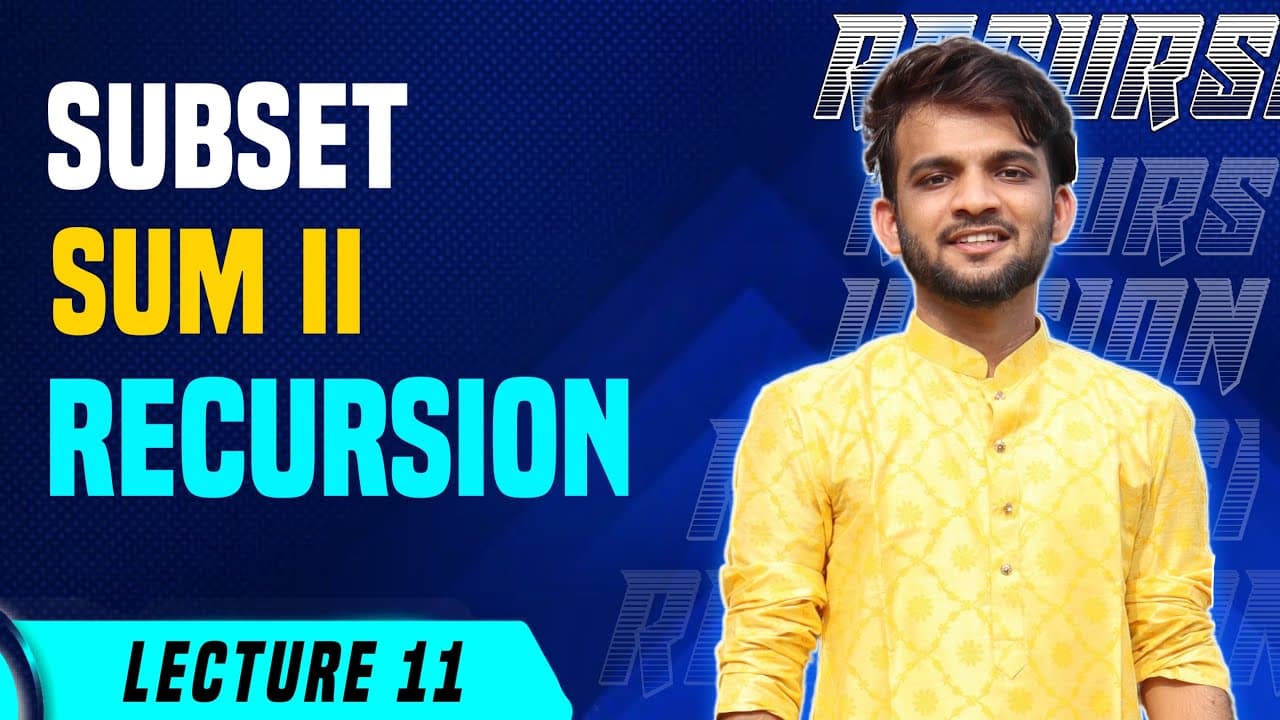
L11. Subset Sum II | Leetcode | Recursion
229.6K views
•
March 3, 2021
by
take U forward
YouTube video player
L11. Subset Sum II | Leetcode | Recursion

TL;DR

A recursive algorithm is used to generate subsets of an array without duplicates for the Subset Sum2 problem.

Transcript

hey everyone welcome back to the channel i hope you guys are doing extremely well so today we will be solving the problem subset sum2 from the sd sheet but before we move on to the problem if you are new to our channel please please please do consider subscribing to our channel so the problem states that you're given an array nums and it may contai... Read More

Key Insights

  • 🛻 The initial solution generates subsets using the pick and non-pick technique and removes duplicates by converting them into a set.
  • ❓ The recursive approach avoids duplicate subsets by skipping elements that are duplicates and not the first occurrence.
  • 👾 The time complexity of the recursion is 2^n, and the space complexity is also 2^n for storing the subsets.

Install to Summarize YouTube Videos and Get Transcripts

Explore YouTube Video Summarizer or Get YouTube Transcript Extractor

Questions & Answers

Q: How does the initial solution handle duplicate subsets?

The initial solution generates all subsets using the pick and non-pick technique, but duplicates are removed by converting them into a set.

Q: What is the time complexity of the recursion?

The time complexity of the recursion is 2^n, where n is the size of the array.

Q: How does the optimized recursion approach avoid duplicates?

The optimized recursion approach checks for duplicates by comparing the current element with the previous one. If they are the same and it's not the first index, it is skipped to avoid generating duplicate subsets.

Q: What is the space complexity for storing the subsets?

The space complexity for storing the subsets is 2^n, as there can be a maximum of 2^n subsets.

Key Insights:

  • The initial solution generates subsets using the pick and non-pick technique and removes duplicates by converting them into a set.
  • The recursive approach avoids duplicate subsets by skipping elements that are duplicates and not the first occurrence.
  • The time complexity of the recursion is 2^n, and the space complexity is also 2^n for storing the subsets.
  • Sorting the array beforehand is necessary to ensure duplicates are together for the recursive approach to work effectively.

Summary & Key Takeaways

  • The problem requires returning all subsets of an array without duplicate subsets.

  • The initial solution involves generating all subsets using the pick and non-pick technique and removing duplicates by converting them into a set.

  • To optimize the solution, a recursive approach is used to generate subsets, avoiding duplicate subsets at each step.


Read in Other Languages (beta)

English

Share This Summary 📚

Summarize YouTube Videos and Get Video Transcripts with 1-Click

Download browser extensions on:

Try YouTube Summary with ChatGPT & Claude or YouTube Transcript Generator

Explore More Summaries from take U forward 📚
G-19. Detect cycle in a directed graph using DFS | Java | C++ thumbnail
G-19. Detect cycle in a directed graph using DFS | Java | C++
take U forward
L9. Reverse a LinkedList | Iterative and Recursive thumbnail
L9. Reverse a LinkedList | Iterative and Recursive
take U forward
What Are Basic Maths Concepts for DSA? thumbnail
What Are Basic Maths Concepts for DSA?
take U forward
G-2. Graph Representation in C++ | Two Ways to Represent thumbnail
G-2. Graph Representation in C++ | Two Ways to Represent
take U forward
L6. Recursion on Subsequences | Printing Subsequences thumbnail
L6. Recursion on Subsequences | Printing Subsequences
take U forward
What Are the Basics of Functions and Arrays in C++? thumbnail
What Are the Basics of Functions and Arrays in C++?
take U forward

Summarize YouTube Videos and Get Video Transcripts with 1-Click

Download browser extensions on:

Try YouTube Summary with ChatGPT & Claude or YouTube Transcript Generator

Apps & Extensions

  • Chrome Extension
  • Safari Extension
  • Edge Add-ons
  • Firefox Add-ons
  • iOS App
  • Android App

Key Features

  • YouTube Video Summarizer
  • Web & PDF Summarizer
  • Web & PDF Highlighter
  • Chat with PDF
  • Ask AI Clone
  • Audio Transcriber
  • Glasp Reader
  • Kindle Highlight Export
  • Idea Hatch

Integrations

  • Obsidian Plugin
  • Notion Integration
  • Pocket Integration
  • Instapaper Integration
  • Medium Integration
  • Readwise Integration
  • Snipd Integration
  • Hypothesis Integration

More Features

  • APIs
  • MCP Connector
  • Blog & Post
  • Embed Links
  • Image Highlight
  • Personality Test
  • Quote Shots

Company

  • About us
  • Blog
  • Community
  • FAQs
  • Job Board
  • Newsletter
  • Pricing
Terms

•

Privacy

•

Guidelines

© 2026 Glasp Inc. All rights reserved.