Evolving Normalization-Activation Layers
TL;DR
Researchers at Google and DeepMind discover new normalization layers for improved image classification accuracy.
Transcript
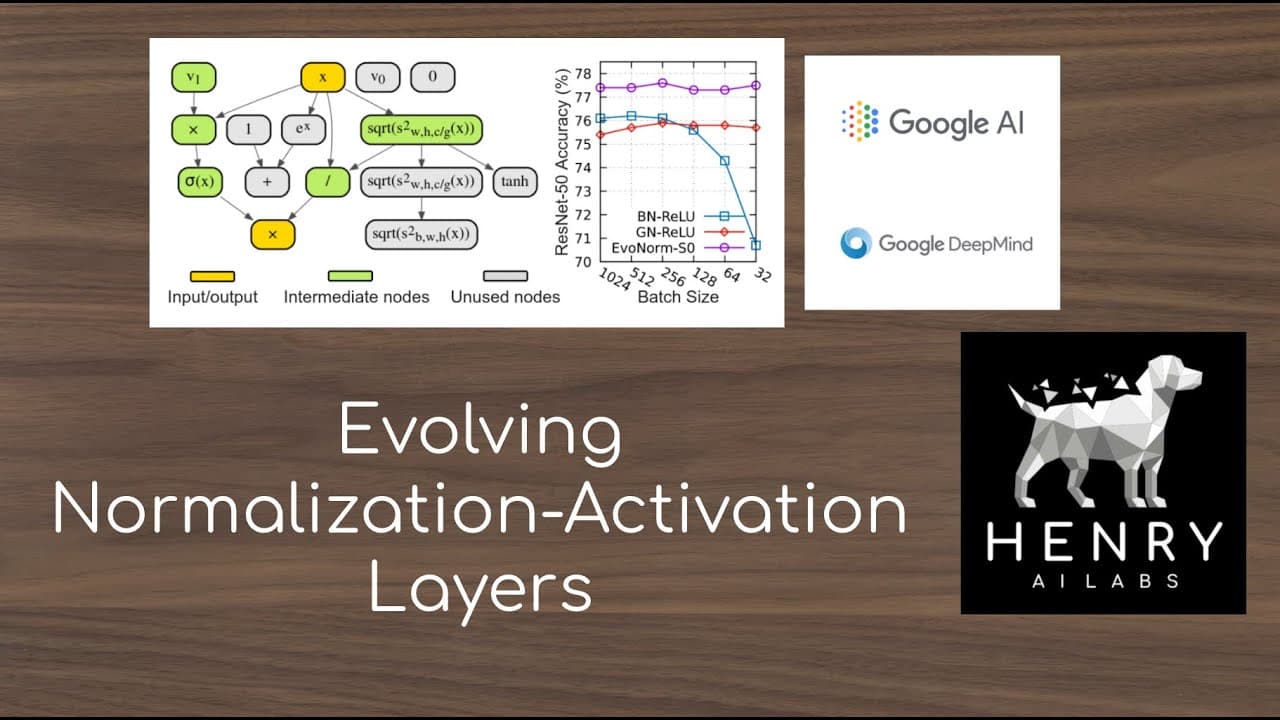
this video will explain a large-scale auto ML experiment from researchers at Google and deepmind the common practice in training deep neural networks is to interleave convolutional layers with bachelors ations followed by a ray lu activation this study parameter eise's the space of normalization activation layers and finds the Evo norm b0 and s0 la... Read More
Key Insights
- 😋 Evolving new normalization and activation layers can significantly enhance the accuracy of deep learning models, as demonstrated by the discovery of fo norm layers.
- 🥺 The study utilizes a systematic evolutionary search approach to explore and optimize the design space of normalization layers, leading to the identification of superior configurations.
- 🛀 Found layers showed different efficacy across various architectures, highlighting the need for tailored approaches in model design.
- 🚂 Researchers discarded configurations that did not meet a minimum validation accuracy threshold, ensuring only promising designs were trained further.
- ❓ The results emphasize the importance of enhancing training processes and model performance in tasks such as image classification and object detection.
- 👨🔬 Comparison of evolutionary search to random search showed substantial improvements, underscoring the value of structured exploration in deep learning layer design.
- 📈 Incorporating diverse evaluation metrics showcases the versatility in assessing the performance of newly developed layers across various architectural contexts.
Install to Summarize YouTube Videos and Get Transcripts
Explore YouTube Video Summarizer or Get YouTube Transcript Extractor
Questions & Answers
Q: What is the main focus of the research conducted by Google and DeepMind?
The main focus is to evolve new normalization and activation layers for deep learning applications, enhancing the performance of CNNs in tasks such as image classification. The researchers systematically explore the design space to discover layers that outperform traditional methods, specifically aiming for robust accuracy across various architectures.
Q: How do the newly discovered layers fo norm B0 and S0 compare to traditional methods?
The fo norm B0 and S0 layers showed improved performance over the traditional batch normalization followed by ReLU activation, achieving 77.8% accuracy compared to 76.1% for the established method in ResNet50. This indicates a significant milestone in enhancing the efficiency and effectiveness of deep learning networks.
Q: What methodology did the researchers use to discover new normalization activation layers?
The researchers used evolutionary search techniques combined with multi-objective optimization to navigate through a design space of possible normalization and activation layers. This method allowed them to systematically mutate and explore various configurations, leading to the discovery of layers that yield better performance metrics.
Q: What implications do the findings have for models beyond ResNet50?
The findings suggest that the new normalization activation layers, while initially validated on ResNet50, also generalize successfully to other architectures like MobileNet V2 and EfficientNet. This adaptability implies potential performance boosts in a wider range of deep learning applications, although specific results can vary per model.
Q: What challenges did the researchers address in the study regarding batch normalization?
One challenge addressed was how batch normalization impacts the training dynamics of models with varying batch sizes and structures. The evolutionary search allowed the team to explore designs that consider both batch statistics and individual image statistics to create more effective normalization processes.
Q: Why does the experiment highlight the importance of multi-objective optimization?
Multi-objective optimization is crucial because it enables the evaluation of new layers across different architectures, ensuring that the enhancements don't apply only to one model design but can yield improvements across the spectrum of deep learning systems, fostering a more adaptable machine learning environment.
Q: How do the new layers fare in tasks other than image classification, such as GANs?
The performance of the new fo norm layers in GAN-related tasks, such as training BigGAN models, does not show significant improvements over traditional normalization methods. This indicates that while the layers enhance accuracy in classification tasks, their effectiveness for generative models may require additional exploration and adjustment.
Q: What is the overall significance of this research for future deep learning models?
The research signifies a shift towards automated layer design, where evolutionary algorithms can efficiently discover and implement improved mixture normalization and activation strategies. This paves the way for future advancements in deep learning architectures, fostering further innovation in AI and machine learning technology.
Summary & Key Takeaways
-
This video presents a large-scale auto ML experiment by Google and DeepMind that aims to improve the training of deep neural networks by evolving new normalization and activation layers.
-
The study introduces the novel fo norm B0 and S0 layers, which outperform traditional batch normalization followed by ReLU activation, achieving enhanced accuracy on popular models like ResNet50.
-
The researchers utilize evolutionary search techniques to systematically explore the design space of normalization layers, demonstrating that different architectures benefit differently from the new layers discovered.
Read in Other Languages (beta)
Share This Summary 📚
Summarize YouTube Videos and Get Video Transcripts with 1-Click
Try YouTube Summary with ChatGPT & Claude or YouTube Transcript Generator
Explore More Summaries from Connor Shorten 📚
Summarize YouTube Videos and Get Video Transcripts with 1-Click
Try YouTube Summary with ChatGPT & Claude or YouTube Transcript Generator