How to Make Homemade Ethanol Fuel
TL;DR
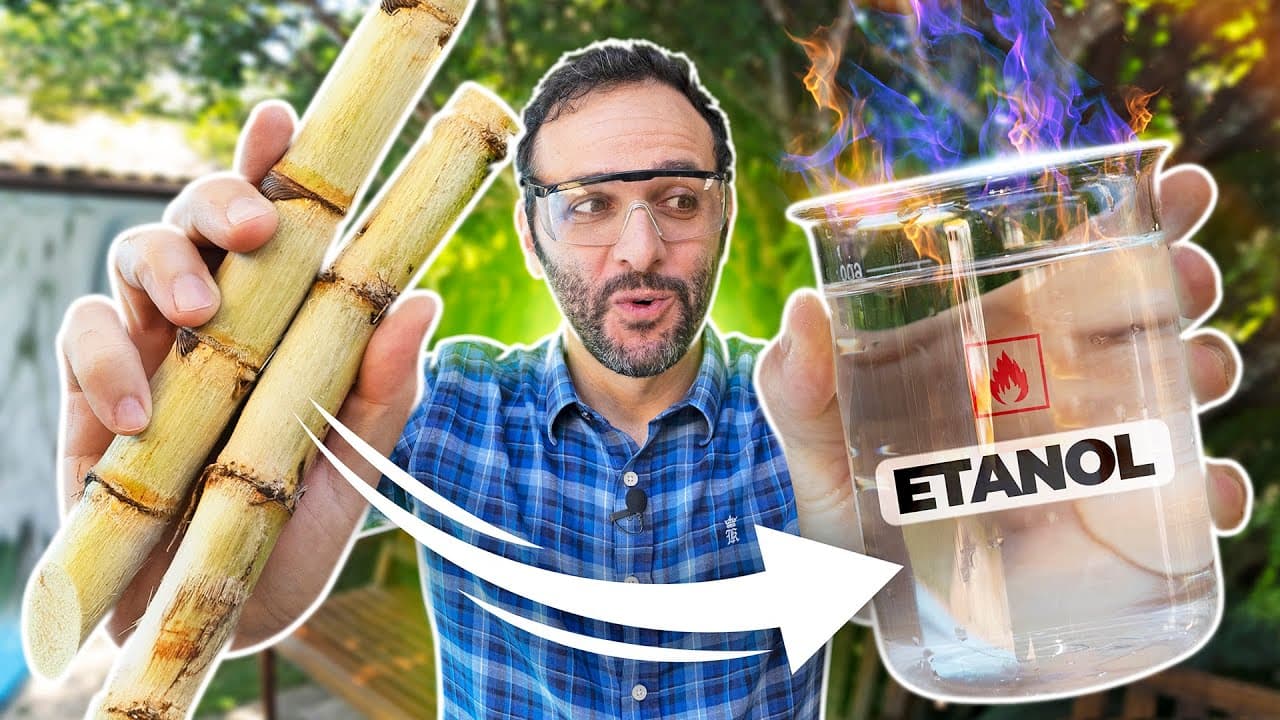
Ethanol is a renewable biofuel derived from sugarcane, reducing carbon emissions compared to gasoline. The process involves fermenting sugarcane juice with yeast to produce alcohol, which is then distilled. This homemade ethanol can be used as a sustainable alternative to fossil fuels, significantly lowering carbon dioxide emissions.
Transcript
Today you will understand why for more than 20 years Brazil has been a pioneer in the production of biofuels. Check it out, I need 5 liters of sugarcane juice and could you give me a little piece of sugarcane too... it's for an internet video. If you don't know what biofuels are, they are fuels made from organic matter. Actual living beings. Who i... Read More
Key Insights
- Ethanol is a renewable biofuel made from sugarcane, emitting less carbon dioxide than gasoline.
- Biofuels, including ethanol, biodiesel, and biomethane, are derived from organic matter and are more sustainable than fossil fuels.
- Biodiesel is produced from vegetable oil and is commonly mixed with diesel for large vehicles.
- Biomethane is generated from organic waste decomposition and is used in industrial processes and large vehicles.
- Ethanol production involves fermenting sugarcane juice with yeast, followed by distillation to obtain alcohol.
- The carbon dioxide emitted from burning ethanol is reabsorbed by sugarcane, making it a carbon-neutral process.
- Brazil has been a pioneer in biofuel production, with ethanol significantly reducing the country's carbon emissions.
- Flex-fuel vehicles in Brazil can run on ethanol, reducing emissions compared to gasoline-powered vehicles.
Install to Summarize YouTube Videos and Get Transcripts
Explore YouTube Video Summarizer or Get YouTube Transcript Extractor
Questions & Answers
Q: How is ethanol made from sugarcane?
Ethanol is produced from sugarcane by first extracting the juice from the sugarcane. This juice is then fermented using yeast, which converts the sugars in the juice into alcohol. After fermentation, the mixture undergoes distillation to separate and purify the ethanol from other components, resulting in a renewable fuel source.
Q: Why is ethanol considered a renewable fuel?
Ethanol is considered a renewable fuel because it is made from sugarcane, a plant that can be grown and harvested repeatedly. Unlike fossil fuels, which take millions of years to form, sugarcane can be replanted each season. The carbon dioxide emitted from burning ethanol is reabsorbed by the next crop of sugarcane, creating a sustainable cycle.
Q: What are the environmental benefits of using ethanol as a fuel?
Using ethanol as a fuel offers several environmental benefits, including reduced carbon dioxide emissions compared to gasoline. The carbon emitted during ethanol combustion is offset by the carbon absorbed by sugarcane during its growth, making it a more sustainable option. Ethanol also helps decrease reliance on fossil fuels, contributing to lower greenhouse gas emissions.
Q: How does the distillation process work in ethanol production?
The distillation process in ethanol production involves heating the fermented sugarcane juice to separate the alcohol from water and other components. As the mixture is heated, alcohol vaporizes at a lower temperature than water. The vapor is then condensed back into liquid form, resulting in purified ethanol, which can be used as fuel.
Q: What role does yeast play in ethanol production?
Yeast plays a crucial role in ethanol production by fermenting the sugars present in sugarcane juice. During fermentation, yeast converts the sugars into alcohol and carbon dioxide. This biological process is essential for transforming sugarcane juice into ethanol, enabling its use as a renewable fuel source.
Q: How does ethanol reduce carbon emissions compared to gasoline?
Ethanol reduces carbon emissions compared to gasoline because its production and use are part of a closed carbon cycle. The carbon dioxide released during ethanol combustion is offset by the carbon absorbed by sugarcane during growth. In contrast, gasoline releases carbon stored underground for millions of years, adding to atmospheric carbon levels.
Q: What are flex-fuel vehicles and their benefits?
Flex-fuel vehicles are designed to run on more than one type of fuel, typically a blend of gasoline and ethanol. These vehicles offer benefits such as reduced carbon emissions and increased fuel flexibility. In Brazil, flex-fuel vehicles have significantly contributed to the country's efforts to decrease reliance on fossil fuels and lower greenhouse gas emissions.
Q: How has Brazil pioneered in biofuel production?
Brazil has pioneered in biofuel production by investing in technologies and policies that promote the use of ethanol as a primary fuel source. The country has developed infrastructure to produce and distribute ethanol efficiently, leading to widespread adoption of flex-fuel vehicles. This has resulted in significant reductions in carbon emissions and decreased dependence on oil imports.
Summary & Key Takeaways
-
Ethanol is produced from sugarcane juice through fermentation and distillation, providing a renewable and sustainable fuel alternative. Unlike gasoline, ethanol's carbon emissions are reabsorbed by sugarcane, making it a carbon-neutral option. This process highlights Brazil's leadership in biofuel production, contributing to significant reductions in carbon dioxide emissions.
-
Biofuels, such as ethanol, biodiesel, and biomethane, offer renewable energy solutions by utilizing organic matter. Ethanol, derived from sugarcane, is particularly beneficial due to its lower carbon emissions compared to fossil fuels. Brazil's flex-fuel vehicles exemplify the successful integration of ethanol into mainstream fuel usage, reducing the country's reliance on oil.
-
The production of homemade ethanol involves fermenting sugarcane juice with yeast to convert sugars into alcohol, followed by distillation to purify the ethanol. This method demonstrates the potential for small-scale biofuel production, aligning with global efforts to decrease carbon emissions and promote sustainable energy practices.
Read in Other Languages (beta)
Share This Summary 📚
Summarize YouTube Videos and Get Video Transcripts with 1-Click
Try YouTube Summary with ChatGPT & Claude or YouTube Transcript Generator
Explore More Summaries from Manual do Mundo 📚


Summarize YouTube Videos and Get Video Transcripts with 1-Click
Try YouTube Summary with ChatGPT & Claude or YouTube Transcript Generator