L07.6 Independence & Expectations
TL;DR
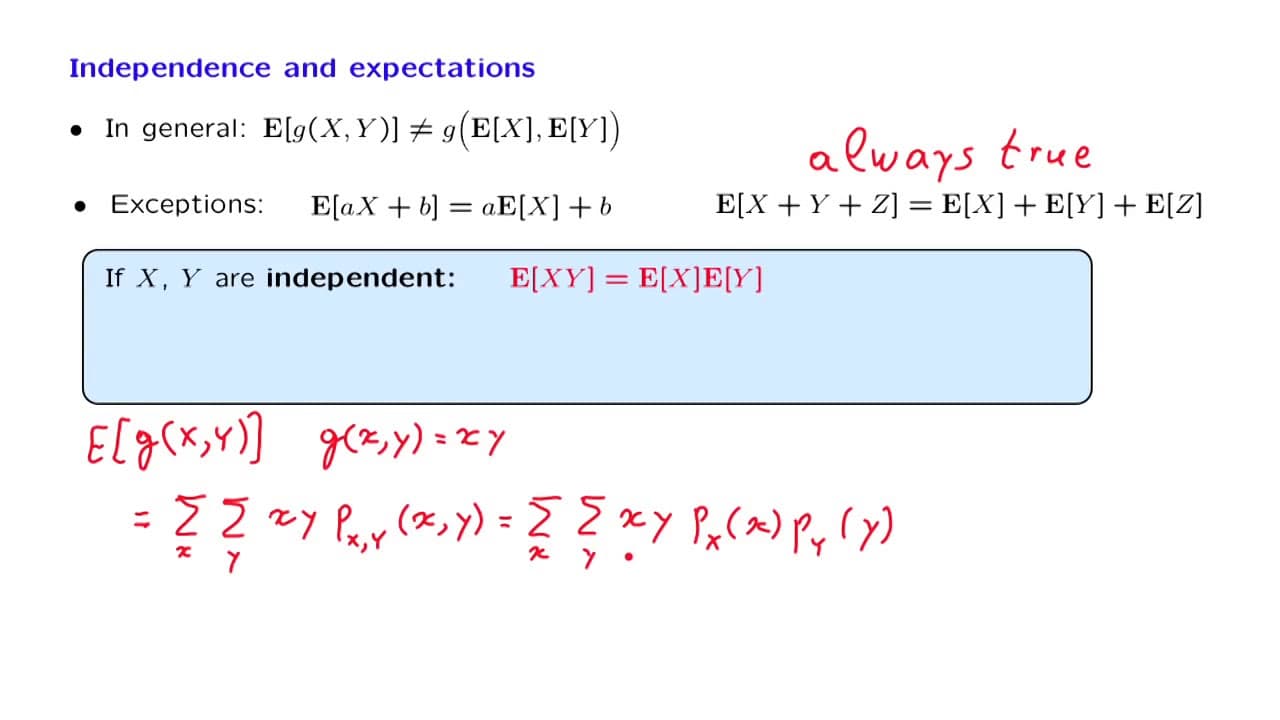
When random variables are independent, the expected value of their product is equal to the product of their expected values.
Transcript
When we have independence, does anything interesting happen to expectations? We know that, in general, the expected value of a function of random variables is not the same as applying the function to the expected values. And we also know that there are some exceptions where we do get equality. This is the case where we are dealing with linear funct... Read More
Key Insights
- 💼 Expected values of functions of random variables are generally not equal to applying the functions to the expected values, except in the case of linear functions of random variables.
- ❓ The expected value of the product of two independent random variables is the product of their expected values.
- ❓ Functions of independent random variables are also independent of each other.
- 📏 The expected value rule can be used to calculate the expected value of a function of random variables.
- 👻 Independence allows simplifications in calculations involving expected values.
- 💆 The joint probability mass function can be written as the product of the marginal probability mass functions when random variables are independent.
- 🟰 The expected value of a function of independent random variables is equal to the product of the expectations of those functions.
Install to Summarize YouTube Videos and Get Transcripts
Explore YouTube Video Summarizer or Get YouTube Transcript Extractor
Questions & Answers
Q: What is the relationship between expected values and functions of random variables?
In general, the expected value of a function of random variables is not the same as applying the function to the expected values. Exceptions exist when dealing with linear functions of random variables.
Q: What is the additional property that holds when random variables are independent?
When random variables are independent, the expected value of the product of two independent random variables is equal to the product of their expected values.
Q: How can the expected value of a product of independent random variables be calculated?
The expected value of the product of independent random variables can be calculated by multiplying the expected values of each random variable.
Q: Are functions of independent random variables also independent?
Yes, when random variables are independent, the functions of those variables are also independent of each other. This is useful in calculating expected values of products of functions.
Summary & Key Takeaways
-
The expected value of a function of random variables is not always equal to applying the function to the expected values, except in the case of linear functions of independent random variables.
-
When random variables are independent, the expected value of their product can be calculated as the product of their expected values.
-
A more general fact states that the expected value of the product of two functions of independent random variables is equal to the product of the expectations of these functions.
Read in Other Languages (beta)
Share This Summary 📚
Summarize YouTube Videos and Get Video Transcripts with 1-Click
Try YouTube Summary with ChatGPT & Claude or YouTube Transcript Generator
Explore More Summaries from MIT OpenCourseWare 📚



Summarize YouTube Videos and Get Video Transcripts with 1-Click
Try YouTube Summary with ChatGPT & Claude or YouTube Transcript Generator