Rabbinic Polemics: What History Says
TL;DR
Rabbis argue Jesus did not fulfill Messianic prophecies, differing from Christian interpretations.
Transcript
all right so starting the presentation on rabbinic polemics does anybody know what a polemic is anybody Alex it's like the opposite of object so instead of Defense it's like offense that's pretty true yeah um it's generally it's usually in relation to religions so um a polemic means that I'm like making an argument against another religion so today... Read More
Key Insights
- 🗂️ Rabbinic polemics focus on challenging Christian interpretations of messianic prophecies, illustrating a significant theological divide.
- 💡 The concept of the Messiah in Judaism is traditionally narrowed to a single figure who fulfills all prophecies within his lifetime, excluding the idea of multiple Messiahs.
- 😥 Historical interpretations point towards a complex understanding of Messianic roles, recognizing contributions from diverse sources, including the Talmud and medieval rabbinical thought.
- 🤑 Discussions around the Talmud reveal a rich tapestry of Jewish scholarship that critiques and reassesses Messianic expectations over time.
- ❓ The targum represents a rabbinic effort to clarify biblical texts, providing context for Messianic prophecies while simultaneously illustrating the varied interpretations between Judaism and Christianity.
- ❓ The dialogue on Isaiah's prophecies emphasizes the importance of understanding historical and cultural contexts in scriptural interpretation.
- ❓ The debate surrounding the interpretation of Isaiah 53 demonstrates the dynamic nature of biblical exegesis and its implications for interfaith discussions.
Install to Summarize YouTube Videos and Get Transcripts
Explore YouTube Video Summarizer or Get YouTube Transcript Extractor
Questions & Answers
Q: What do rabbinic polemics entail in the context of Christianity?
Rabbinic polemics represent arguments or disputes posed by Jewish scholars against Christian doctrines, specifically critiquing claims like Jesus's fulfillment of Messianic prophecies. The goal is often to uphold traditional Jewish interpretations of Scripture that may contradict or challenge Christian views.
Q: How do rabbis interpret Messianic prophecies differently than Christians?
Rabbis assert that Jesus did not meet specific criteria for the Messiah outlined in Jewish texts, such as bringing world peace or fully restoring Israel. They focus on interpretations that emphasize a singular, conquering Messiah who does not undergo death and resurrection, contrasting with Christian beliefs that incorporate a suffering servant narrative.
Q: What is the significance of the Talmud in this discussion?
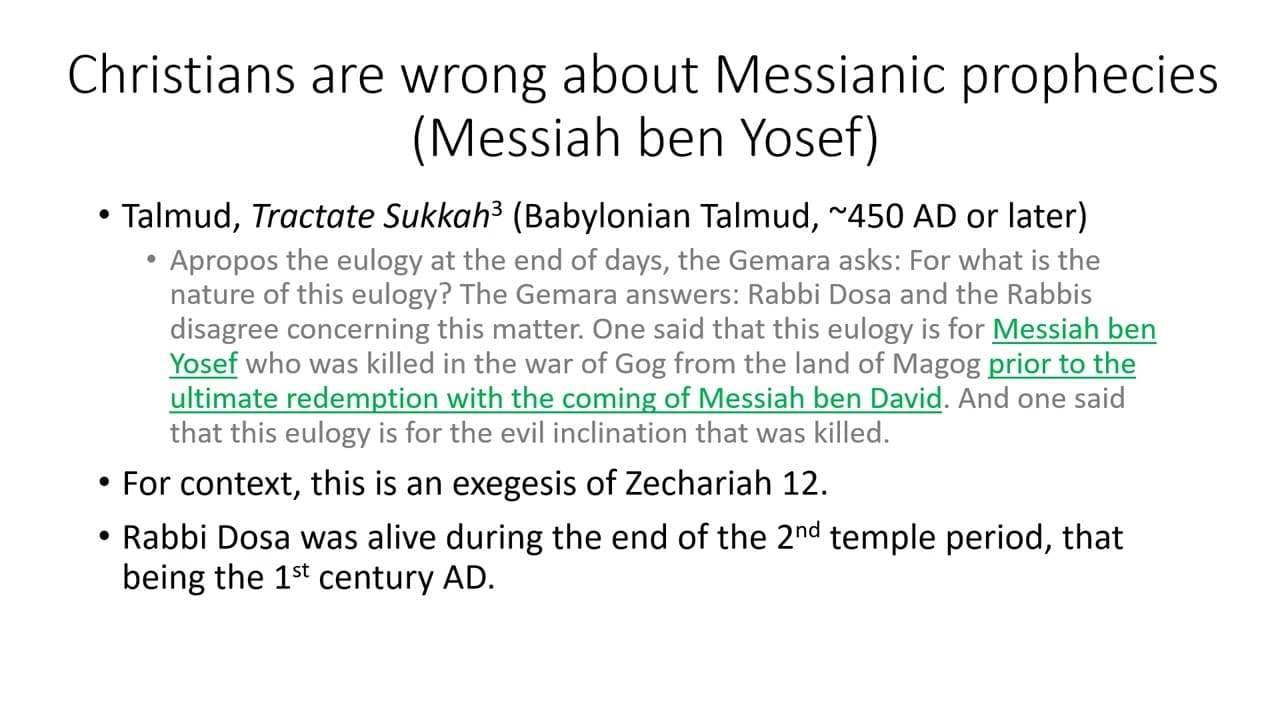
The Talmud serves as a vital source for understanding rabbinic thought, comprising interpretations, discussions, and historical contexts relevant to Biblical texts. It helps elucidate the rabbinic perspective that there may be two Messiahs—one who conquers and one who experiences suffering—challenging the Christian assertion of a single Messiah in Jesus.
Q: How does the targum relate to the interpretation of Isaiah and the Messiah?
The targum is an Aramaic translation of the Hebrew Bible that includes interpretative additions to clarify meanings. Its existence supports the belief among some Jewish scholars that Isaiah references a figure akin to the Messiah, but interpretations differ significantly, especially regarding the implications of suffering and death.
Q: Can you explain the concept of Messiah Ben David and Messiah Ben Yosef?
The term Messiah Ben David refers to a conquering Messiah expected to bring peace, while Messiah Ben Yosef represents a warrior figure who fights against evil but suffers and dies. This duality presents a significant divergence in understanding the nature of the Messiah within Jewish thought compared to Christian belief.
Q: What are some common misconceptions about Isaiah 53?
A notable misconception is that Isaiah 53 exclusively refers to the nation of Israel as a collective servant. Some argue it should be read as a reference to an individual, which aligns more closely with Christian interpretations of Jesus as the suffering servant. This debate highlights the challenge in reconciling differing theological perspectives.
Summary & Key Takeaways
-
The presentation discusses rabbinic polemics that critique Christian views on Jesus as the Messiah, highlighting misunderstandings of Messianic prophecies.
-
It presents key arguments made by rabbis regarding Jesus's failure to fulfill prophesied roles and the interpretations of prophetic texts, particularly from Isaiah.
-
The content emphasizes the complexity of rabbinic literature and the historical context of Messianic beliefs, noting the existence of differing rabbinical perspectives on the Messiah.
Read in Other Languages (beta)
Share This Summary 📚
Summarize YouTube Videos and Get Video Transcripts with 1-Click
Try YouTube Summary with ChatGPT & Claude or YouTube Transcript Generator