Line Graph | Manufactured & Sold | DI | Reasoning | Part - 11 | Bharath Kumar
TL;DR
Session explains how to analyze line graph data of units manufactured and sold.
Transcript
hi everyone welcome to the session in this session I am continuing line graph data and repetition here first of all we need to see the information which is provided in this line graph data and repetition after that based on that information we need to solve the questions first look at the information which is provided in this line graph data and op... Read More
Key Insights
- 🫥 Understanding line graph data requires interpreting both manufacturing and sales figures over specified years.
- 🆘 Calculating differences between unsold units in different years helps assess production efficiency.
- 🫵 Averages provide a simplified view of production trends over multiple years, critical for strategic decision-making.
- 🥳 Ratios allow for comparative analysis of manufacturing and sales performance across different time periods.
- ⏮️ Percentages help contextualize sales figures relative to previous production years, indicating growth or decline in performance.
- 🌥️ The data is primarily presented in lakhs, necessitating consistent conversion and understanding of large numeric values.
- 👨💼 Careful calculations are essential to derive meaningful insights that can guide business operations and strategies.
Install to Summarize YouTube Videos and Get Transcripts
Explore YouTube Video Summarizer or Get YouTube Transcript Extractor
Questions & Answers
Q: What does the line graph represent in this session?
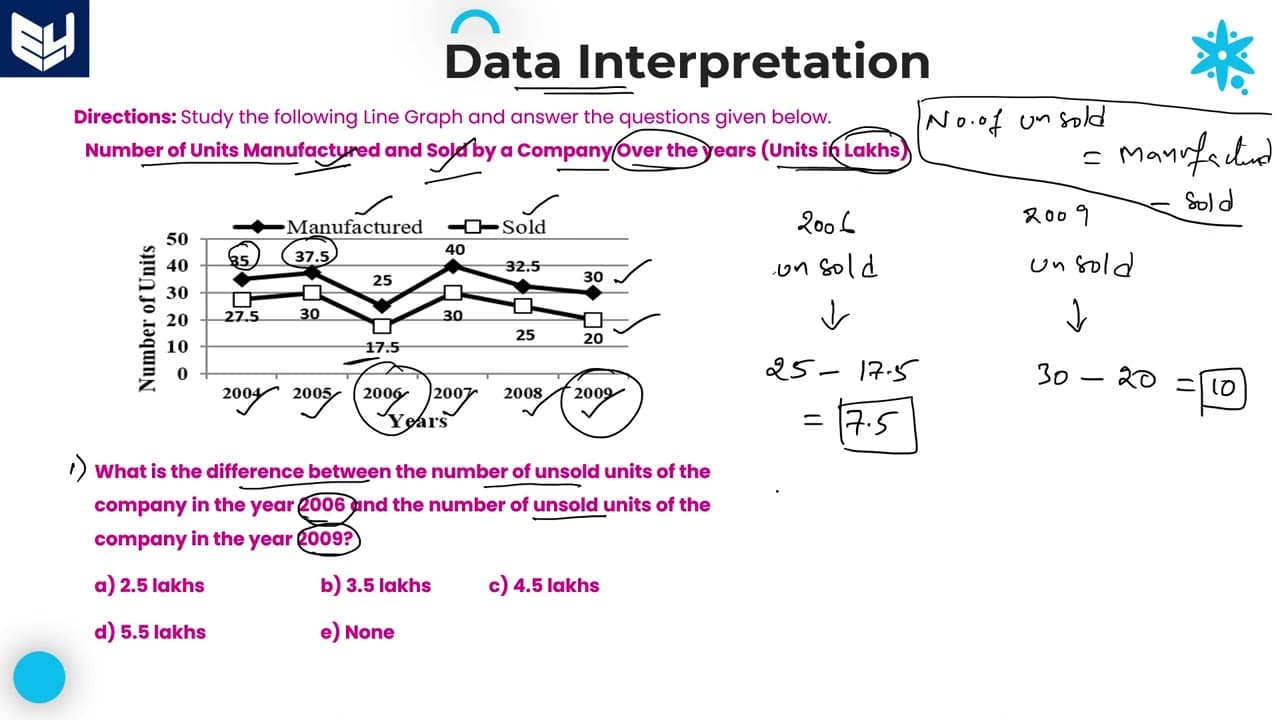
The line graph illustrates the number of units manufactured and sold by a company from 2004 to 2009. The data is provided in lakhs, indicating a clear trend in production and sales figures over these years, allowing for various analytical calculations based on this information.
Q: How can one calculate the number of unsold units in a given year?
The unsold units can be calculated by subtracting the number of units sold from the total units manufactured in that specific year. For example, if a company manufactured 25 lakhs and sold 17.5 lakhs in 2006, the unsold units are 25 - 17.5, resulting in 7.5 lakhs unsold.
Q: What is the significance of approximating averages in this analysis?
Approximating averages is significant as it simplifies complex calculations for quick understanding. For instance, calculating the average manufacturing units provided a general idea about the company’s production trends, making it easier to compare performance over the years without needing exact figures.
Q: How is the ratio of units manufactured in one year to units sold in another year determined?
The ratio is calculated by dividing the number of units manufactured in the specified year by the number of units sold in another year. For example, if 40 lakhs were manufactured in 2007 and 25 lakhs were sold in 2008, the ratio becomes 40:25, which simplifies to 8:5.
Summary & Key Takeaways
-
This session focuses on interpreting line graph data that reflects a company’s production and sales figures over six years from 2004 to 2009.
-
Important calculations are demonstrated, including determining the difference in unsold units between years, averaging produced units, and calculating ratios and percentages based on sales.
-
The content emphasizes understanding how to derive unsold units from manufacturing and sales data, teaching practical analytical skills for addressing related questions.
Read in Other Languages (beta)
Share This Summary 📚
Summarize YouTube Videos and Get Video Transcripts with 1-Click
Try YouTube Summary with ChatGPT & Claude or YouTube Transcript Generator