6.4.8 R6. Segmenting Images - Video 6: Detecting Tumors
TL;DR
This video demonstrates how to use k-means clustering to automatically detect tumors in MRI images, specifically focusing on a patient with oligodendroglioma, using R programming.
Transcript
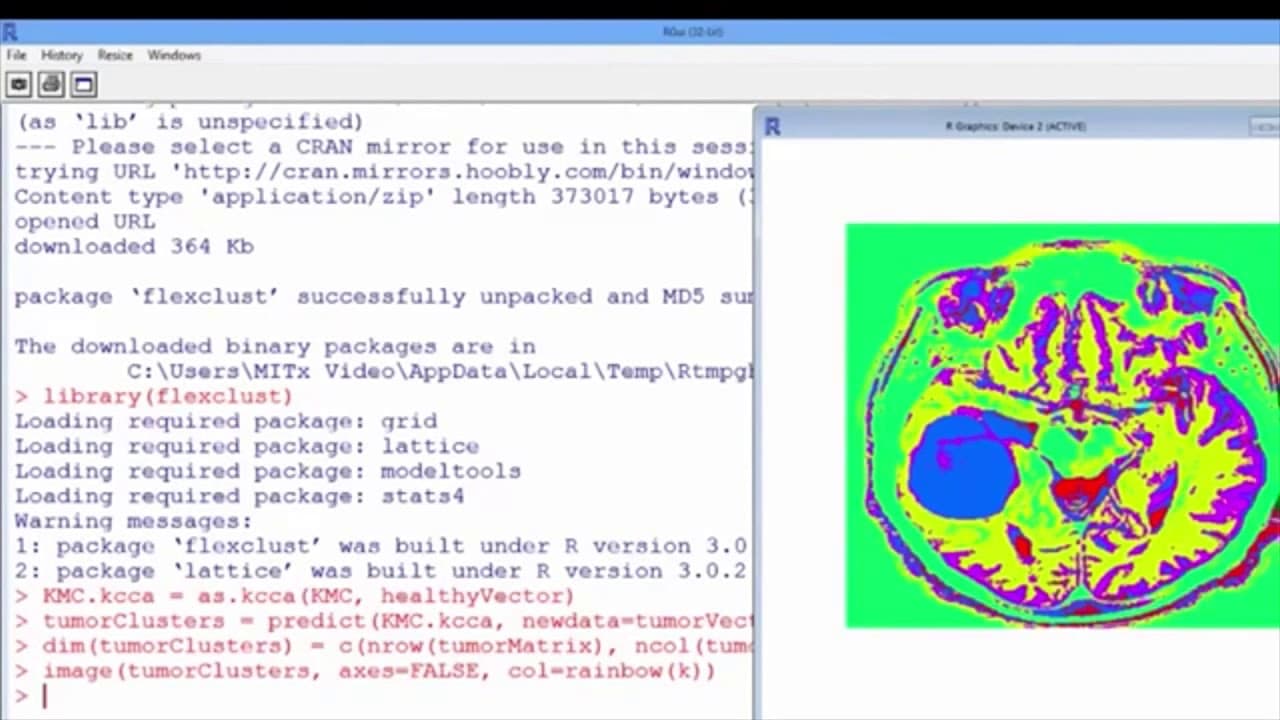
In the previous video we identified clusters, or tissue substances, in a healthy brain image. It would be really helpful if we can use these clusters to automatically detect tumors in MRI images of sick patients. The tumor.csv file corresponds to an MRI brain image of a patient with oligodendroglioma, a tumor that commonly occurs in the front lobe ... Read More
Key Insights
- 😉 K-means clustering can be utilized for automatic tumor detection in MRI images by identifying clusters associated with different substances in the brain.
- 😷 The application of clustering results from a healthy brain image to a tumor vector enables the identification of abnormal substances, such as tumors, in MRI images of sick patients.
- 😉 Advanced techniques, such as the modified fuzzy k-means clustering method, have been proposed to improve the accuracy of tumor segmentation in MRI images.
Install to Summarize YouTube Videos and Get Transcripts
Explore YouTube Video Summarizer or Get YouTube Transcript Extractor
Questions & Answers
Q: How does k-means clustering help in the detection of tumors in MRI images?
K-means clustering is a popular method for analyzing patterns in data. By segmenting the pixel intensities of an MRI image, it can automatically identify clusters associated with different substances in the brain, such as healthy and tumor tissues.
Q: Why is K-means clustering applied to the tumor vector instead of running the algorithm again?
Applying the clustering results obtained from a healthy brain image to the tumor vector allows for the identification of abnormal substances, such as the tumor, in the MRI image of a sick patient. This approach saves time by avoiding the need to re-run the k-means algorithm on the tumor vector.
Q: Are there more advanced techniques for tumor detection in MRI images?
Yes, while k-means clustering is a good starting point, more advanced techniques have been proposed in the literature, such as the modified fuzzy k-means clustering method. These techniques aim to improve accuracy and segmentation of tumor regions in MRI images.
Q: How can 3D reconstruction be beneficial in the medical field?
3D reconstruction of MRI images is particularly important in the medical field for diagnosis, surgical planning, and biological research purposes. By segmenting and capturing the geometries of substances at different levels and interpolating between segmented images, a 3D reconstruction of the brain's anatomy can be obtained for detailed analysis.
Summary & Key Takeaways
-
The video demonstrates the process of using k-means clustering to detect tumors in MRI images of a patient with oligodendroglioma, a brain tumor.
-
The tumor.csv file is read and saved to a data frame called "tumor", and then converted to a matrix and vector for analysis.
-
Instead of running the k-means algorithm on the tumor vector, the results obtained from clustering a healthy brain image are applied to the tumor vector.
-
The "flexclust" package is installed and loaded to convert the clustering algorithm information to an object of the class "KCCA".
-
The tumor vector is clustered using the predict function, and the resulting clusters are visualized as an image, highlighting the tumor region.
Read in Other Languages (beta)
Share This Summary 📚
Summarize YouTube Videos and Get Video Transcripts with 1-Click
Try YouTube Summary with ChatGPT & Claude or YouTube Transcript Generator
Explore More Summaries from MIT OpenCourseWare 📚

Summarize YouTube Videos and Get Video Transcripts with 1-Click
Try YouTube Summary with ChatGPT & Claude or YouTube Transcript Generator