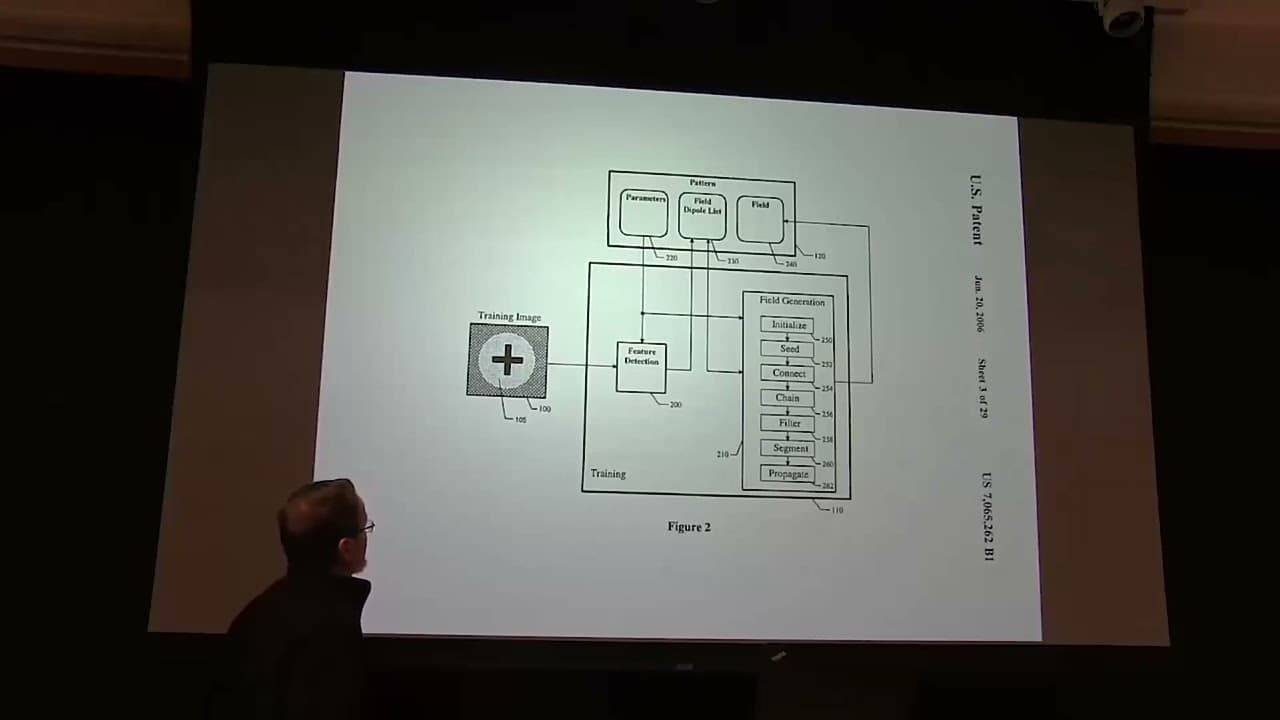
Lecture 15: Alignment, PatMax, Distance Field, Filtering and Sub-Sampling (US 7,065,262)
TL;DR
This patent discusses a method for efficiently computing filters for multiscale processing using piecewise polynomial kernels and sparsifying the convolution operations.
Transcript
[SQUEAKING] [RUSTLING] [CLICKING] BERTHOLD HORN: So we've talked about edge detection. And we've talked about finding objects in two dimensional images. And, in particular, we discussed the Pad Quick patent, which provides an efficient way of doing that by building a model based on some training image and then using probes to collect evidence about... Read More
Key Insights
- 🎭 Piecewise polynomial kernels can be used to approximate filters and perform convolutions more efficiently.
- 😥 Sparsifying the convolution by focusing on the non-zero values at transition points reduces computation and improves efficiency.
Install to Summarize YouTube Videos and Get Transcripts
Explore YouTube Video Summarizer or Get YouTube Transcript Extractor
Questions & Answers
Q: What is the main idea behind the method proposed in this patent?
The main idea is to approximate a given filter with a piecewise polynomial kernel and perform sparse convolution by focusing on the non-zero values at the transition points in the spline approximation.
Q: How does this method improve efficiency in multiscale processing?
By using a sparsified convolution, the method reduces the number of non-zero values in the convolution kernel, making the computation more efficient while still preserving important image details.
Q: Can you explain how the sparsified convolution is achieved?
The sparsified convolution is achieved by convolving the sample signal with a spline approximated kernel, which has small support and few non-zero values. The spline approximation is created by properly splicing together segments of quadratic, piecewise polynomial functions.
Q: What are the benefits of using this method in multiscale processing tasks?
This method allows for efficient computation of multiscale filters by leveraging the sparsity of the convolution kernel. It reduces computational complexity while still providing effective low-pass filtering and preserving important image features and details.
Summary & Key Takeaways
-
The patent proposes using piecewise polynomial kernels and their derivatives to approximate and perform convolutions more efficiently.
-
The method allows for sparse convolution by focusing on the non-zero values at transition points in the spline approximation.
-
The sparsified convolution can be used for multiscale processing, providing effective low-pass filtering and preserving important image details.
Read in Other Languages (beta)
Share This Summary 📚
Summarize YouTube Videos and Get Video Transcripts with 1-Click
Try YouTube Summary with ChatGPT & Claude or YouTube Transcript Generator
Explore More Summaries from MIT OpenCourseWare 📚


Summarize YouTube Videos and Get Video Transcripts with 1-Click
Try YouTube Summary with ChatGPT & Claude or YouTube Transcript Generator