LangGraph Simplified: Master Custom AI Agent Creation
TL;DR
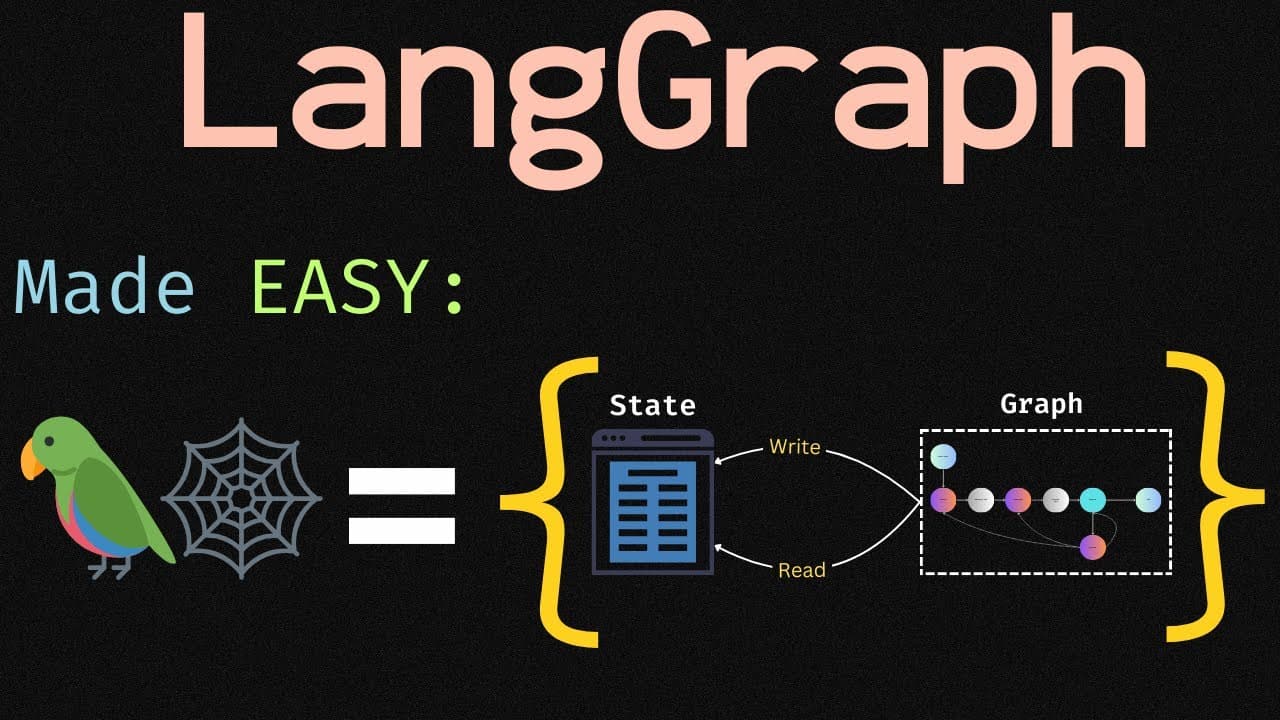
The video offers a comprehensive guide to developing agents using the Langra framework.
Transcript
I recorded this video with the ambitious goal of helping you to master the langra framework I knowe that there's a lot of interest in developing agents with langra but the technical difficulties around understanding the framework have deterred many people from proceeding I hope to alleviate that problem for you by first explaining the philosophy an... Read More
Key Insights
- 📈 Understanding the fundamentals of the Langra framework, particularly state and graph, is vital for successful development of agent workflows.
- 👻 The structure of the graph allows for clear interactions and efficient communication between agents, which can perform varied tasks based on large language models.
- 🍝 Feedback loops within the graph are crucial for refining outputs as they enable agents to learn from past interactions, making workflows more effective and responsive.
- 👻 The state’s design helps avoid token inefficiencies by allowing selective data sharing among agents, as opposed to passing the entire workflow context.
- 👋 Preparing a schematic outline of the graph and identifying important state information prior to coding are recommended best practices for building agent workflows.
- 👨🔬 The video includes a demonstration of a functional Langra-based web search agent, providing a tangible example of how the framework operates in practice.
- 😄 The creator compares Langra favorably against typical frameworks like Autogen and Agency Swarm, highlighting its flexibility and ease of directing specific context to agents as significant advantages.
Install to Summarize YouTube Videos and Get Transcripts
Explore YouTube Video Summarizer or Get YouTube Transcript Extractor
Questions & Answers
Q: What are the two key concepts in the Langra framework that the video focuses on?
The two key concepts emphasized in the video are 'state' and 'graph.' The state acts as a record keeping track of agent activities within the workflow, while the graph determines how agents and tools interact with each other through nodes and edges. Understanding these concepts is crucial for developing effective agent workflows.
Q: How does the graph structure work in the Langra framework?
In the Langra framework, the graph comprises nodes, which can either be agents or tools, and edges that determine the sequence of operations. The planner initially receives a user input, and various tools like research and web-scraping are executed based on conditions. This structure allows for flexible and dynamic workflows, including feedback loops where outputs can influence successive actions.
Q: What role does the state play in agent workflows within the Langra framework?
The state serves as a crucial record of all activities and interactions that occur throughout the agent workflow. Each time an agent or tool operates, the output is written to the state. This tracking capability helps agents adapt based on previous actions, such as adjusting their responses according to reviewer feedback, leading to more informed decision-making.
Q: Can you explain the difference between normal edges and conditional edges in a graph?
Normal edges are deterministic connections between nodes that define the straightforward sequence of operations. In contrast, conditional edges allow for flexibility based on specific criteria or conditions being met. For example, if a reviewer decides an output doesn't meet quality standards, the workflow can branch back to the planner or researcher for further adjustments, enhancing the adaptability of the agent's actions.
Summary & Key Takeaways
-
The video introduces the Langra framework, aiming to help viewers understand its key concepts, specifically focusing on 'state' and 'graph,' which are essential for developing agent workflows.
-
The creator presents a custom web search agent as a practical example, detailing how the planner, researcher, scraper, and reporter work together within the graph structure, emphasizing the importance of the feedback loop in agent communication.
-
Viewers are encouraged to explore the provided GitHub repository for code snippets, along with tips for effective agent software design, including the significance of understanding graph structure before coding.
Read in Other Languages (beta)
Share This Summary 📚
Summarize YouTube Videos and Get Video Transcripts with 1-Click
Try YouTube Summary with ChatGPT & Claude or YouTube Transcript Generator
Explore More Summaries from Data Centric 📚
Summarize YouTube Videos and Get Video Transcripts with 1-Click
Try YouTube Summary with ChatGPT & Claude or YouTube Transcript Generator