nMOS Transistor | Ids versus Vds derivation | Saturation Region | Part-2/2 | VLSI | Lec-12
TL;DR
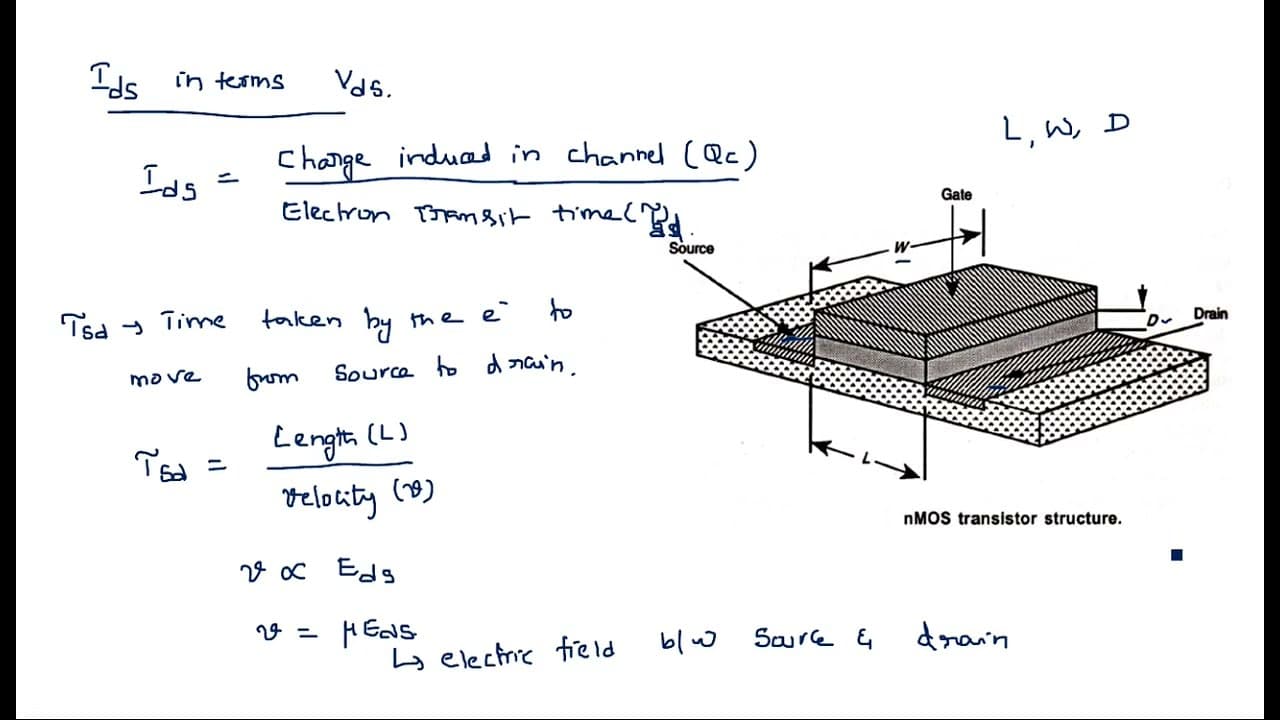
This video continues the derivation of drain-source current equations, focusing on gate capacitance and saturation region characteristics.
Transcript
hi everyone in this video I am going to continue the derivation which was started in the previous video ideas versus various so this derivation as I discussed it was it is very very important and definitely you may get this question in the external examination IDs versus VDS so here we are going to derive the drain to Source current in terms of foo... Read More
Key Insights
- 💐 Understanding Ids is vital for anyone studying semiconductor devices, as it captures the current flow characteristics in transistors.
- 🔬 The derivation emphasizes the role of gate capacitance (Cg) and its relationship with the transistor's physical structure, impacting performance.
- 🚱 Distinguishing between saturation and non-saturation regions is essential for applying the correct equations to analyze a transistor's operational state.
- 🧑🎓 The personalized substitution of constants into the equations enables simplification, making calculations more intuitive for students and practitioners alike.
- 🎮 Video content stresses the importance of mastering these equations for success in both academic and practical electronics scenarios, particularly for examinations.
- 🚱 Knowledge of the unique characteristics that define the transition from non-saturation to saturation will empower learners to better predict transistor behavior under varying electrical conditions.
- 😥 The video serves as both a teaching tool and a reference point for deeper engagement with electronic circuitry principles, especially for future engineers and researchers.
Install to Summarize YouTube Videos and Get Transcripts
Explore YouTube Video Summarizer or Get YouTube Transcript Extractor
Questions & Answers
Q: What is the significance of the derivation discussed in the video?
The derivation is crucial for understanding how the drain-source current (Ids) behaves in transistor circuits. It provides foundational knowledge for electronics students, particularly because similar derivations often appear in examinations. By engaging with these equations, learners can solidify their grasp of key semiconductor principles.
Q: How is the gate capacitance (Cg) defined in the derivation?
Gate capacitance (Cg) is formulated as the product of permittivity and area divided by the oxide thickness (D). Specifically, Cg is expressed using the relation Cg = epsilon * A/D, where epsilon is the permittivity, effectively linking the electrical characteristics of the gate to the physical dimensions of the transistor.
Q: What are the conditions that distinguish saturation and non-saturation regions in transistors?
The saturation region occurs when the drain-source voltage (Vds) exceeds the difference between the gate-source voltage (Vgs) and the threshold voltage (Vt). When Vds equals or surpasses Vgs - Vt, the transistor enters saturation, leading to a different set of equations that governs how the Ids behaves compared to the non-saturation region.
Q: Can you explain how K and beta factors are integrated into the Ids equations?
In the Ids equations, factors K and beta represent the transconductance parameters of the transistor and are functions of capacitance and other device characteristics. They allow us to simplify complex relationships into manageable equations that calculate Ids based on operating conditions, like applied voltages in both saturation and non-saturation regions.
Summary & Key Takeaways
-
The video extends a previous discussion on drain-source current (Ids) derivations, detailing critical equations essential for understanding this concept in electronics, especially regarding exams.
-
Key parameters introduced include gate capacitance (Cg) and its expression in terms of area and oxide thickness, along with an explanation of saturation region characteristics.
-
The derivation is relevant for both saturation and non-saturation regions, emphasizing the equations’ importance in analyzing transistor operation.
Read in Other Languages (beta)
Share This Summary 📚
Summarize YouTube Videos and Get Video Transcripts with 1-Click
Try YouTube Summary with ChatGPT & Claude or YouTube Transcript Generator