An Insight, An Idea with Duncan Haldane
TL;DR
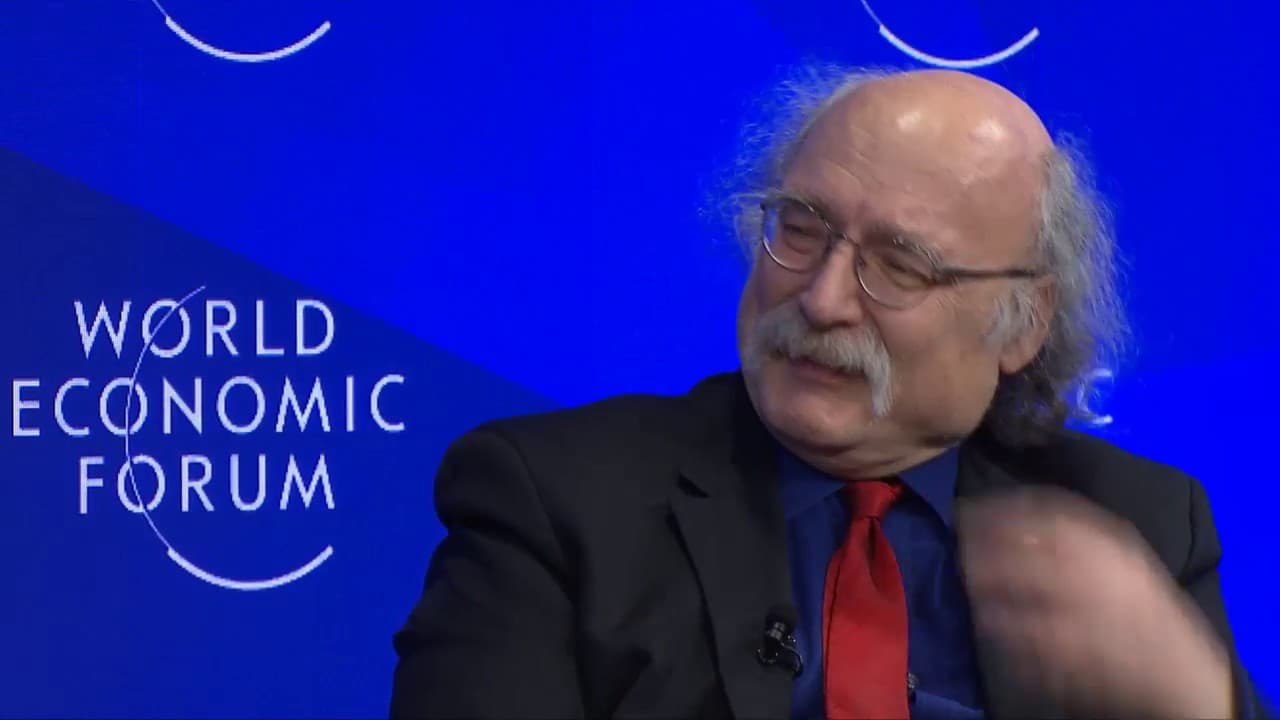
Duncan Haldane discusses his Nobel Prize-winning work in physics, exploring topological matter and its potential applications.
Transcript
good morning I'm so glad to see you my name is Mary at d Christina and I'm the editor-in-chief of Scientific American also the director of editorial and publishing for nature of research group I'm just delighted absolutely delighted to to say that today we're going to have a discussion an idea an insight with Duncan Haldane who is this past years w... Read More
Key Insights
- 🦾 Topological matter, a branch of quantum mechanics, exhibits stable properties based on the topology of materials.
- 💻 Quantum computers, utilizing topological matter, have the potential to revolutionize computation by harnessing parallel processing capabilities.
- 🪛 Collaboration and competition in theoretical physics drive innovation and discovery.
- 🥺 Understanding the simplicity and underlying principles of physics can lead to groundbreaking insights.
- 👶 Topological matter bridges the gap between classical and quantum physics, offering a new perspective on material behavior.
- 😉 Duncan Haldane's journey from childhood curiosity to Nobel Prize-winning research highlights the importance of passion and persistence in scientific pursuits.
- 🦾 The study of quantum mechanics challenges classical notions of physics, revealing intricate phenomena on the atomic scale.
Install to Summarize YouTube Videos and Get Transcripts
Explore YouTube Video Summarizer or Get YouTube Transcript Extractor
Questions & Answers
Q: How did Duncan Haldane's childhood influence his interest in science and ultimately lead him to study physics?
Duncan Haldane's parents' belief in science and exposure to various scientific disciplines during his schooling nurtured his interest in physics, which he found more captivating than other sciences due to its simplicity and underlying principles.
Q: What is quantum mechanics, and how does it differ from classical physics in explaining the world?
Quantum mechanics describes the behavior of matter and energy on the atomic scale; it presents a different interpretation of the world, challenging classical physics by demonstrating phenomena like matter-wave duality and quantum entanglement.
Q: What is the significance of topological matter in physics, and how does it differ from conventional matter?
Topological matter introduces the concept of stability and novel properties based on the topology of materials, leading to unique behaviors such as one-way signal propagation and resistance to external disturbances, unlike traditional matter.
Q: How did Duncan Haldane's research in topological matter pave the way for potential applications in quantum computing?
Haldane's work provided a foundation for developing stable quantum computers based on topological properties, offering solutions to the challenge of coherence and enabling parallel calculations for tasks like factorizing large numbers efficiently.
Summary & Key Takeaways
-
Duncan Haldane shares his journey from a childhood interest in science to studying physics due to an enthusiastic teacher.
-
Topological matter, a branch of quantum mechanics, is highlighted for its unique properties and implications in quantum computing.
-
Collaboration and competition in theoretical physics play crucial roles in uncovering new insights and advancements in the field.
Read in Other Languages (beta)
Share This Summary 📚
Summarize YouTube Videos and Get Video Transcripts with 1-Click
Try YouTube Summary with ChatGPT & Claude or YouTube Transcript Generator
Explore More Summaries from World Economic Forum 📚

Summarize YouTube Videos and Get Video Transcripts with 1-Click
Try YouTube Summary with ChatGPT & Claude or YouTube Transcript Generator