Distributed database | Introduction | Distributed Systems | Lec-64 | Bhanu Priya
TL;DR
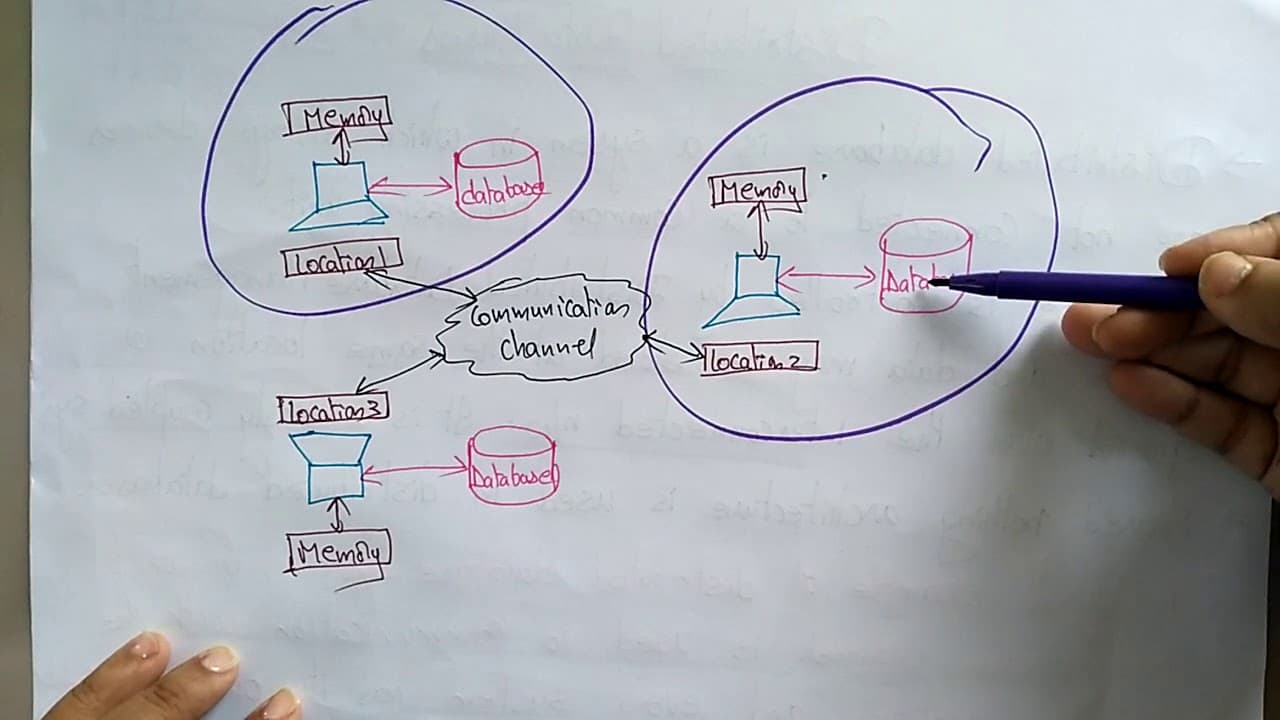
Distributed databases provide data storage across multiple systems without a common processing unit.
Transcript
students welcome back coming to the next topic in the subject distributed systems is a distributed databases so you already know the concept of databases databases it's a storage device where you can access the data but with the help of the queries ok the data is stored in the form of tables so far in the database management system what you learn a... Read More
Key Insights
- 🔂 Distributed databases eliminate the dependency on a single processing unit, promoting system independence among various storage devices.
- 💯 The flexibility of data location is a core feature, facilitating easier data access and management options across different sites.
- ❓ Communication channels are crucial for the operation of distributed databases, enabling systems to share data seamlessly regardless of geographic distance.
- 🏛️ Redundancy is built into distributed databases, enhancing reliability by ensuring that tasks can be reassigned to other systems in case of failure.
- 🤩 Availability is a key goal, allowing client requests to be processed by backup systems even during severe system failures.
- 📌 Distributed databases offer improved performance due to reduced latency and better resource allocation across multiple locations.
- 👻 The design of distributed databases supports scalability, allowing new systems to be added without disruption to the existing network.
Install to Summarize YouTube Videos and Get Transcripts
Explore YouTube Video Summarizer or Get YouTube Transcript Extractor
Questions & Answers
Q: What is a distributed database?
A distributed database is a database system in which the storage devices are not connected to a single processing unit. Each device operates independently and has its own storage, allowing for localized data management and accessibility across different locations without relying on a central system.
Q: How is data stored in a distributed database?
Data in a distributed database can be stored at the same location or spread over an interconnected network. Each system maintains its own database, which allows for flexibility and redundancy since data is not reliant on a single source, enhancing accessibility across different locations.
Q: What ensures the reliability of a distributed database?
The reliability of a distributed database is ensured through its ability to continue operations even if one system fails. In such cases, other systems within the network can take over the tasks, preventing downtime and ensuring that client requests are still serviced efficiently.
Q: What are the performance advantages of distributed databases?
The performance advantages of distributed databases include improved speed and accessibility, as data management can occur across various locations. This distribution allows for maintenance and data retrieval that can be optimized based on the geographical distribution of user requests, enhancing overall system performance.
Q: What is meant by 'loosely coupled system' in distributed databases?
A loosely coupled system refers to how the individual storage devices in a distributed database operate independently of each other. This means that each system has its own processing unit, enabling them to function autonomously while still being part of a connected network that allows access to shared data.
Summary & Key Takeaways
-
Distributed databases are systems where each storage device operates independently without a central processing unit, allowing for separate control of data.
-
Data in distributed databases can either be located at a single site or spread across multiple sites, connected through a communication channel.
-
The primary goals of distributed databases include reliability, availability, and performance, ensuring that tasks can continue even if one system fails.
Read in Other Languages (beta)
Share This Summary 📚
Summarize YouTube Videos and Get Video Transcripts with 1-Click
Try YouTube Summary with ChatGPT & Claude or YouTube Transcript Generator