Economic Systems - Traditional, Command, Market, Underground, & Mixed Economies
TL;DR
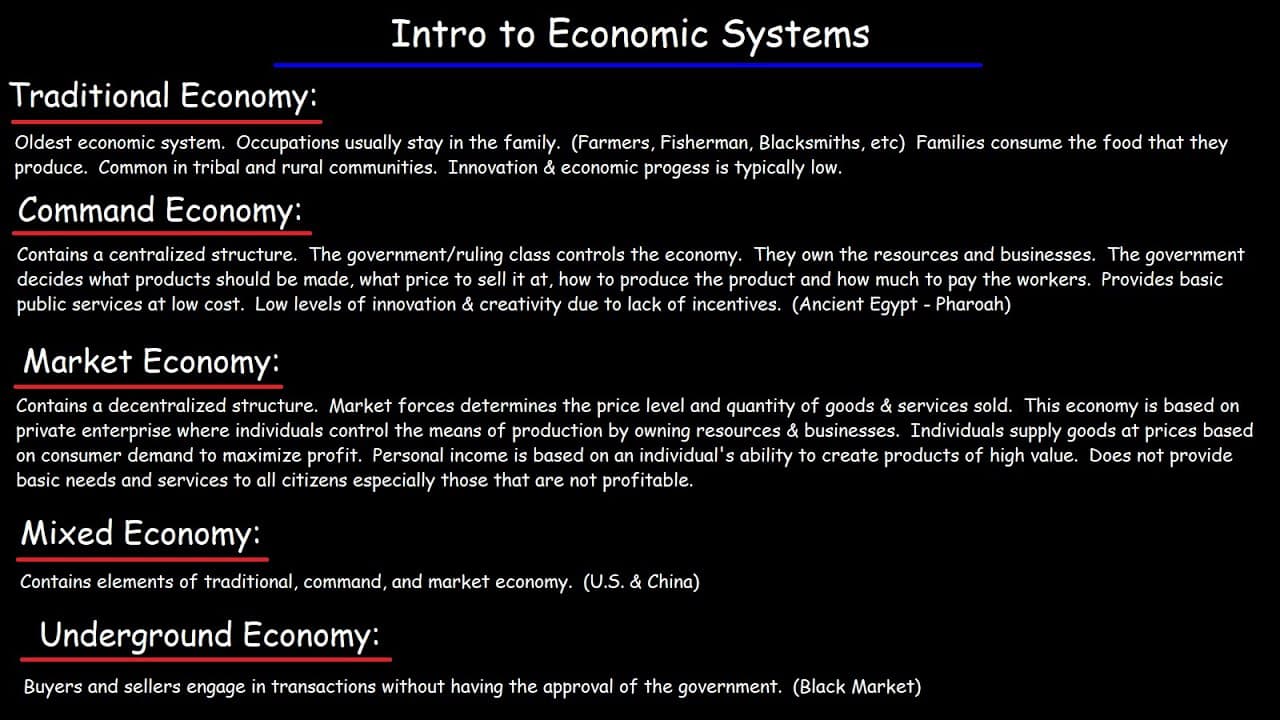
This video provides an overview of the five types of economic systems: traditional, command, market, mixed, and underground, highlighting their advantages and disadvantages.
Transcript
in this video we're going to talk about economic systems the different forms of economies that are out there we're going to cover five types of economies the traditional economy command economy market economy mix economy and the underground economy well let's start with the traditional economy so this one is the oldest of the economic systems that ... Read More
Key Insights
- 🖤 The traditional economy promotes environmental sustainability but lacks innovation and economic progress.
- 🧑⚕️ The command economy provides basic public services but discourages worker productivity due to fixed income.
- 👻 The market economy allows for personal income based on value creation but may not provide basic needs and services to all citizens.
- ⚖️ Mixed economies, like the US, strike a balance between the market and command systems.
Install to Summarize YouTube Videos and Get Transcripts
Explore YouTube Video Summarizer or Get YouTube Transcript Extractor
Questions & Answers
Q: What are some advantages of the traditional economy?
The traditional economy has limited environmental pollution and fosters a sense of community. It also preserves cultural practices and traditions.
Q: How does the command economy control income for workers?
In a command economy, the government sets the amount of pay for workers, regardless of their performance or productivity levels. This lack of incentive can lead to reduced motivation and productivity.
Q: How does the market determine prices and quantities in a market economy?
In a market economy, prices are determined by supply and demand. If a product is priced too high, there will be fewer buyers, forcing sellers to lower prices. Quantity is determined by the equilibrium of supply and demand.
Q: What are the main characteristics of a mixed economy?
A mixed economy combines elements of the traditional, command, and market economies. It typically involves private individuals owning businesses, but also includes government regulations and intervention to provide necessary services.
Summary & Key Takeaways
-
The traditional economy is the oldest system where occupations remain within families, resulting in limited environmental pollution but low innovation and economic progress.
-
In the command economy, the government or ruling class controls resources, businesses, and production, which leads to limited control over income for workers and low creativity.
-
The market economy is decentralized, with prices and quantities determined by market forces and private individuals owning resources and businesses, allowing for income based on value creation but lacking in providing basic needs and services.
-
The mixed economy combines elements of traditional, command, and market systems, with most countries falling into this category. Examples include the US and China.
-
The underground economy involves illegal transactions that do not have government approval, such as the black market.
Read in Other Languages (beta)
Share This Summary 📚
Summarize YouTube Videos and Get Video Transcripts with 1-Click
Try YouTube Summary with ChatGPT & Claude or YouTube Transcript Generator
Explore More Summaries from The Organic Chemistry Tutor 📚



Summarize YouTube Videos and Get Video Transcripts with 1-Click
Try YouTube Summary with ChatGPT & Claude or YouTube Transcript Generator