Lecture 03: Random Variables, Distributions, and Joint Distributions
TL;DR
This content provides an overview of random variables, their probability distributions, and the concept of joint distributions.
Transcript
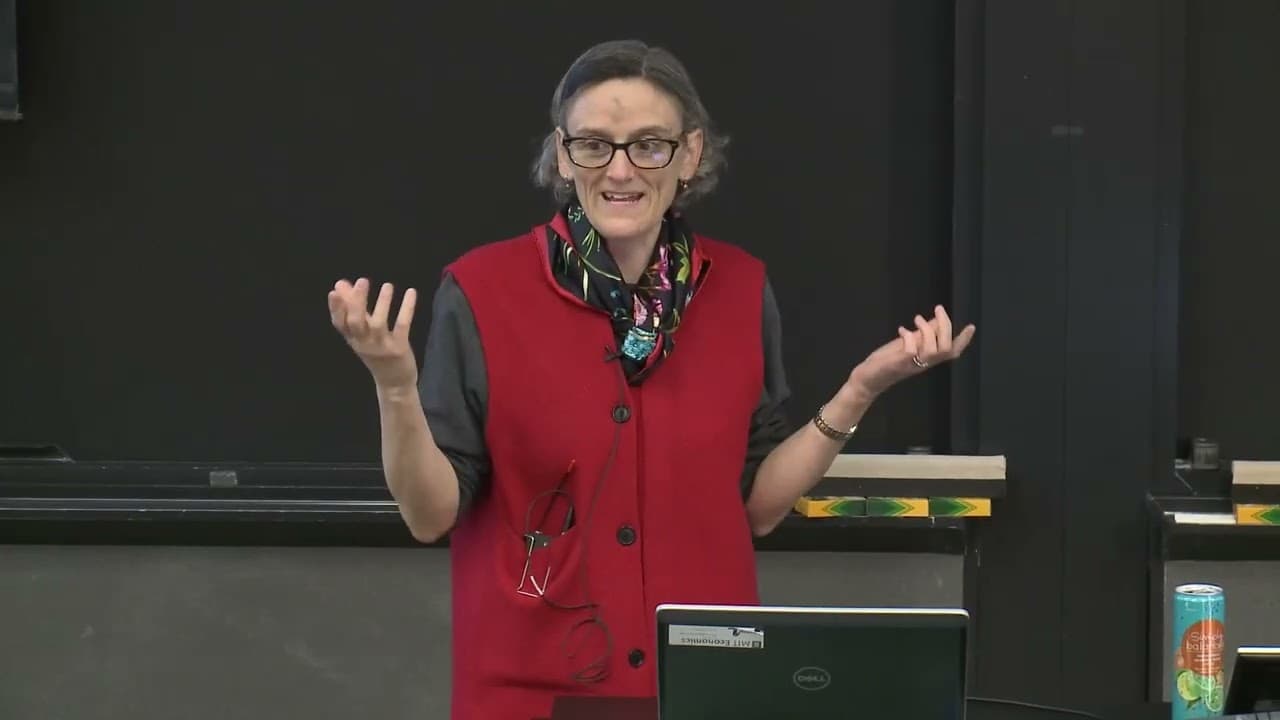
[SQUEAKING] [RUSTLING] [CLICKING] SARA ELLISON: OK. Let's go ahead and get started. Today, I'm going to talk about-- start talking about random variables and distributions of random variables. And at the end, I will probably also get to a discussion of joint distributions. Tuesday, then, Esther is going to be lecturing. She's going to do a bunch of... Read More
Key Insights
- 👾 Random variables are used to analyze numerical characteristics of sample spaces.
- ❓ The probability function describes the probabilities of different values for discrete random variables.
- ❓ The probability density function describes the probabilities of different regions for continuous random variables.
- ❓ Joint distributions describe the probabilities of combinations of values for two or more random variables.
- ❓ The CDF is a complete description of the probabilities associated with a random variable and has various properties.
- ❓ The joint probability density function can be used to calculate probabilities of combinations of values for random variables.
Install to Summarize YouTube Videos and Get Transcripts
Explore YouTube Video Summarizer or Get YouTube Transcript Extractor
Questions & Answers
Q: What is a random variable?
A random variable is a real-valued function whose domain is the sample space, used to analyze numerical characteristics of the sample space.
Q: What is the difference between a probability function and a probability density function?
A probability function describes the probabilities of different values for discrete random variables, while a probability density function describes the probabilities of different regions for continuous random variables.
Q: How can we calculate the probability of a random variable being in a specific region?
For discrete random variables, we can sum the probability function over the values in the region. For continuous random variables, we can integrate the probability density function over the region.
Q: What is a joint distribution?
A joint distribution describes the probabilities of combinations of values for two or more random variables.
Summary & Key Takeaways
-
Random variables are mathematical constructs used to analyze numerical characteristics of sample spaces.
-
Probability functions describe the probabilities of different values for discrete random variables.
-
Probability density functions describe the probabilities of different regions for continuous random variables.
Read in Other Languages (beta)
Share This Summary 📚
Summarize YouTube Videos and Get Video Transcripts with 1-Click
Try YouTube Summary with ChatGPT & Claude or YouTube Transcript Generator
Explore More Summaries from MIT OpenCourseWare 📚



Summarize YouTube Videos and Get Video Transcripts with 1-Click
Try YouTube Summary with ChatGPT & Claude or YouTube Transcript Generator