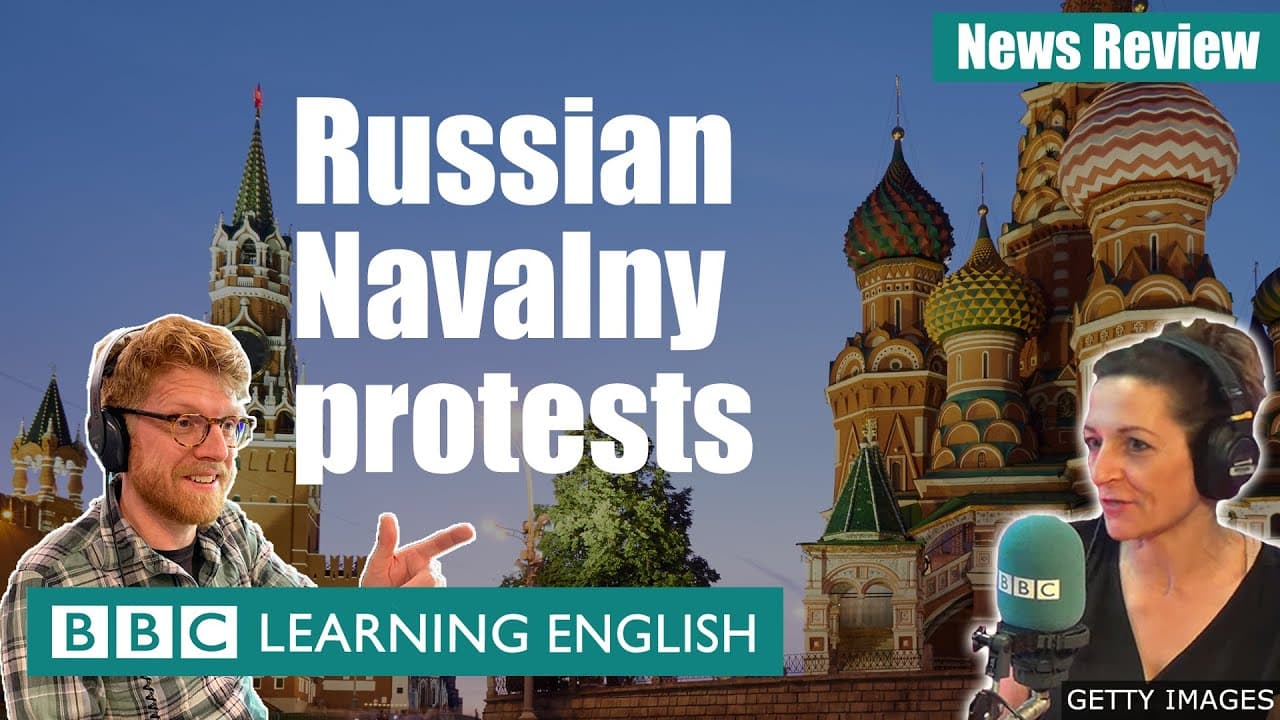
Why Are Russians Protesting Navalny's Arrest?
TL;DR
Protests erupted across Russia following the arrest of Alexei Navalny, a prominent critic of Vladimir Putin. Demonstrators took to the streets in response to Navalny's call for action, marking the largest protests in Russia in a decade. The video explores the vocabulary and expressions used in media coverage of these events.
Transcript
Hello and welcome to News Review from BBC Learning English. I'm Neil. Joining me is Catherine. Hi Catherine. Hello Neil and hello everybody. Yes, today's show is all about protests and demonstrations that took place in Russia over the weekend. If you'd like to test yourself on the vocabulary you learn in this programme, there's a quiz on our websit... Read More
Key Insights
- Alexei Navalny is a high-profile critic of Vladimir Putin and was arrested upon returning to Russia.
- Protests have occurred in hundreds of locations across Russia, with significant police presence in Moscow.
- The phrase 'spell the end' indicates a major change is imminent, as used in the context of political shifts.
- The term 'downplays' refers to making something appear less important than it is, often used in political discourse.
- 'Echoes' refers to reminders of past events, highlighting similarities between current protests and those in Belarus.
- The past tense of 'spell' can be either 'spelt' or 'spelled', both are correct.
- 'Downplay' is a strategy-related word, often used to minimize the perceived importance of an event or issue.
- An 'echo chamber' is an environment where a person only encounters beliefs or opinions that coincide with their own.
Install to Summarize YouTube Videos and Get Transcripts
Explore YouTube Video Summarizer or Get YouTube Transcript Extractor
Questions & Answers
Q: Why were there protests in Russia after Navalny's arrest?
Protests erupted in Russia following Alexei Navalny's arrest because he is a prominent critic of President Vladimir Putin. Navalny had called for demonstrations, leading to widespread unrest across the country. The protests are significant as they represent the largest public dissent in Russia in the last decade, indicating deep-seated dissatisfaction with the current political climate.
Q: What does the phrase 'spell the end' mean in the context of the protests?
In the context of the protests, 'spell the end' is used to indicate that a major change is likely to occur. It suggests that the current events, such as the protests following Navalny's arrest, could lead to significant political shifts or the end of existing power structures. This expression highlights the potential for transformative outcomes as a result of the ongoing unrest.
Q: How is the term 'downplays' relevant to the discussion of the protests?
The term 'downplays' is relevant as it describes how certain parties might attempt to minimize the perceived importance of the protests. In political discourse, downplaying is a strategy used to reduce the impact or urgency of events, such as these protests, to maintain control or prevent escalation. This term helps understand the narrative strategies in media and political responses.
Q: What are 'echoes' in relation to the Russian protests?
'Echoes' in relation to the Russian protests refer to similarities or reminders of past events, such as previous demonstrations in Belarus. This term is used to draw comparisons between current and historical events, highlighting patterns or recurring themes in political dissent. It suggests that the protests in Russia may have elements reminiscent of other significant movements.
Q: How does the video explain the use of 'downplay' in everyday language?
The video explains that 'downplay' is used in everyday language to describe making something seem less important than it is. It is often employed as a strategy to achieve a desired outcome, such as convincing others that an event or issue is not significant. This term is applicable in various contexts, from political discourse to personal interactions, where minimizing importance is beneficial.
Q: What is an 'echo chamber' and how does it relate to the protests?
An 'echo chamber' is an environment, particularly on social media, where individuals only encounter opinions that align with their own. This can lead to reinforcement of beliefs without exposure to differing perspectives. In relation to the protests, echo chambers might influence how information is shared and perceived, potentially amplifying certain viewpoints while excluding others, thus affecting public discourse and perception.
Q: What linguistic nuances are discussed in the video regarding the term 'spell'?
The video discusses that the past tense of 'spell' can be either 'spelt' or 'spelled', both of which are correct. This linguistic nuance highlights the flexibility in English language usage, where regional preferences might dictate the choice of one form over the other. Understanding such nuances is important for accurate communication and comprehension in both written and spoken English.
Q: How do the protests in Russia compare to those in Belarus according to the video?
According to the video, the protests in Russia have 'echoes' of those in Belarus, suggesting similarities in the nature of public dissent and the challenges faced by protestors. Both movements reflect significant opposition to governmental authority and highlight the potential for widespread unrest. The comparison underscores the broader context of political dissatisfaction in the region, with shared themes of resistance and demand for change.
Summary & Key Takeaways
-
Alexei Navalny's arrest upon his return to Russia sparked widespread protests, with demonstrators responding to his call for action. The protests have been the largest in Russia in a decade, highlighting significant unrest.
-
The video explores expressions used in media coverage, such as 'spell the end', indicating major change, and 'downplays', which refers to minimizing the importance of events. These terms help understand the narrative around the protests.
-
The protests in Russia have 'echoes' of past events, drawing comparisons to previous demonstrations in Belarus. The video also discusses language nuances, such as the use of 'downplay' and the concept of 'echo chambers'.
Read in Other Languages (beta)
Share This Summary 📚
Summarize YouTube Videos and Get Video Transcripts with 1-Click
Try YouTube Summary with ChatGPT & Claude or YouTube Transcript Generator
Explore More Summaries from BBC Learning English 📚
Summarize YouTube Videos and Get Video Transcripts with 1-Click
Try YouTube Summary with ChatGPT & Claude or YouTube Transcript Generator