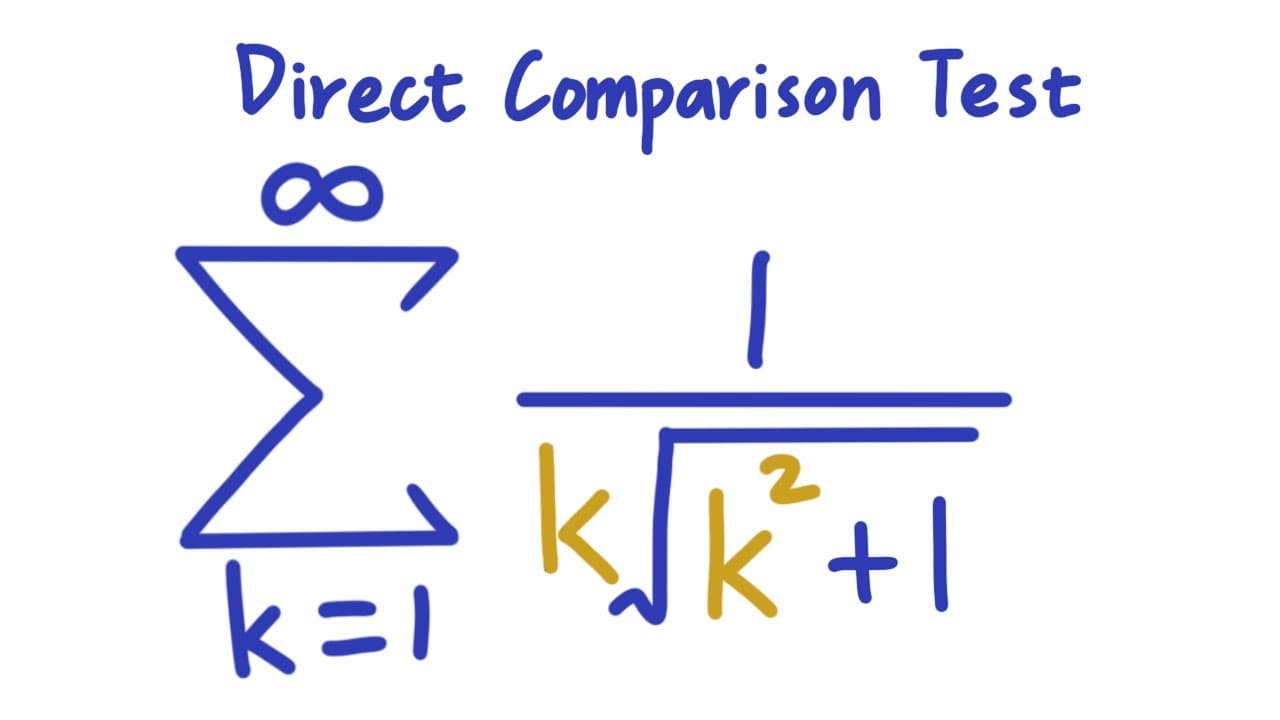
series of 1/(k*sqrt(k^2+1)), quick direct comparison test, calculus 2 tutorial
TL;DR
The video explains how to use the direct comparison test to determine whether a given series converges or diverges.
Transcript
converge your diverge Sigma when K go 1 to Infinity 1 over K * the otk of k + 1 in this video I will show you guys a slightly different way to write out the solutions than my usual way you can check out my other videos for my usual way to Red Solutions but anyways before I do anything right here for you guys comment down below and let me know why a... Read More
Key Insights
- 🏆 The direct comparison test is a method for analyzing the convergence or divergence of a series by comparing it to a known series.
- 😑 By simplifying the given expression and comparing it to a known convergent series, it can be deduced whether the original series converges or diverges.
- 🟰 The presenter demonstrates that if the original series is less than or equal to a convergent series, then the original series also converges.
- ❓ The comparison between series involves considering the size of the denominator and the impact on the overall value of each series.
- 🏆 By correctly applying the direct comparison test, one can determine the convergence or divergence of various series in mathematics.
- 😑 The concept of a p-series, where p is greater than 1, is used to establish the convergence of a simplified expression.
- ❓ Understanding the relationship between different series and their convergence properties is essential in advanced mathematical analysis.
Install to Summarize YouTube Videos and Get Transcripts
Explore YouTube Video Summarizer or Get YouTube Transcript Extractor
Questions & Answers
Q: What is the purpose of the direct comparison test?
The direct comparison test is used to determine whether a given series converges or diverges by comparing it with a known convergent or divergent series.
Q: How does the presenter simplify the given expression before applying the direct comparison test?
The presenter removes the additional "+ 1" in the square root of the denominator, simplifying the expression to the sum of 1/K multiplied by the square root of K.
Q: How does the presenter establish that the original series is less than or equal to the known convergent series?
By observing that the denominator of the known series is larger than the denominator of the original series, it is concluded that the original series is smaller or equal to the known series.
Q: Why does the knowledge that the known series converges indicate that the original series also converges?
The presenter uses the inequality established between the original series and the known convergent series to deduce that if the known series converges to a finite value, the original series must also converge to a finite value.
Summary & Key Takeaways
-
The video introduces the direct comparison test as a method to analyze the convergence or divergence of a given series.
-
The presenter demonstrates the application of the test to simplify an expression and compare it with a known convergent series.
-
It is shown that the original series is less than or equal to the known convergent series, thus indicating that the original series also converges.
Read in Other Languages (beta)
Share This Summary 📚
Summarize YouTube Videos and Get Video Transcripts with 1-Click
Try YouTube Summary with ChatGPT & Claude or YouTube Transcript Generator
Explore More Summaries from blackpenredpen 📚
Summarize YouTube Videos and Get Video Transcripts with 1-Click
Try YouTube Summary with ChatGPT & Claude or YouTube Transcript Generator