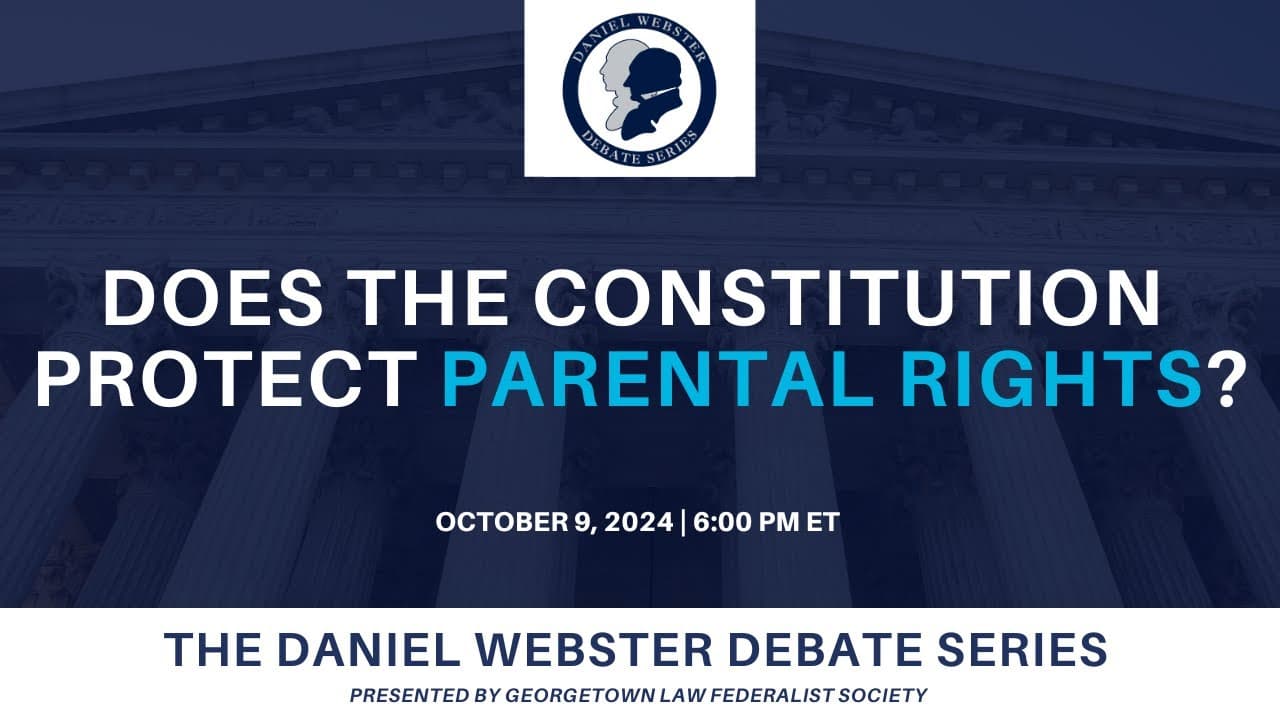
Does the Constitution Protect Parental Rights? - Georgetown Law Daniel Webster Debate Series
TL;DR
Debate explores constitutional protection of parental rights versus children's rights.
Transcript
thank you for joining us tonight welcome to the Daniel Webster debate series hosted by the Georgetown law federal Society this series is dedicated to Daniel Webster one of our nation's most revered orders and public servants Webster relied on the strength of his ideas to advance the American people's liberty and prosperity he is rel... Read More
Key Insights
- The debate centers on whether the Constitution protects parental rights, examining historical and legal precedents.
- Parental rights are often viewed as procedural due process, focusing on the duties parents owe to their children.
- Children's rights have evolved to include protection against abuse, the right to education, and healthcare, reflecting their status as persons under the law.
- The Supreme Court has historically recognized parental rights under the Due Process Clause, but the scope and application remain debated.
- Current legal challenges include the balance between parental rights and children's rights in education and healthcare decisions.
- The Religious Freedom Restoration Act (RFRA) is discussed as potentially undermining children's rights by allowing exemptions from generally applicable laws.
- Homeschooling regulation is debated, with concerns about educational neglect versus parental autonomy.
- The debate highlights the tension between state interests in child welfare and parental rights, with implications for future legal interpretations.
Install to Summarize YouTube Videos and Get Transcripts
Explore YouTube Video Summarizer or Get YouTube Transcript Extractor
Questions & Answers
Q: What is the central focus of the debate on parental rights?
The central focus is whether the Constitution, particularly the Due Process Clause of the Fourteenth Amendment, protects parental rights. The debate examines historical and legal precedents, the balance between parental authority and children's rights, and the implications of recent legal cases and legislation.
Q: How do children's rights factor into the debate on parental rights?
Children's rights are a critical aspect of the debate, emphasizing their protection against abuse, the right to education, and healthcare. The discussion highlights the evolution of children's rights as persons under the law and the need to balance these rights with parental authority, particularly in education and healthcare decisions.
Q: What role does the Religious Freedom Restoration Act (RFRA) play in the debate?
RFRA is discussed as potentially undermining children's rights by allowing religious exemptions from generally applicable laws. This raises concerns about the impact on children's safety and welfare, as RFRA could enable parents to bypass laws designed to protect children, such as those related to healthcare and education.
Q: What are the implications of homeschooling regulation in the context of parental rights?
The debate on homeschooling regulation centers on the need for oversight to prevent educational neglect while respecting parental autonomy. Concerns are raised about the lack of regulation in some states, which may leave children without adequate education, highlighting the tension between parental rights and state interests in child welfare.
Q: How have recent legal cases influenced the debate on parental rights?
Recent legal cases have brought attention to the balance between parental rights and children's rights, particularly in education and healthcare. These cases underscore the complexity of defining the scope of parental rights and the need for legal frameworks that protect children's welfare while respecting parental authority.
Q: What historical precedents are relevant to the debate on parental rights?
Historical precedents include Supreme Court cases that have recognized parental rights under the Due Process Clause. However, the scope and application of these rights remain debated, with differing interpretations of how they should be balanced with children's rights and state interests in child welfare.
Q: How does the debate address the issue of children's rights to an open future?
The concept of children's rights to an open future is discussed as a framework for ensuring their protection and development. This includes safeguarding their education, health, and welfare, allowing them to reach adulthood without undue harm or deprivation, and balancing these rights against parental authority.
Q: What are the broader societal implications of the debate on parental rights?
The debate reflects broader societal challenges in balancing parental rights with children's rights and state interests. It highlights the need for legal frameworks that protect children's welfare while respecting parental authority, with implications for future legal interpretations and policy decisions in education, healthcare, and child welfare.
Summary & Key Takeaways
-
The debate at Georgetown Law explores the constitutional basis for parental rights, focusing on whether these rights are protected under the Due Process Clause. Legal experts discuss historical precedents and the evolving nature of children's rights, emphasizing the need to balance parental authority with child welfare.
-
Panelists examine the implications of recent legal cases and proposed legislation on parental rights, particularly in education and healthcare. The discussion highlights the complexity of defining the scope of parental rights while ensuring children's rights to safety, education, and healthcare are upheld.
-
The role of the Religious Freedom Restoration Act in potentially expanding parental rights at the expense of children's rights is debated. The panelists also discuss the impact of homeschooling regulations and the need for oversight to prevent educational neglect, reflecting broader societal and legal challenges.
Read in Other Languages (beta)
Share This Summary 📚
Summarize YouTube Videos and Get Video Transcripts with 1-Click
Try YouTube Summary with ChatGPT & Claude or YouTube Transcript Generator