Tim Ferris on Learning: How to Use DiSSS method To Master any Skill ( CASE STUDY )
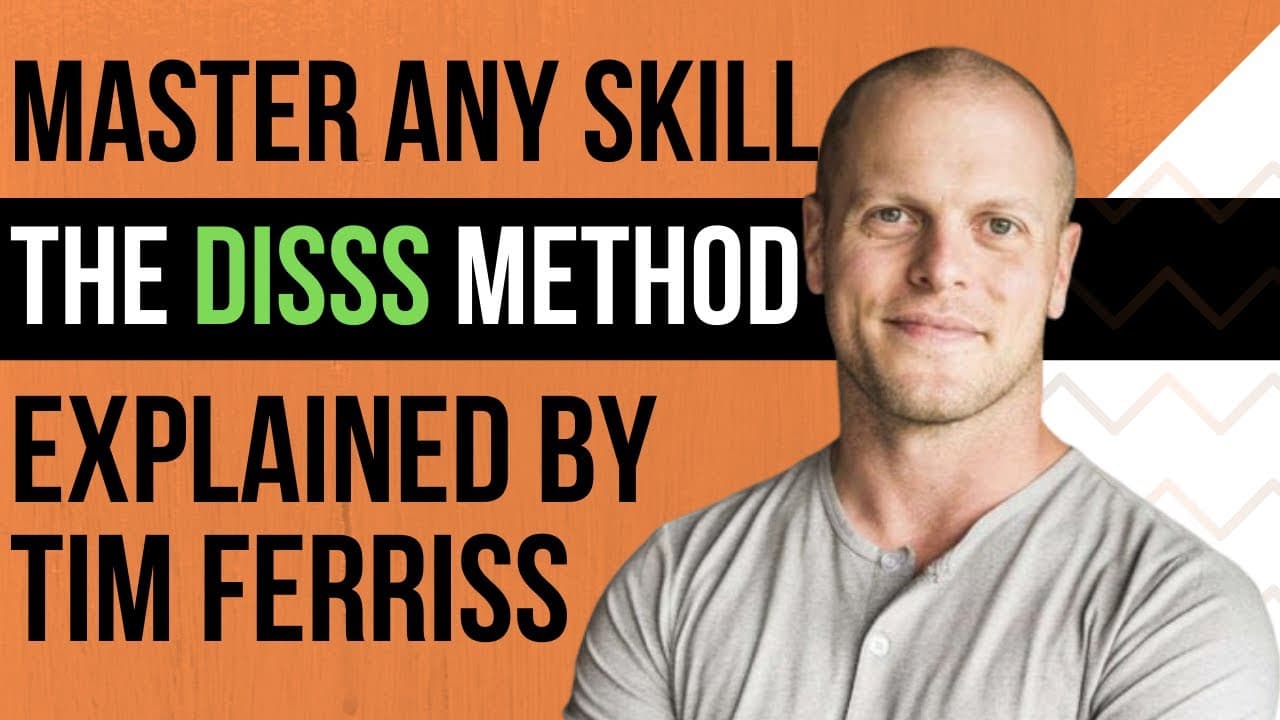
TL;DR
Learn how to become world-class in any skill in less than a year by emulating the world's fastest learners using the four-hour ethos.
Transcript
this presentation is about emulating the world's fastest learners and trying to decipher the recipe if there is one that they share in common and in fact at least from what I've seen it is possible by emulating these people to become world-class in almost any skill and by world class I mean top five percent in the general population in six to twelv... Read More
Key Insights
- 🥺 Emulating the methods of fast learners can lead to rapid skill acquisition.
- 😥 Deconstructing a skill and identifying potential failure points helps prevent quitting or failure.
- 🥺 Selecting the most effective activities or tools leads to the greatest results.
- 👶 Sequencing, including doing things in the opposite order, can unlock new learning approaches.
- ❓ Minimalism reduces complexity and focuses on essential elements for efficient skill acquisition.
- ✋ No stakes practice, practicing without pressure, helps build skills before applying them in high-pressure situations.
- ❓ Incentives or consequences can be powerful motivators for skill acquisition.
Install to Summarize YouTube Videos and Get Transcripts
Explore YouTube Video Summarizer or Get YouTube Transcript Extractor
Questions & Answers
Q: How can emulating the world's fastest learners help one become world-class in any skill?
By studying and replicating the methods and approaches of fast learners, individuals can identify patterns and techniques that can be applied to their own skill acquisition journey. This allows for rapid progress and the ability to reach a high level of proficiency in a relatively short timeframe.
Q: What is the four-hour ethos and how does it contribute to skill acquisition?
The four-hour ethos consists of deconstruction, selection, sequencing, and stakes. Deconstruction involves breaking down a skill into smaller pieces and identifying potential failure points. Selection focuses on identifying the most effective activities or tools that produce the majority of results. Sequencing involves trying the opposite order or omitting traditional best practices to accelerate learning. Stakes refer to building incentives or consequences into the learning process to motivate and drive progress.
Q: How can minimalism be applied to skill acquisition?
Minimalism involves identifying the essential components of a skill and eliminating unnecessary complexity or tools. For example, in language learning, focusing on a core set of 1,200 to 2,000 words can lead to functional fluency. In cooking, a basic set of pots, pans, and knives can be sufficient for effective cooking. Minimalism helps streamline the learning process and prevent overwhelm.
Q: What role does sequencing play in skill acquisition?
Sequencing involves exploring different approaches and considering doing things in the opposite order or omitting traditional best practices. This helps challenge assumptions and potentially uncover more efficient methods of learning. For example, learning the female role first in tango instead of the male role can lead to faster progress and better understanding of the dance.
Key Insights:
- Emulating the methods of fast learners can lead to rapid skill acquisition.
- Deconstructing a skill and identifying potential failure points helps prevent quitting or failure.
- Selecting the most effective activities or tools leads to the greatest results.
- Sequencing, including doing things in the opposite order, can unlock new learning approaches.
- Minimalism reduces complexity and focuses on essential elements for efficient skill acquisition.
- No stakes practice, practicing without pressure, helps build skills before applying them in high-pressure situations.
- Incentives or consequences can be powerful motivators for skill acquisition.
- Researching and studying successful individuals' strategies and techniques can provide valuable insights for skill acquisition.
Summary & Key Takeaways
-
Emulating the world's fastest learners can lead to becoming world-class in any skill within six to twelve months.
-
The four-hour ethos, which includes deconstruction, selection, sequencing, and stakes, is the key to rapid skill acquisition.
-
Minimalism is a powerful approach that can be applied to various fields, including language learning, cooking, and coffee brewing.
Read in Other Languages (beta)
Share This Summary 📚
Summarize YouTube Videos and Get Video Transcripts with 1-Click
Try YouTube Summary with ChatGPT & Claude or YouTube Transcript Generator