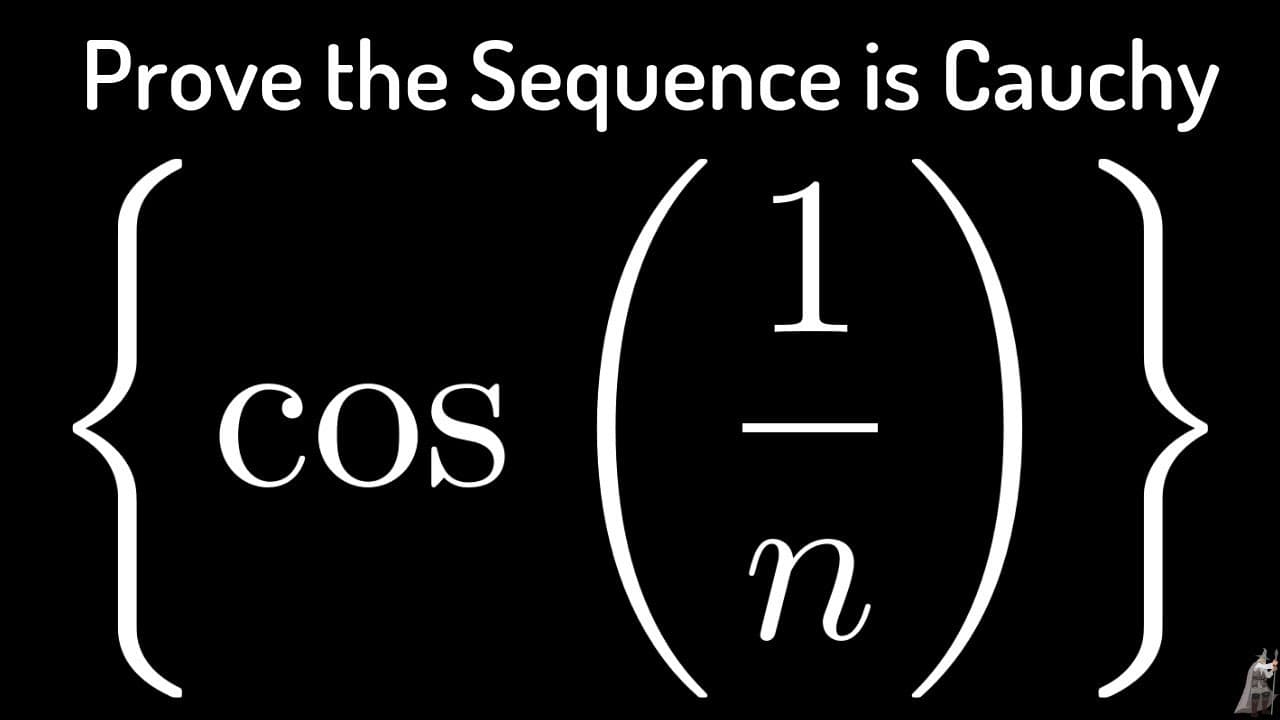
Proof that the Sequence {cos(1/n)} is a Cauchy Sequence
TL;DR
Proving a Cauchy sequence involves showing terms get closer together using trigonometry identities and Archimedean property.
Transcript
hey YouTube in this video we're gonna prove that this sequence is a Cauchy sequence so before we do that let's recall the definition of Koshi so we'll say that a sequence a sub n is Koshi if for every epsilon greater than zero we can find some positive integer say n such that for all little N and little m m bigger than capital n we can make the dis... Read More
Key Insights
- 😚 Understanding the Cauchy sequence requires terms getting closer together arbitrarily.
- 👍 Trigonometry identities, like the cosine difference formula, aid in proving convergence.
- ❓ The Archimedean property ensures the selection of appropriate positive integers for convergence.
Install to Summarize YouTube Videos and Get Transcripts
Explore YouTube Video Summarizer or Get YouTube Transcript Extractor
Questions & Answers
Q: What is a Cauchy sequence?
A Cauchy sequence is one in which the terms get arbitrarily close together as the sequence progresses, demonstrated by the distance between terms becoming smaller than any given epsilon.
Q: How is trigonometry used to prove a Cauchy sequence?
Trigonometry identities, such as the cosine difference formula and sine bounds, are utilized to manipulate expressions and show that the terms in the sequence converge as needed.
Q: What is the significance of the Archimedean property in proving a Cauchy sequence?
The Archimedean property allows for the selection of an appropriate positive integer to ensure the terms of the sequence satisfy the Cauchy condition, leading to convergence.
Q: How does algebraic manipulation play a role in proving a Cauchy sequence?
Algebraic techniques are crucial in demonstrating the sequence's convergence, involving inequalities and manipulations to show that the terms approach each other as required by the Cauchy criterion.
Summary & Key Takeaways
-
A sequence is Cauchy if terms get closer together arbitrarily.
-
Using trigonometry identities and Archimedean property to prove Cauchy sequence.
-
Demonstrating the proof step by step with algebraic manipulations.
Read in Other Languages (beta)
Share This Summary 📚
Summarize YouTube Videos and Get Video Transcripts with 1-Click
Try YouTube Summary with ChatGPT & Claude or YouTube Transcript Generator
Explore More Summaries from The Math Sorcerer 📚



Summarize YouTube Videos and Get Video Transcripts with 1-Click
Try YouTube Summary with ChatGPT & Claude or YouTube Transcript Generator