Are Viruses Intelligent? | Manolis Kellis and Lex Fridman
TL;DR
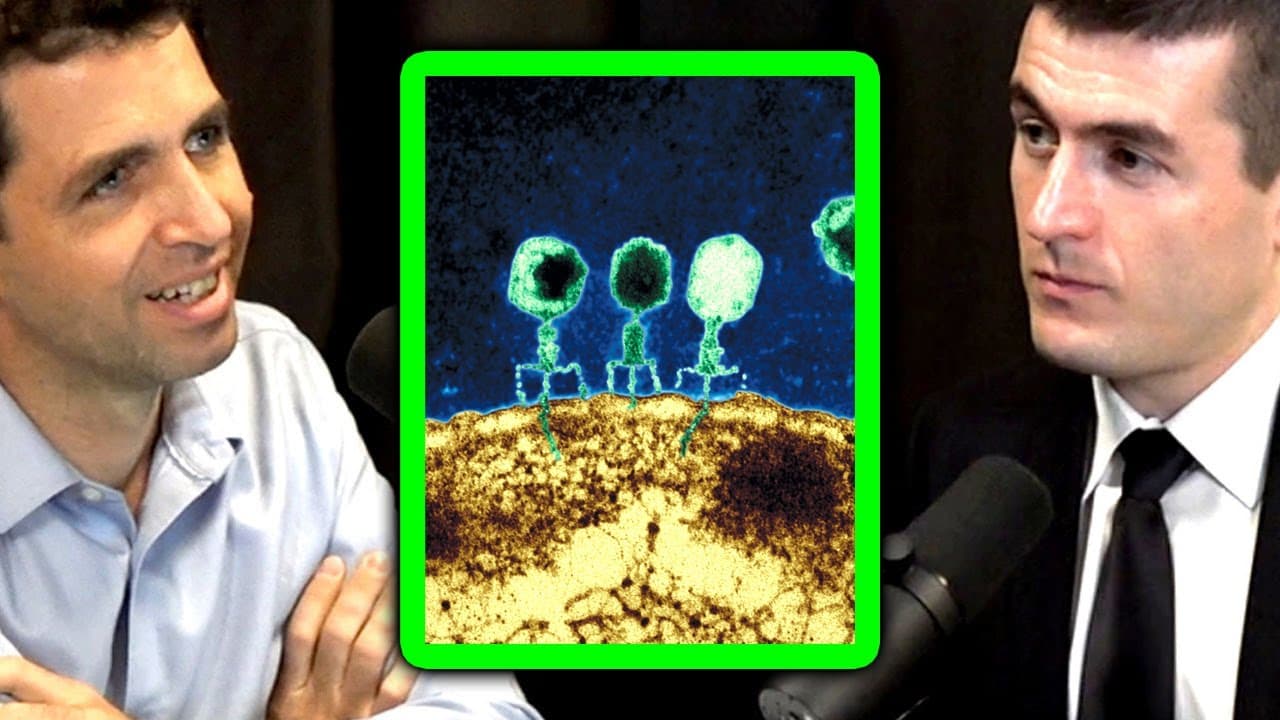
Viruses exhibit intelligent behavior through their evolutionary dynamics and mechanisms, although their actions are a result of the smart selection component of evolution rather than inherent intelligence.
Transcript
is it fascinating to you that viruses are doing this i mean it feels like they're this intelligent organism i mean is it like does it give you pause how incredible it is that they are um the the evolutionary dynamics that you're describing is actually happening and they're freaking out figuring out how to jump from bass to humans all in this distri... Read More
Key Insights
- 📱 The intelligence attributed to viruses is actually a product of the smart selection component of evolution.
- 💠 Viruses have had a significant impact on mammalian evolution, shaping gene regulation and complexity.
- 👻 Viruses prioritize spread over host death, making them adapt to avoid immediate lethal consequences.
- 👻 The coronavirus showcases remarkable strategies to hijack the host cell's machinery and produce its own proteins.
- ◀️ Viral replication involves complex processes, such as translational slippage and reverse transcription, contributing to their efficiency.
- 🧑⚕️ Understanding the mechanisms of viruses can help in developing strategies to mitigate their impact on human health.
- 💄 Anthropomorphizing viruses and assigning consciousness to them is inaccurate, as their actions are solely driven by their genetic makeup.
Install to Summarize YouTube Videos and Get Transcripts
Explore YouTube Video Summarizer or Get YouTube Transcript Extractor
Questions & Answers
Q: Are viruses intelligent?
No, viruses are not inherently intelligent. It is the process of evolution, specifically the smart selection component, that appears intelligent in finding solutions through parallel infections and mutations.
Q: How have viruses contributed to mammalian evolution?
Viruses have spread throughout our genome, creating binding sites for regulatory proteins and enhancing the complexity of mammalian gene circuits.
Q: Do viruses intentionally try to kill humans?
No, viruses are not actively trying to kill humans. Their priority is to spread, and the mutations that enhance their spread while avoiding immediate host death are the ones that survive.
Q: What makes the design of the coronavirus fascinating?
The coronavirus exhibits an intelligent design in its ability to hijack human cells, manipulate their protein translation process, and effectively replicate itself.
Summary & Key Takeaways
-
Viruses employ both blind mutations and smart selection to adapt and jump from animals to humans in a distributed fashion.
-
Viruses have played a crucial role in mammalian evolution by spreading throughout our genome and influencing gene regulation.
-
Contrary to popular belief, viruses are not actively trying to kill humans but rather avoid it in order to maximize their spread.
Read in Other Languages (beta)
Share This Summary 📚
Summarize YouTube Videos and Get Video Transcripts with 1-Click
Try YouTube Summary with ChatGPT & Claude or YouTube Transcript Generator
Explore More Summaries from Lex Clips 📚




Summarize YouTube Videos and Get Video Transcripts with 1-Click
Try YouTube Summary with ChatGPT & Claude or YouTube Transcript Generator