Universal shift register | STLD | Lec-133
TL;DR
The video covers the operations and design of a universal shift register.
Transcript
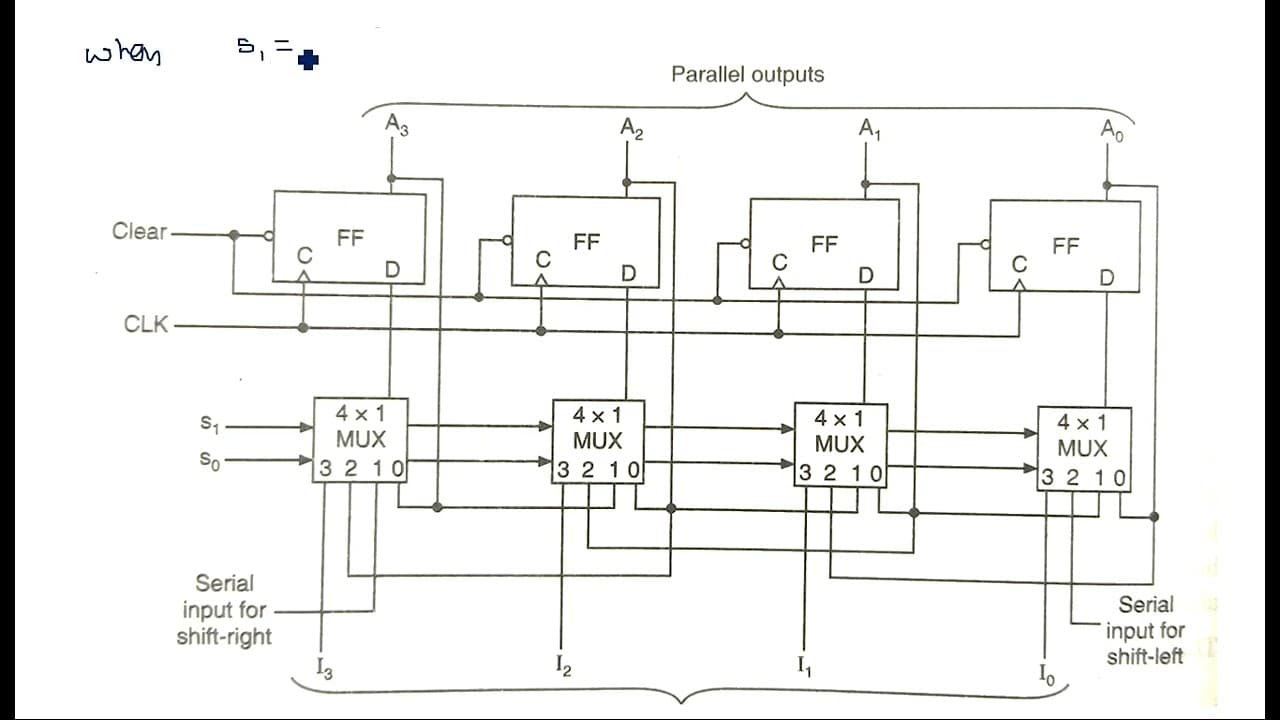
hi everyone in this video I'm going to explain about Universal shift register Universal shift register is different from the bidirectional shift register which was discussed in the previous video that bidirectional shift register only shifts the data in left side or right side okay there is no other way but Universal shift register along with those... Read More
Key Insights
- 👻 The universal shift register enhances data handling capabilities beyond mere shifting, allowing for loading and maintaining data.
- 📳 Multiplexors are fundamental components that help manage multiple data paths and operation modes efficiently.
- 🎨 The design of a universal shift register maximizes the flexibility of data manipulation for digital circuits.
- 🖐️ D flip-flops play a crucial role in data storage and timing synchronization within shift registers.
- 🤩 Understanding the control logic is key to effectively utilizing a universal shift register in any application.
- 🫥 Operations can be performed in sequence, allowing complex data behavior that can be controlled easily through selection lines.
- 😴 Resetting the outputs using a clearance pin is an essential feature for consistent operation and reliability in digital systems.
Install to Summarize YouTube Videos and Get Transcripts
Explore YouTube Video Summarizer or Get YouTube Transcript Extractor
Questions & Answers
Q: What operations can be performed by a universal shift register?
A universal shift register can perform four main operations: no change operation where the output is fed back to the input, shift right operation for moving data towards the right, shift left operation for moving data towards the left, and parallel load operation for loading data simultaneously into all flip-flops.
Q: How does the multiplexor function in a universal shift register?
The multiplexor in a universal shift register selects between different operational paths based on control signals. It has multiple inputs corresponding to each operation and one output that is directed to the flip-flops. The selection lines determine which operation is executed during a clock pulse.
Q: How does the design of a universal shift register differ from a bidirectional shift register?
Unlike a bidirectional shift register, which can only shift data left or right, the universal shift register includes additional functionality for parallel loading and no change operations, allowing for more versatile data manipulation within a single device.
Q: What role do the D flip-flops play in a universal shift register?
D flip-flops in a universal shift register serve as storage elements that hold data bits. They receive input from the multiplexor based on the selected operation and ensure that the data is shifted or loaded correctly during each clock cycle.
Q: Why is the clearance pin important in the design of a universal shift register?
The clearance pin in a universal shift register is crucial for resetting all outputs to zero simultaneously. This allows the designer to ensure all flip-flops start from a known state, which is critical during the initialization phase or when troubleshooting.
Q: How do the selection lines impact the operation of the universal shift register?
The selection lines directly control which operation is performed by indicating the desired function: no change, shift right, shift left, or parallel load. Depending on their binary state, different data paths are activated in the multiplexor, thus determining the output behavior.
Q: What happens when more operations need to be added to the universal shift register?
To incorporate more operations, the size of the multiplexor must increase accordingly. For instance, adding additional operations may necessitate switching from a 4-to-1 multiplexor to an 8-to-1 configuration to accommodate the increased number of inputs and operations.
Summary & Key Takeaways
-
The universal shift register distinguishes itself from the bidirectional shift register by performing four operations: no change, shift left, shift right, and parallel load.
-
To execute these operations, a multiplexor is essential, allowing the selection of different data paths based on specified input conditions.
-
The design incorporates multiple D flip-flops and uses selection lines to control the desired operation during each clock pulse.
Read in Other Languages (beta)
Share This Summary 📚
Summarize YouTube Videos and Get Video Transcripts with 1-Click
Try YouTube Summary with ChatGPT & Claude or YouTube Transcript Generator