Sphere - Volume & Surface area | Mensuration | Aptitude | Part-29 | Pratik Shrivastava
TL;DR
The video explains how to calculate the volume and surface area of a sphere, with practical examples.
Transcript
hello friends welcome back our today's topic is menstruation as you know medicine is one of the very important topic for all kind of competitive exams let it be Bank SSE Railway UPC CSAT and placement trainings friends for all the exams menstruation plays a very important role so two questions will be asked minimum in your exams principai are prepa... Read More
Key Insights
- 🎮 The video underscores the criticality of grasping sphere dimensions for academic success, especially in mathematics.
- 🧑🎓 Mastery of the formulas for a sphere's volume and surface area is essential for students in technical fields.
- 🌍 Practical examples enhance comprehension by illustrating the application of theoretical concepts in real-world scenarios.
- 👶 Understanding how to calculate the radius of a new sphere formed from smaller spheres is a valuable skill.
- 😄 Simplifying calculations by transforming measurements into fractions can help ease complex mathematical problems.
- 🔇 The relationship between volume and surface area encapsulates the principles of three-dimensional geometry.
- ❓ Regular practice on sphere-related problems can boost confidence and efficiency for competitive exam takers.
Install to Summarize YouTube Videos and Get Transcripts
Explore YouTube Video Summarizer or Get YouTube Transcript Extractor
Questions & Answers
Q: What are the key formulas used for calculating the volume and surface area of a sphere?
The volume of a sphere is calculated using the formula V = 4/3 π R³, where R is the radius. The surface area is determined with A = 4 π R². These formulas are foundational for solving numerous mathematical problems related to spheres.
Q: How is the radius of a newly formed sphere calculated when combining smaller spheres?
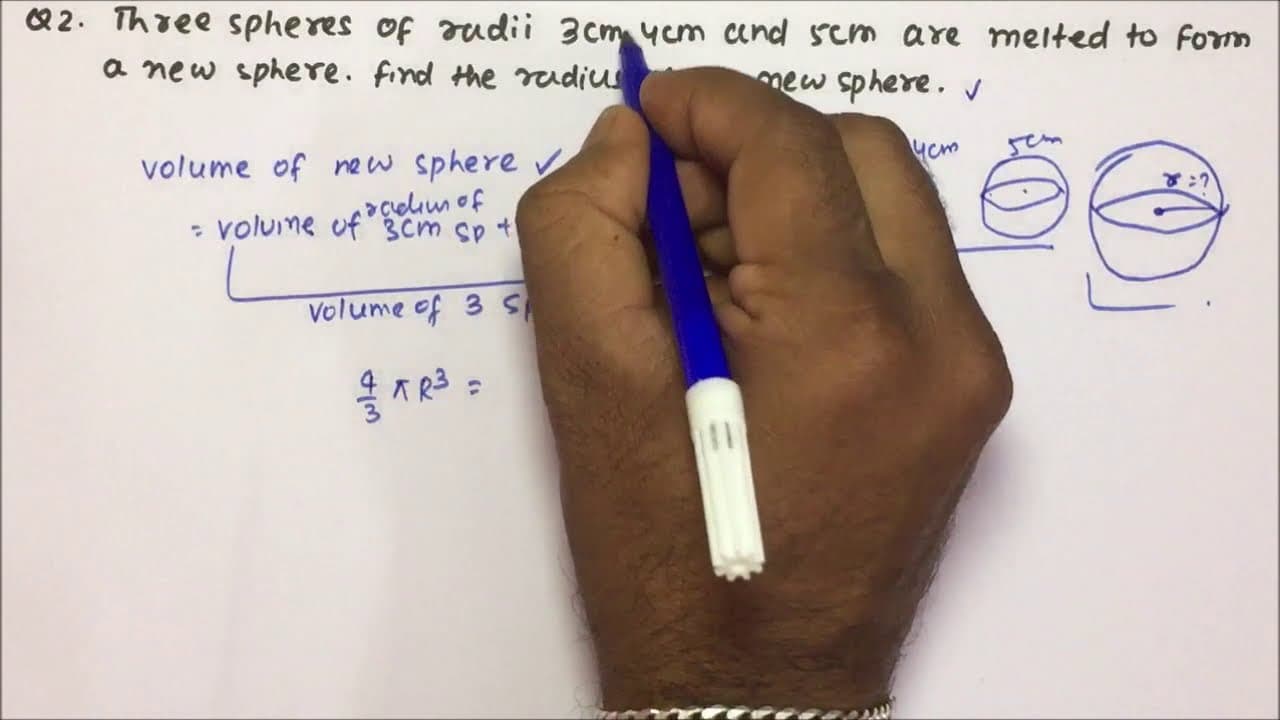
To find the radius of a new sphere formed by melting smaller spheres, the total volume of the smaller spheres is equated to the volume of the new sphere. By using V = 4/3 π R³ for each sphere and equating their sum to the volume of the larger sphere, the new radius can be derived.
Q: Can you explain how to calculate the volume of a sphere with a 10.5 cm radius?
To calculate the volume, substitute the radius into the formula V = 4/3 π R³. For R = 10.5 cm, this becomes V = 4/3 × (22/7) × (10.5)³, resulting in a volume of 4851.4 cm³ after simplification and calculation.
Q: What steps should be taken to find the surface area of a sphere with a 10.5 cm radius?
Use the surface area formula A = 4 π R². Substituting R = 10.5 cm yields A = 4 × (22/7) × (10.5)². After calculation, the surface area is found to be approximately 1386 cm², emphasizing the importance of squaring the radius.
Q: Why is understanding spheres crucial for competitive exams?
Spheres are commonly featured in various competitive exams such as Bank, SSC, and Railway tests. Understanding the properties and calculations of spheres equips candidates to confidently solve related mathematical problems in these assessments.
Q: How many questions related to spheres can be expected in competitive exams?
Candidates can anticipate at least two questions exclusively about spheres in exams. Notably, the topic is significant enough to yield more than five related questions in various competitive examinations.
Summary & Key Takeaways
-
The content focuses on the mathematical concepts related to spheres, emphasizing the significance of understanding these principles for competitive exams.
-
Key formulas for calculating the sphere’s volume (4/3 π R³) and surface area (4 π R²) are introduced with practical illustrations.
-
Examples are worked out in detail, demonstrating volume and surface area calculations for spheres of various radii.
Read in Other Languages (beta)
Share This Summary 📚
Summarize YouTube Videos and Get Video Transcripts with 1-Click
Try YouTube Summary with ChatGPT & Claude or YouTube Transcript Generator