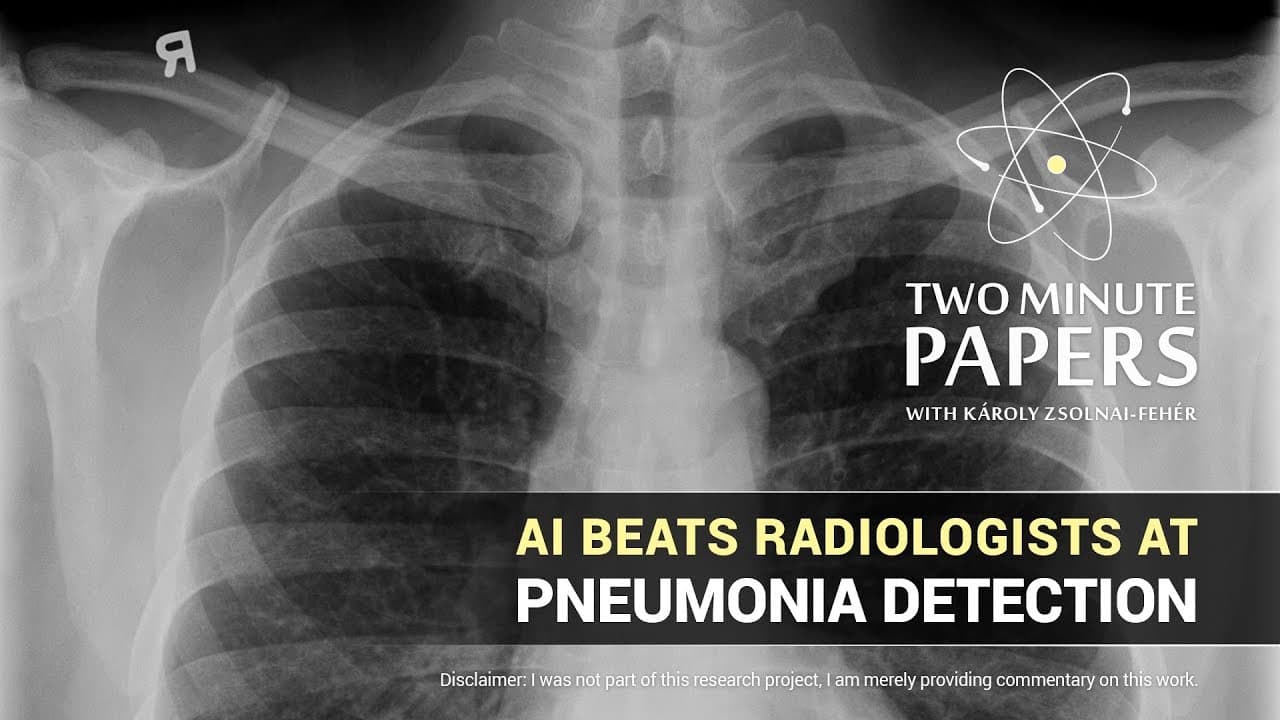
AI Beats Radiologists at Pneumonia Detection | Two Minute Papers #214
TL;DR
A 121-layer neural network trained on a dataset of over 100,000 x-ray images outperforms human radiologists in detecting pneumonia and 13 other diseases.
Transcript
Dear Fellow Scholars, this is Two Minute Papers with Károly Zsolnai-Fehér. In this work, a 121-layer convolutional neural network is trained to recognize pneumonia and 13 different diseases. Pneumonia is an inflammatory lung condition that is responsible for a million hospitalizations and 50,000 deaths per year in the US alone. Such an algorithm re... Read More
Key Insights
- 📤 A 121-layer CNN trained on a large dataset of x-ray images can outperform human radiologists in detecting pneumonia and other diseases.
- 😒 The use of annotations by multiple expert radiologists helps create more reliable training and test sets for the neural network.
- 🖤 Limitations include the lack of patient history and lateral views, but these can be addressed in future work.
Install to Summarize YouTube Videos and Get Transcripts
Explore YouTube Video Summarizer or Get YouTube Transcript Extractor
Questions & Answers
Q: How was the training set for the CNN algorithm created?
The training set consisted of over 100,000 frontal x-ray images from more than 30,000 patients, with annotations provided by multiple radiologists who voted on the presence of diseases and marked potential regions.
Q: How was the performance of the CNN algorithm compared to human radiologists?
The performance of the CNN algorithm was measured in terms of sensitivity and specificity. The algorithm outperformed all human radiologists, as indicated by its position above the blue curve in the 2D space of sensitivity and specificity.
Q: What limitations were noted in the study?
The study acknowledged that it was an isolated test and that radiologists were only given single images, whereas they typically have access to patient history. The lack of lateral views and additional patient information may sway the results in favor of radiologists.
Q: Are there other algorithms for pneumonia detection?
Yes, there are other algorithms, but this particular technique outperformed the state-of-the-art algorithms for all 14 diseases examined in the study.
Summary & Key Takeaways
-
A 121-layer convolutional neural network (CNN) is trained to recognize pneumonia and 13 other diseases using a large dataset of over 100,000 frontal x-ray images.
-
The training set consists of input x-ray images and expert annotations marking the presence of different diseases, providing detailed heatmaps of potential regions.
-
The CNN algorithm surpasses the average human radiologist in sensitivity and specificity, demonstrating the potential of machine intelligence in healthcare.
Read in Other Languages (beta)
Share This Summary 📚
Summarize YouTube Videos and Get Video Transcripts with 1-Click
Try YouTube Summary with ChatGPT & Claude or YouTube Transcript Generator
Explore More Summaries from Two Minute Papers 📚




Summarize YouTube Videos and Get Video Transcripts with 1-Click
Try YouTube Summary with ChatGPT & Claude or YouTube Transcript Generator