29.5 Deep Dive - Moment of Inertia of a Sphere
TL;DR
The moment of inertia of a uniform sphere can be calculated using symmetry, resulting in the formula 2/5 m R².
Transcript
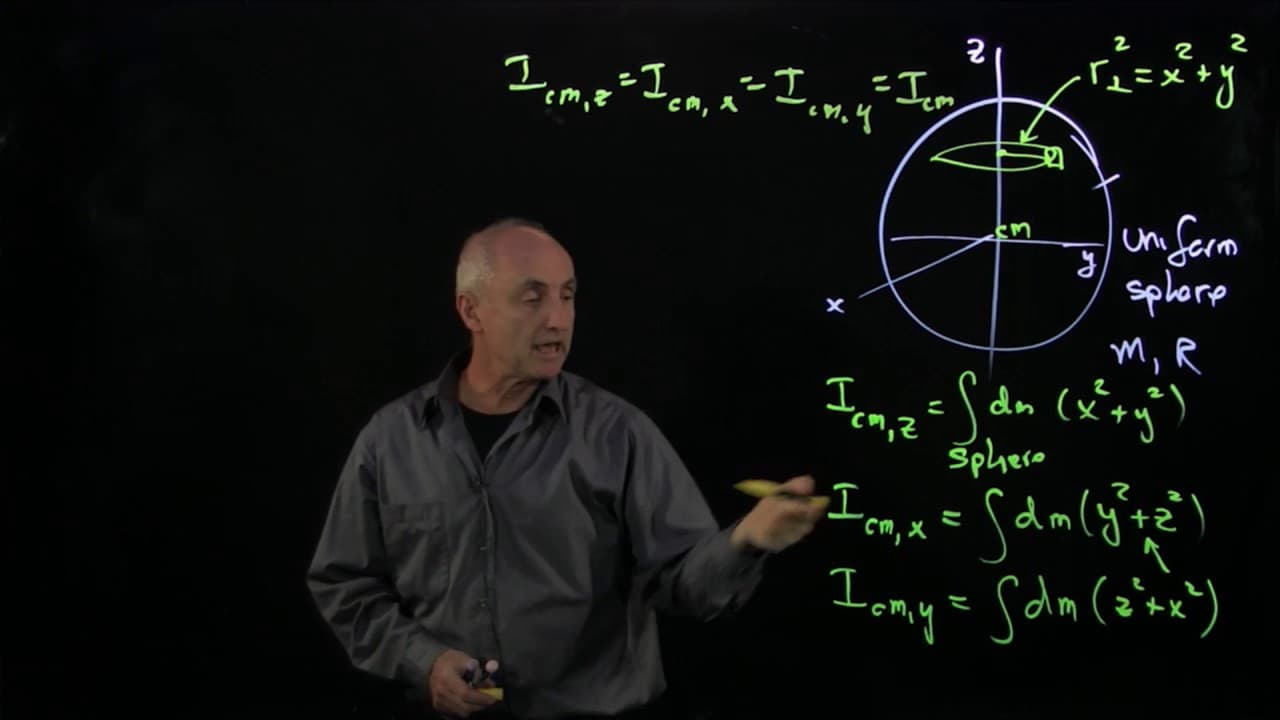
I would now like to calculate the moment of inertia of a uniform sphere. And it has a mass m and radius r. I'm going to look at three axes. So I'll call this the x-axis, the y-axis, and the z-axis. And first, let's calculate the moment about the z-axis. So if I write down our definition, and I'm going to calculate it about the center of mass, so th... Read More
Key Insights
- 🥋 Moment of inertia can be calculated for a uniform sphere around different axes.
- 🍹 The perpendicular distances for each axis involve the sums of squares of coordinates.
- 👻 The symmetry of the sphere allows for all three moments of inertia to be equal.
Install to Summarize YouTube Videos and Get Transcripts
Explore YouTube Video Summarizer or Get YouTube Transcript Extractor
Questions & Answers
Q: How is the moment of inertia calculated for a uniform sphere?
The moment of inertia for a uniform sphere is calculated by considering three axes, x-axis, y-axis, and z-axis. The perpendicular distances for each axis are x²+y², y²+z², and z²+x² respectively. By integrating over the sphere and considering its symmetry, all three moments of inertia are found to be equal.
Q: What is the volume density and how is it used in the moment of inertia calculation?
Volume density is the total mass divided by the volume of an object. In the moment of inertia calculation of a uniform sphere, the volume density is multiplied by the volume of a spherical shell (4πr²dr) to obtain the mass element (dm). This dm is then integrated over the sphere to calculate the moment of inertia.
Q: How does the symmetry of the sphere simplify the moment of inertia calculation?
The symmetry of the sphere allows for simplification of the moment of inertia calculation. By considering the symmetry, it is determined that the moment of inertia around each axis is equal. This symmetry eliminates the need to calculate separate moments of inertia for each axis, making the overall calculation simpler.
Q: What is the final formula for the moment of inertia of a uniform sphere?
The moment of inertia of a uniform sphere is given by the formula 2/5 m R², where m is the mass of the sphere and R is its radius. This formula holds true for any axis of rotation through the center of the sphere.
Summary & Key Takeaways
-
The moment of inertia is calculated for a uniform sphere around three axes: x-axis, y-axis, and z-axis.
-
By considering the perpendicular distances for each axis, the moment of inertia is found to be equal for all three axes.
-
The calculation involves integrating over the sphere and simplifying using the symmetry of the sphere.
Read in Other Languages (beta)
Share This Summary 📚
Summarize YouTube Videos and Get Video Transcripts with 1-Click
Try YouTube Summary with ChatGPT & Claude or YouTube Transcript Generator
Explore More Summaries from MIT OpenCourseWare 📚



Summarize YouTube Videos and Get Video Transcripts with 1-Click
Try YouTube Summary with ChatGPT & Claude or YouTube Transcript Generator