An Ode to Salps: Our Gelatinous Marine Cousins
TL;DR
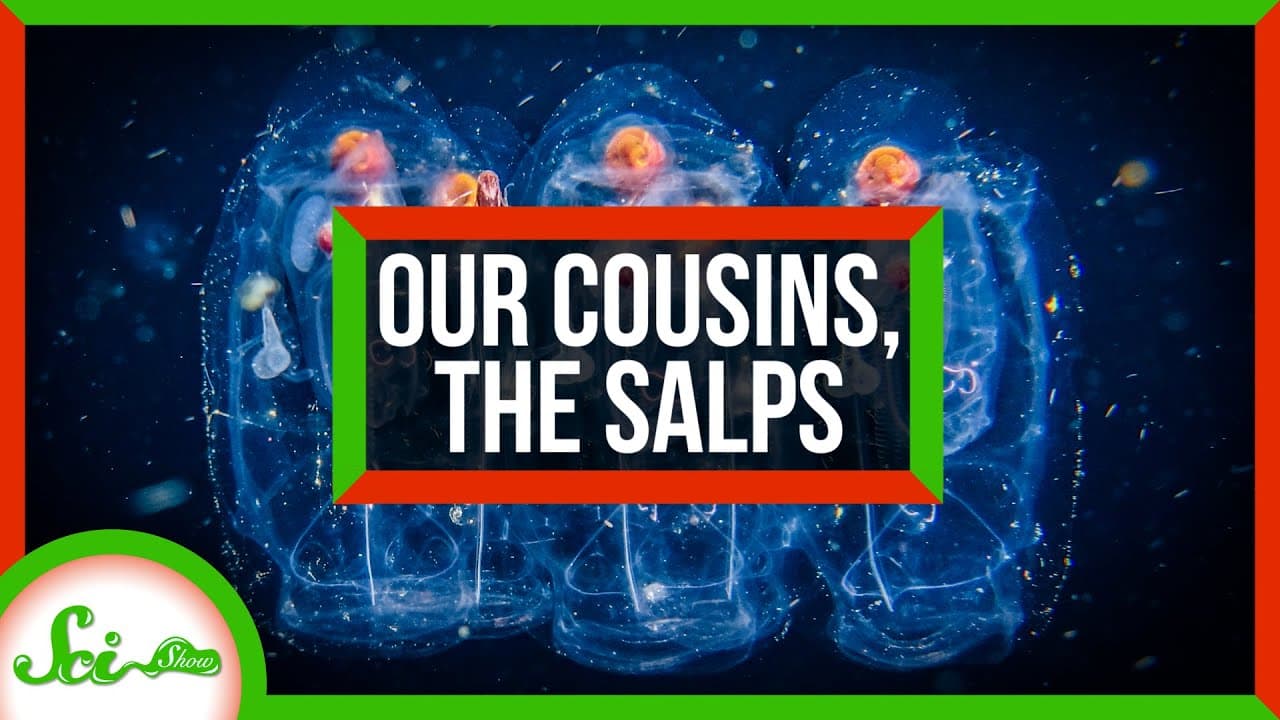
Salps are barrel-shaped ocean-dwelling creatures that are closely related to humans and play a vital role in marine ecosystems by filtering water, reproducing rapidly, and providing food for other species.
Transcript
Thanks to the Monterey Bay Aquarium and their research and technology partner MBARI for partnering with us on this episode of SciShow. Their excitement for this video is salp-able! [♪ INTRO] You might have heard them called “jellyfish eggs”, “sea walnuts,” or simply “balls of goo”. But the correct term is salp! Yes, that’s the real name for thi... Read More
Key Insights
- ❓ Salps are closely related to humans, belonging to the same phylum Chordata, and can provide insights into our ancient ancestors and evolutionary processes.
- 🔶 They are efficient filter-feeders, capable of filtering large amounts of water and consuming a wide range of particles.
- 💁 Salps reproduce rapidly by forming chains of clones, allowing for quick population growth and the formation of massive swarms.
- 😋 Salp swarms are an important food source for many marine animals, and their fecal pellets provide nutrition to deep-sea communities.
- 🖐️ Salps play a role in carbon sequestration by sinking carbon dioxide through their fecal pellets, contributing to climate change mitigation.
- 🧑🔬 Scientists can study salps to better understand and maximize their carbon-storing abilities.
- 🌊 Conservation efforts should ensure the well-being of salps by maintaining suitable ocean conditions.
Install to Summarize YouTube Videos and Get Transcripts
Explore YouTube Video Summarizer or Get YouTube Transcript Extractor
Questions & Answers
Q: What makes salps different from jellyfish?
While salps and jellyfish have a similar appearance, salps are actually more closely related to humans as they belong to the phylum Chordata, which includes vertebrates like us, while jellyfish belong to the phylum Cnidaria.
Q: How do salps contribute to marine ecosystems?
Salps play a crucial role in marine ecosystems by filtering large amounts of water and consuming a variety of particles, including bacteria and phytoplankton. They are also a significant food source for many marine animals, and their fecal pellets provide nutrition to the deep-sea community.
Q: How do salps reproduce?
Salps can reproduce asexually by producing clones, forming long chains of individuals. They can also sexually reproduce, with female clones producing eggs that get fertilized by sperm from another chain.
Q: How do salps help combat climate change?
Salps help remove carbon dioxide from the atmosphere by consuming it in their diet and sinking it to the deep sea through their fast-sinking fecal pellets. This process helps sequester carbon for extended periods, contributing to climate change mitigation.
Summary & Key Takeaways
-
Salps are barrel-shaped zooplankton that resemble jellyfish but are actually more closely related to humans.
-
They filter water through a mucous mesh and consume a wide range of particles, making them efficient filter-feeders.
-
Salps can reproduce asexually, forming long chains of clones, and they also sexually reproduce, contributing to their rapid population growth.
Read in Other Languages (beta)
Share This Summary 📚
Summarize YouTube Videos and Get Video Transcripts with 1-Click
Try YouTube Summary with ChatGPT & Claude or YouTube Transcript Generator
Explore More Summaries from SciShow 📚


Summarize YouTube Videos and Get Video Transcripts with 1-Click
Try YouTube Summary with ChatGPT & Claude or YouTube Transcript Generator