Carnot Cycle & Heat Engines, Maximum Efficiency, & Energy Flow Diagrams Thermodynamics & Physics
TL;DR
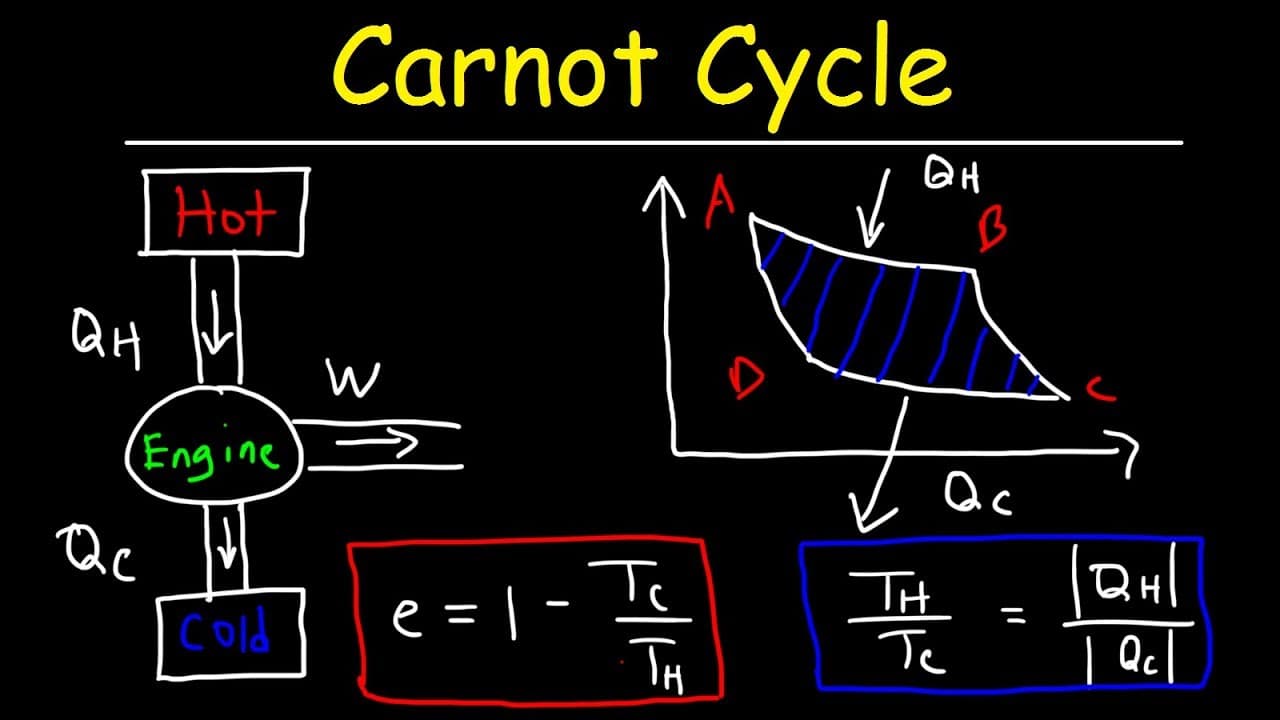
This video explains how to calculate the maximum efficiency of a heat engine using the Carnot cycle, as well as how to determine the amount of heat energy absorbed and discarded by the engine.
Transcript
in this video i'm going to show you how to solve problems associated with the carnot engine and then towards the end of this video i'm going to talk about the carnot cycle and all the steps that are associated with it so let's go over this problem first calculate the maximum efficiency of a heat engine with operating temperatures of 300 celsius and... Read More
Key Insights
- 🥵 The maximum efficiency of a heat engine is calculated using the Carnot engine equation, which compares the temperatures of the hot and cold reservoirs.
- 🥵 The amount of heat energy discarded into the cold reservoir can be determined by applying the equation Th / Tc = |Qh| / |Qc|.
- 🎭 The mechanical work performed by a heat engine is equal to the difference between the absorbed and discarded heat energies.
- 🥵 The efficiency of a heat engine can be improved by either decreasing the temperature of the cold reservoir or increasing the temperature of the hot reservoir.
- 🏍️ The Carnot cycle consists of four steps: isothermal expansion, adiabatic expansion, isothermal compression, and adiabatic compression.
- 🥵 The net work done by a heat engine for an entire cycle can be calculated as the difference between the heat energies absorbed and discarded.
- 💦 The area under the PV diagram represents the net work done by the engine.
Install to Summarize YouTube Videos and Get Transcripts
Explore YouTube Video Summarizer or Get YouTube Transcript Extractor
Questions & Answers
Q: How is the maximum efficiency of a heat engine calculated using the Carnot engine equation?
The efficiency of a Carnot engine is calculated using the equation (Th - Tc) / Th, where Th is the temperature of the hot reservoir and Tc is the temperature of the cold reservoir. The result is then multiplied by 100 to obtain the percentage efficiency.
Q: How is the amount of heat energy discarded into the cold reservoir determined?
To calculate the amount of heat energy discarded, we use the equation Th / Tc = |Qh| / |Qc|, where Th and Tc are the temperatures of the hot and cold reservoirs, and Qh and Qc are the heat energies absorbed and discarded, respectively. By cross-multiplying, we can find the value of Qc.
Q: How is the mechanical work performed by a heat engine calculated?
The mechanical work done by a heat engine is determined by subtracting the heat energy discarded from the heat energy absorbed. This difference represents the amount of mechanical work performed by the engine during one cycle.
Q: How can the efficiency of a heat engine be improved?
The efficiency of a heat engine can be improved by either decreasing the temperature of the cold reservoir or increasing the temperature of the hot reservoir. Both methods will result in an increase in the efficiency of the engine.
Summary & Key Takeaways
-
The video begins by explaining how to calculate the maximum efficiency of a heat engine with operating temperatures of 300 and 500 Celsius using the Carnot engine equation.
-
It then demonstrates how to determine the amount of heat energy discarded into the cold reservoir when a heat engine is operating at temperatures of 400 and 700 Kelvin, with 14,000 joules of heat energy absorbed.
-
The video also shows how to calculate the amount of mechanical work performed by the engine and the efficiency of the heat engine when given different operating temperatures and heat energy inputs.
Read in Other Languages (beta)
Share This Summary 📚
Summarize YouTube Videos and Get Video Transcripts with 1-Click
Try YouTube Summary with ChatGPT & Claude or YouTube Transcript Generator
Explore More Summaries from The Organic Chemistry Tutor 📚


Summarize YouTube Videos and Get Video Transcripts with 1-Click
Try YouTube Summary with ChatGPT & Claude or YouTube Transcript Generator