Internal Heat Generation in Case of Cylinders
TL;DR
This video analyzes the heat generation in cylinders and provides a simplified equation to deduce the temperature profile.
Transcript
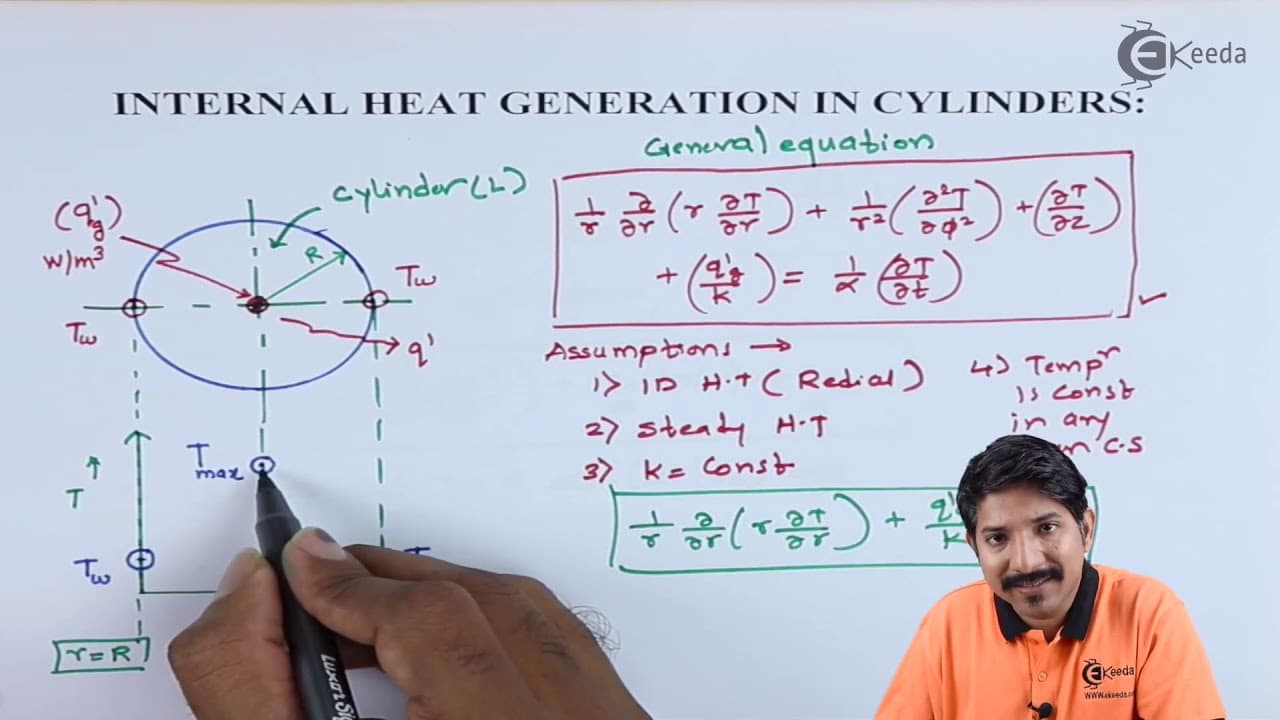
click the bell icon to get latest videos from ekeeda hello friends previously we have seen the analysis of heat conduction without hue generation in cylinder now in this topic let us consider the analysis with heat generation in case of cylinders here we have considered internal heat generation in cylinders let us consider a cylinder whose radius i... Read More
Key Insights
- 🎭 Internal heat generation in cylinders can be analyzed using a simplified equation derived from the general equation for heat transfer in cylindrical form.
- 🥵 The temperature profile of the cylinder depends on factors such as heat generation, radius, and boundary conditions.
- 💼 Two cases with different boundary conditions are considered: one with a constant temperature boundary and another with convection at the outer surface of the cylinder.
- 👻 The temperature profile equation allows for the determination of the maximum temperature (Tmax) within the cylinder.
- 🆘 The assumptions made in the analysis help simplify the equation and make it more feasible to solve.
- 🥵 The derived temperature profile equation enables the understanding of temperature distribution in cylinders with internal heat generation.
- 🖐️ The boundary conditions play a crucial role in determining the temperature profile and require careful consideration.
Install to Summarize YouTube Videos and Get Transcripts
Explore YouTube Video Summarizer or Get YouTube Transcript Extractor
Questions & Answers
Q: What are the assumptions made for deducing the simplified equation for heat generation in cylinders?
The assumptions include one-dimensional radial heat transfer, steady state heat transfer, and constant thermal conductivity. Additionally, the temperature is assumed to be constant in any given cross-section.
Q: How is the temperature profile of the cylinder derived?
The temperature profile is obtained by integrating the simplified equation twice. The resulting equation includes terms related to heat generation, radius, and constants.
Q: What are the two boundary conditions considered in the analysis?
The first boundary condition is that at r=0, the derivative of temperature with respect to radius is zero. The second boundary condition is that at r=capital R (radius of the cylinder), the temperature is equal to a given value.
Q: How can the maximum temperature (Tmax) be determined?
The maximum temperature is found by substituting r=0 into the temperature profile equation, resulting in Tmax = T(w) + (qdash/g) / (4kR).
Summary & Key Takeaways
-
The video explores the concept of internal heat generation in cylinders and considers a cylinder with a given radius and length.
-
The general equation for heat transfer in cylindrical form is simplified under certain assumptions.
-
Two cases with different boundary conditions are analyzed to determine the temperature profile of the cylinder.
Read in Other Languages (beta)
Share This Summary 📚
Summarize YouTube Videos and Get Video Transcripts with 1-Click
Try YouTube Summary with ChatGPT & Claude or YouTube Transcript Generator
Explore More Summaries from Ekeeda 📚






Summarize YouTube Videos and Get Video Transcripts with 1-Click
Try YouTube Summary with ChatGPT & Claude or YouTube Transcript Generator