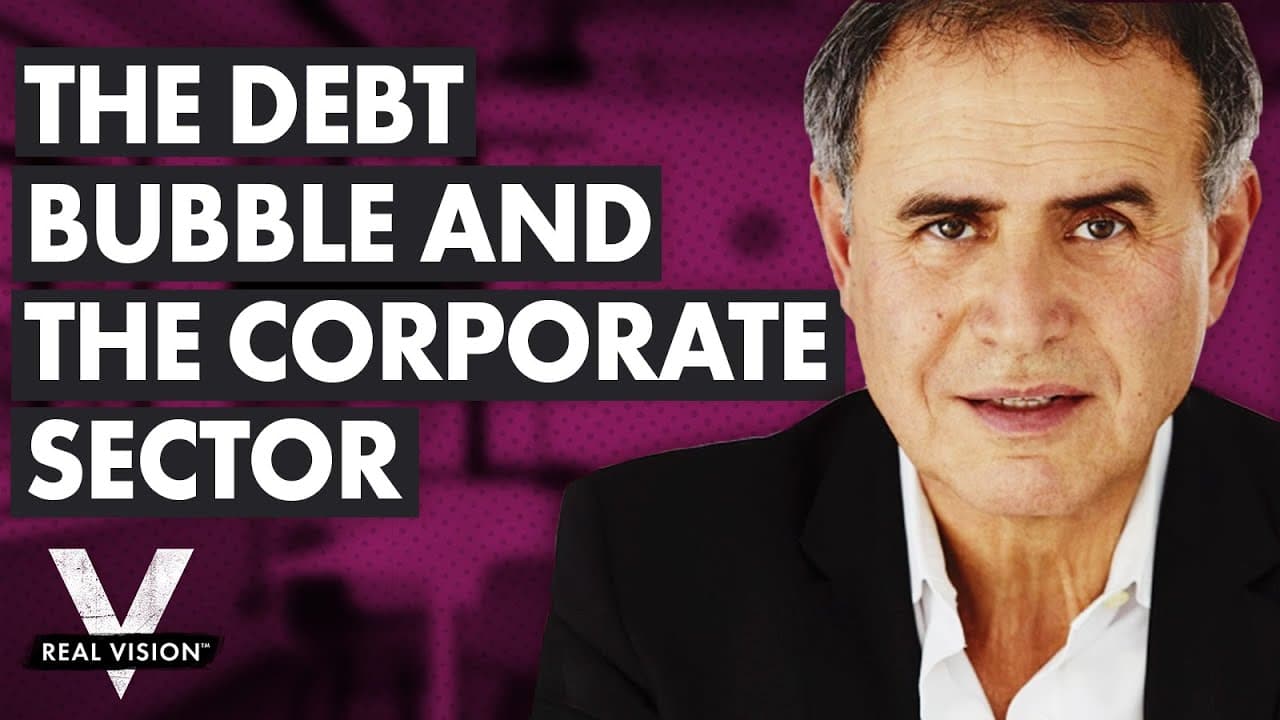
Will the Corona Crisis Burst the Debt Bubble? (w/ Nouriel Roubini)
TL;DR
The US is facing a potential credit shock due to a corporate debt bubble, which is worsened by the COVID-19 pandemic. The Federal Reserve and Treasury are implementing measures to backstop high-grade debt, but the majority of firms, especially those issuing junk bonds, are not protected. This raises concerns about moral hazard and the privatization of gains while socializing losses.
Transcript
ASH BENNINGTON: When you look at the potential for credit shock, when you think about bond yields, what's your outlook on that front? NOURIEL ROUBINI: Well, as I pointed out, even before, for the last two years, we've had the debt bubble in the United States. That debt bubble was mostly in the corporate sector. The last debt crisis was households, ... Read More
Key Insights
- 😚 The US is facing a corporate debt bubble in the midst of the COVID-19 pandemic, with high-yield junk bonds, leveraged loans, and CLOs being heavily affected.
- ✋ The Federal Reserve and Treasury's efforts to backstop high-grade debt overlook the majority of firms, leaving them at risk.
- ☣️ The moral hazard arises from years of share buybacks, which have weakened firms' financial stability and now call for government bailouts.
- 🤨 The privatization of gains and socialization of losses raises concerns about fairness and the potential consequences for the economy.
- ◾ Smaller firms and those not issuing bonds are particularly vulnerable, lacking access to capital markets.
- ✋ The market for high-yield debt has effectively shut down, threatening both solvent and insolvent firms.
- 🫢 The looming bankruptcy of shale gas and oil producers, as well as industries like hospitality and retail, adds to the economic turmoil.
Install to Summarize YouTube Videos and Get Transcripts
Explore YouTube Video Summarizer or Get YouTube Transcript Extractor
Questions & Answers
Q: What has been the main cause of the debt bubble in the US?
The debt bubble has mainly been in the corporate sector and shadow banks, fueled by the issuance of high-yield junk bonds, leveraged loans, and CLOs with loosened lending and credit standards.
Q: Why is it challenging for the Fed to backstop all the firms issuing junk bonds?
The Fed cannot take that credit risk and is only able to backstop high-grade debt. This leaves out a huge portion of firms, especially smaller ones and those not issuing bonds, who have no access to the capital markets.
Q: What are the risks associated with backstopping high-grade debt, including BBB-minus bonds?
While backstopping high-grade debt may seem like a solution, within the high-grade category, there are a trillion dollars of bonds that are BBB-minus, on the verge of being downgraded to junk. This poses market risks and potential losses if they further downgrade.
Q: How do share buybacks relate to the risk of moral hazard?
Share buybacks have been prevalent in corporate America, artificially increasing earnings per share and boosting valuations. This has led to increased compensation for CEOs and senior managers, while changing the capital structure of firms by increasing debt and decreasing equity.
Summary & Key Takeaways
-
The US has been experiencing a corporate debt bubble, primarily in the corporate sector and shadow banks, which was a crisis waiting to happen.
-
The market for high-yield junk bonds, leveraged loans, and collateralized loan obligations (CLOs) has completely shut down due to the COVID-19 pandemic.
-
The Federal Reserve and Treasury are focusing on backstopping high-grade debt, but this leaves out smaller firms, majority of firms, and those on the verge of being downgraded to junk.
Read in Other Languages (beta)
Share This Summary 📚
Summarize YouTube Videos and Get Video Transcripts with 1-Click
Try YouTube Summary with ChatGPT & Claude or YouTube Transcript Generator
Explore More Summaries from Real Vision 📚
Summarize YouTube Videos and Get Video Transcripts with 1-Click
Try YouTube Summary with ChatGPT & Claude or YouTube Transcript Generator