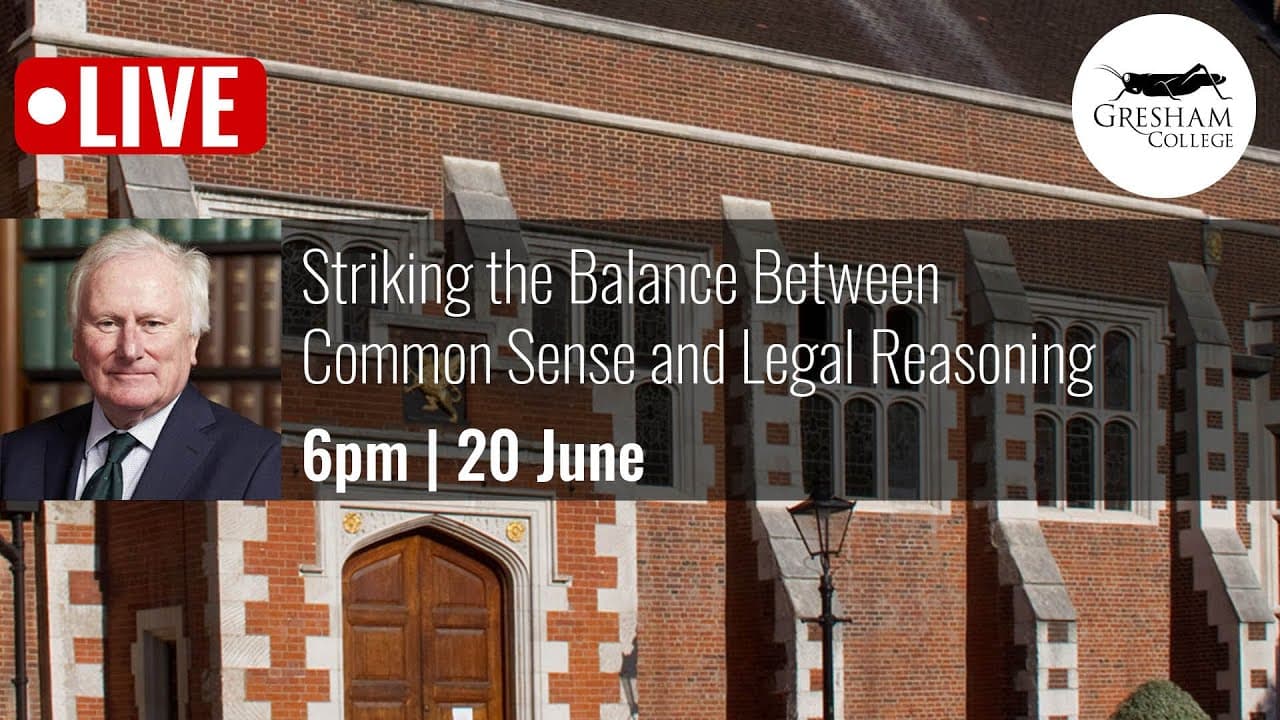
The Gray's Inn Reading
TL;DR
The application of common sense in legal reasoning can enhance the enrichment of legal outcomes, as demonstrated in a recent defamation case.
Transcript
between common-sense and legal reasoning for that title implies does it not implies at least that there is a divergence between legal reasoning and the application of common sense to perennial legal problems as a judge one likes to believe or perhaps to delude oneself that if common sense doesn't infuse legal reasoning it at least provides a backdr... Read More
Key Insights
- ❓ Common sense can enhance legal reasoning and provide a backdrop for judicial decisions.
- 🧑⚖️ The single meaning rule in defamation cases requires judges to determine the meaning that an ordinary reasonable reader would understand.
- 😒 The use of dictionary definitions in defamation cases may be limited and should only be considered if they directly contribute to the understanding of an ordinary reader.
Install to Summarize YouTube Videos and Get Transcripts
Explore YouTube Video Summarizer or Get YouTube Transcript Extractor
Questions & Answers
Q: What role does common sense play in legal reasoning?
Common sense serves as a backdrop to judicial decisions, infusing legal reasoning and providing a framework to reach just outcomes.
Q: How does the single meaning rule apply in defamation cases?
In defamation cases, judges must determine the single meaning that an ordinary reasonable reader would understand from alleged defamatory statements, ignoring any other possible meanings.
Q: Why is the use of dictionary definitions in defamation cases questionable?
The casual nature of platforms like Facebook requires a more impressionistic interpretation of statements, and consulting a dictionary may not accurately reflect how ordinary reasonable readers understand the meaning of the words.
Q: How should judges approach defamation cases involving social media posts?
Judges must place themselves in the position of the normal Facebook reader and consider how a typical ordinary reasonable reader would interpret the message, taking into account the fast-moving and impressionistic nature of social media.
Summary & Key Takeaways
-
Common sense provides a backdrop to judicial decisions, infusing legal reasoning and influencing outcomes.
-
The task of the judge is to determine the single meaning that an ordinary reasonable reader would understand from alleged defamatory statements.
-
The use of dictionary definitions in defamation cases may not be entirely appropriate, as the casual nature of platforms like Facebook requires a more impressionistic interpretation of statements.
-
Judges should consider relevant facts and combine them with legal principles to ensure a fair and just outcome.
Read in Other Languages (beta)
Share This Summary 📚
Summarize YouTube Videos and Get Video Transcripts with 1-Click
Try YouTube Summary with ChatGPT & Claude or YouTube Transcript Generator
Explore More Summaries from Gresham College 📚


Summarize YouTube Videos and Get Video Transcripts with 1-Click
Try YouTube Summary with ChatGPT & Claude or YouTube Transcript Generator