Meet CERN's New Particle: A Double-Charm Baryon!
TL;DR
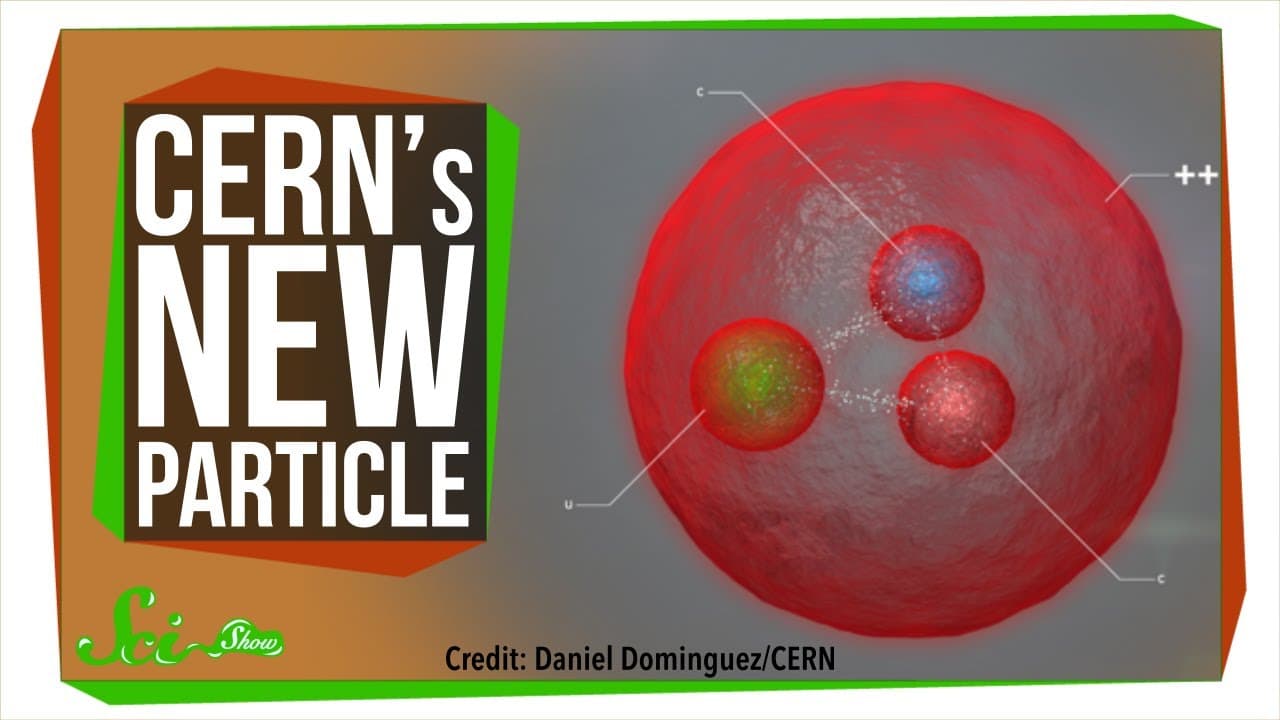
Physicists at CERN have discovered a new particle called Xicc++ made of two charm quarks and one up quark. Meanwhile, a study suggests that rangeomorphs, primitive multicellular organisms from 571 million years ago, grew bigger due to changing ocean chemistry.
Transcript
This episode of SciShow is brought to you by Anker SoundCore Portable Speaker Series. [INTRO ♪] We’re covering the gamut of scale on SciShow News this week, from fundamental particles to the time when life started getting bored of being microscopic and grew much bigger. We’ll start with the particles, because physicists just found a new one. Most o... Read More
Key Insights
- 👶 Physicists at CERN have discovered a new particle called Xicc++ made of two charm quarks and one up quark, providing new insights into the fundamental forces of the universe.
- 👻 The Xicc++ particle's discovery allows for a better understanding of the strong force and the behavior of heavier quarks.
- 🌊 Rangeomorphs, ancient multicellular organisms, grew bigger due to changing ocean chemistry and the availability of nutrients in higher-up water.
- 💱 The growth flexibility of rangeomorphs, known as ecophenotypic plasticity, helped them adapt to changing environmental conditions.
- 🫒 The study suggests that rangeomorphs' growth patterns influenced the growth of other organisms living alongside them.
- 💁 The discovery of the Xicc++ particle and the study of rangeomorphs contribute to our understanding of particle physics and the evolution of ancient life forms.
- 👨🔬 More research is needed to further explore the properties and behavior of the Xicc++ particle and the growth patterns of rangeomorphs.
Install to Summarize YouTube Videos and Get Transcripts
Explore YouTube Video Summarizer or Get YouTube Transcript Extractor
Questions & Answers
Q: What is the name of the newly discovered particle, and what is it made of?
The newly discovered particle is called Xicc++, and it is made of two charm quarks and one up quark.
Q: How does the discovery of the Xicc++ particle contribute to our understanding of particle physics?
The Xicc++ particle allows physicists to study the strong force, which holds quarks together, and provides insights into the behavior of heavier quarks in the subatomic universe.
Q: What were rangeomorphs, and why did they grow bigger?
Rangeomorphs were primitive multicellular organisms that lived 571 million years ago. They grew bigger due to changing ocean chemistry and the availability of nutrients in higher-up water, allowing them to maximize nutrient absorption.
Q: How did scientists study rangeomorphs and their growth patterns?
Scientists studied rangeomorph fossils and used computer models to simulate their growth with different nutrient levels. The simulations showed that the availability of nutrients influenced the size and shape of rangeomorphs.
Summary & Key Takeaways
-
Physicists at CERN have discovered a new particle called Xicc++ made of two charm quarks and one up quark, providing a new tool to study the fundamental forces that bind the universe together.
-
Rangeomorphs, ancient multicellular organisms dating back 571 million years, may have grown bigger due to changing ocean chemistry and the availability of nutrients in higher-up water, as suggested by a recent study.
Read in Other Languages (beta)
Share This Summary 📚
Summarize YouTube Videos and Get Video Transcripts with 1-Click
Try YouTube Summary with ChatGPT & Claude or YouTube Transcript Generator
Explore More Summaries from SciShow 📚

Summarize YouTube Videos and Get Video Transcripts with 1-Click
Try YouTube Summary with ChatGPT & Claude or YouTube Transcript Generator