Beyond the well-mixed room: Respiratory puffs and jets
TL;DR
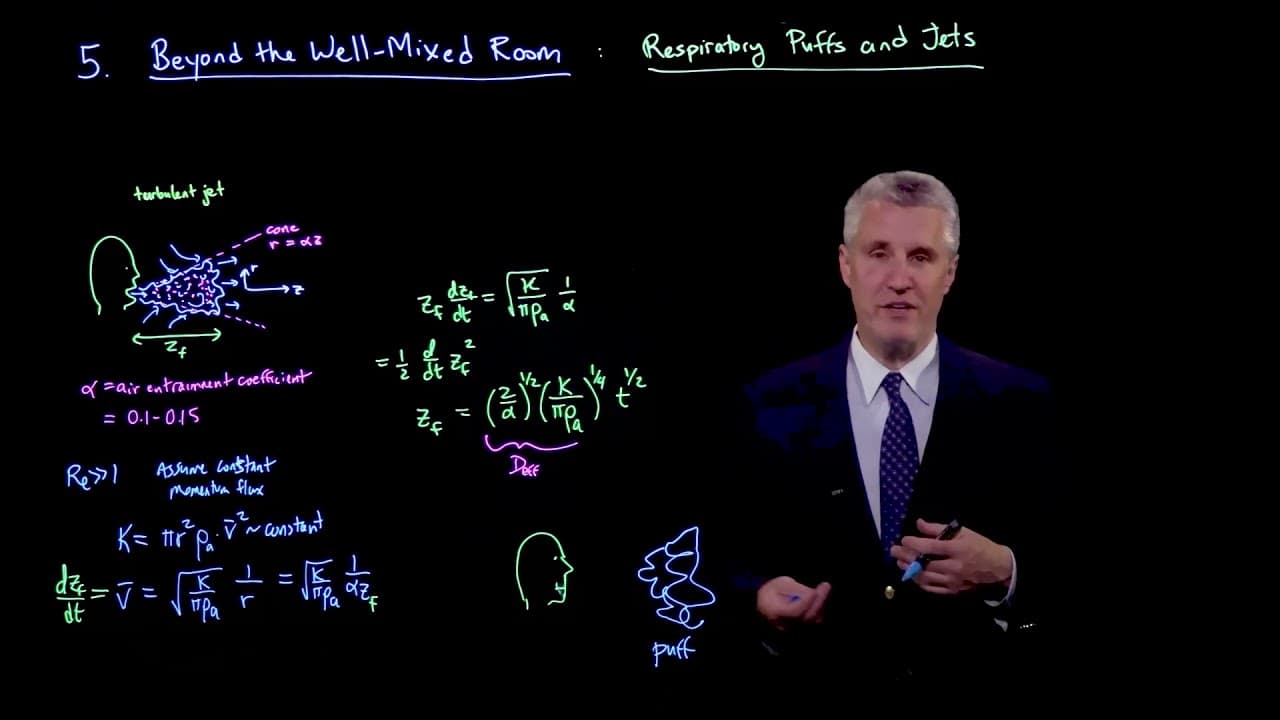
Exhaled respiratory particles form turbulent jets that initially progress like a square root of time but eventually slow down, and speaking or continuous exhalation can create a puff train resembling a continuous cone.
Transcript
PROFESSOR: So while I've argued that there are many ways in which a room can become well mixed, hopefully well enough to apply our well mixed criterion for airborne transmission through long range aerosols, there is one very important way in which the transmission problem is never well mixed. And that is taking into account the source of the partic... Read More
Key Insights
- 🥺 Exhaled respiratory particles create high concentrations near the source, leading to a non-uniform distribution in a room.
- 👱 The shape of the exhaled jet is influenced by the entrainment of ambient air, resulting in a cone-like structure.
- 🐢 The velocity of the jet decreases with distance, causing the jet to slow down as it spreads.
Install to Summarize YouTube Videos and Get Transcripts
Explore YouTube Video Summarizer or Get YouTube Transcript Extractor
Questions & Answers
Q: How do exhaled respiratory particles disperse throughout a room?
Exhaled respiratory particles form turbulent jets that mix with the background air in a room, dispersing the particles and spreading them across the space.
Q: What shape does the jet of exhaled respiratory particles take?
The jet of exhaled respiratory particles takes the form of a cone, where the cone angle represents the air entrainment coefficient and the radius of the jet decreases with distance from the mouth.
Q: How does the velocity of the jet change with distance from the mouth?
The velocity of the jet decreases with distance from the mouth, following a decay of 1 over the distance. This causes the jet to slow down as it spreads out.
Q: What happens when a person is continuously speaking or breathing?
Continuous speaking or breathing creates a puff train, where each breath forms a new puff that progresses for a certain distance before slowing down. The puff train resembles a continuous cone and follows a similar scaling to the initial jet.
Summary & Key Takeaways
-
Exhaled respiratory particles create turbulent jets that disperse throughout a room, but the concentration is highest near the source of exhalation.
-
The shape of the jet resembles a cone due to the entrainment of ambient air, and the cone angle represents the air entrainment coefficient.
-
The velocity of the jet decays with distance from the mouth, and the rate of progress of the front of the jet follows a square root of time initially.
-
Speaking or continuous exhalation leads to the formation of a puff train, where each breath creates a new puff that disperses and slows down over time.
Read in Other Languages (beta)
Share This Summary 📚
Summarize YouTube Videos and Get Video Transcripts with 1-Click
Try YouTube Summary with ChatGPT & Claude or YouTube Transcript Generator
Explore More Summaries from MIT OpenCourseWare 📚


Summarize YouTube Videos and Get Video Transcripts with 1-Click
Try YouTube Summary with ChatGPT & Claude or YouTube Transcript Generator