probability card problems | Aptitude | Part-12 | Pratik Shrivastava
TL;DR
Overview of solving probability using playing cards focusing on various scenarios.
Transcript
hello friends welcome back our today's topic is probability and we know priority is one of the very important topic for any kind of exams let it be or Bank exams SSC ray Louie you PCC sat and placement exams in all the exams questions from probability you can expect two to three so our today's our topic of discussion is problems on carts when proba... Read More
Key Insights
- 🏆 Probability is a vital topic for various competitive exams including banking and placement tests, requiring familiarity with problem-solving techniques.
- 💳 A standard deck of cards consists of 52 cards, with 26 red (13 hearts, 13 diamonds) and 26 black (13 clubs, 13 spades), influencing the probability calculations.
- 🎴 Removing specific cards from a deck alters not just the total count but also the composition of available cards, requiring recalculations for various outcomes.
- 🪡 The computed probability changes depending on the count of favorable outcomes compared to total remaining outcomes, showcasing the need for precision in probability studies.
- 🎴 Probabilities like drawing hearts, queens, or clubs hinge on specific combinations available after certain removals, illustrating the dynamic nature of probability with playing cards.
- 🧑🎓 Understanding the process of calculating probabilities equips students with essential skills applicable in real-world scenarios and decision-making situations.
- 🦻 The content emphasizes clarity in instructional approaches, aiding learners in grasping complex probability concepts through practical examples.
Install to Summarize YouTube Videos and Get Transcripts
Explore YouTube Video Summarizer or Get YouTube Transcript Extractor
Questions & Answers
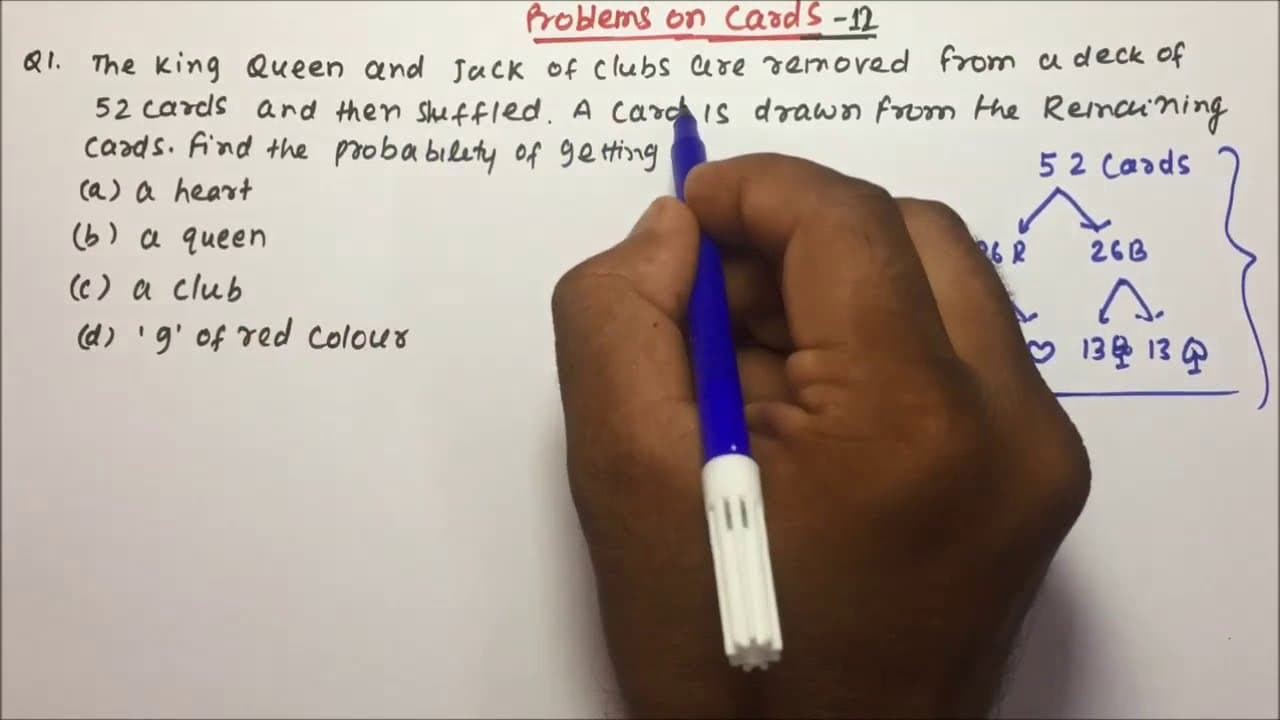
Q: What is the total number of cards remaining after removing the King, Queen, and Jack of Clubs?
Initially, there are 52 cards in a deck, but after removing the King, Queen, and Jack of Clubs, the total count reduces to 49. This is calculated by subtracting 3 from the original 52 cards, thus leaving 49.
Q: How many hearts are available in the remaining deck?
In the remaining deck of 49 cards, all 13 hearts are still present since no heart cards were removed during the card discard. Therefore, when calculating the probability of drawing a heart, it is based on the 13 available hearts out of 49 total cards.
Q: How do you calculate the probability of drawing a queen from the modified deck?
The probability of drawing a queen is determined by the number of favorable outcomes over total outcomes. After removal of cards, there are 46 total cards remaining. Since the King, Queen, and Jack of Clubs were removed, there's one queen still available in diamonds, one in hearts, and one in spades, leading to a probability of 3/49.
Q: What is the probability of drawing a club from the remaining cards?
After removing the King, Queen, and Jack of Clubs, there are 10 remaining clubs in the deck. Therefore, given the total of 49 cards left, the probability of drawing a club is calculated as 10/49.
Q: How many red cards are in the deck after the modifications?
The original deck contains 26 red cards (13 hearts and 13 diamonds). As none of these were removed, all 26 red cards still remain despite the removal of the three black cards (which include clubs).
Q: Can you explain the formula for calculating probability as mentioned in the video?
The formula for probability used in the video is P(E) = n(E) / n(S). Here, n(E) represents the number of favorable outcomes, while n(S) represents the total number of possible outcomes. This formula is fundamental for determining the likelihood of drawing a specific card.
Q: Why is understanding probability important for exams?
Probability forms a crucial component in various competitive exams, as questions related to it frequently appear in standardized tests. Mastery of probability concepts can help students perform better in exams like bank or SSC, where such topics are commonly featured.
Summary & Key Takeaways
-
The video discusses the fundamentals of probability, particularly in the context of playing cards, highlighting its relevance for various exams including bank and placement tests.
-
It provides a clear breakdown of a standard deck composition, explaining the implications of removing certain cards on the total count and probability outcomes.
-
Through direct calculation examples involving specific card draws, the video illustrates how to determine probabilities for drawing hearts, queens, and clubs post-removal of specific cards.
Read in Other Languages (beta)
Share This Summary 📚
Summarize YouTube Videos and Get Video Transcripts with 1-Click
Try YouTube Summary with ChatGPT & Claude or YouTube Transcript Generator