Lorenz Attractor and Chaos
TL;DR
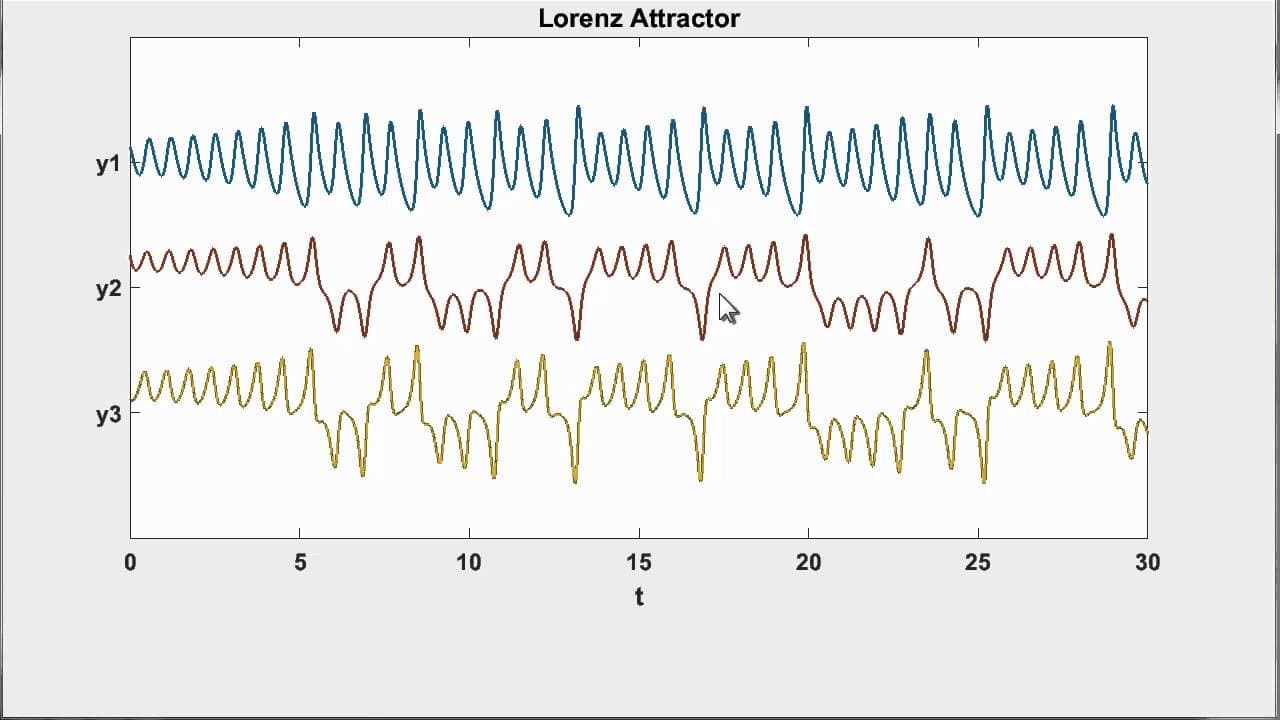
The Lorenz strange attractor, discovered by Edward Lorenz in 1963, is a famous example of chaotic systems that are sensitive to initial conditions.
Transcript
CLEVE MOLER: The Lorenz strange attractor, perhaps the world's most famous and extensively studied ordinary differential equations. They were discovered in 1963 by an MIT mathematician and meteorologist, Edward Lorenz. They started the field of chaos. They're famous because they are sensitive to their initial conditions. Small changes in the initia... Read More
Key Insights
- 🏑 The Lorenz strange attractor is a famous example of chaos in the field of mathematics.
- 💐 The equations originate from modeling fluid flow in the Earth's atmosphere.
- 🍉 The sensitivity to initial conditions makes long-term predictions challenging.
- 😥 By representing the equations in matrix form, critical points can be analyzed.
- 🦋 The Lorenz attractor is associated with the butterfly effect and unpredictable behavior.
- ❓ Different values of the parameter rho can result in periodic solutions or chaotic behavior.
- 💄 The chaotic nature of the Lorenz equations makes them an interesting subject of study.
Install to Summarize YouTube Videos and Get Transcripts
Explore YouTube Video Summarizer or Get YouTube Transcript Extractor
Questions & Answers
Q: What is the Lorenz strange attractor?
The Lorenz strange attractor is a set of ordinary differential equations that exhibit chaotic behavior. It was discovered by Edward Lorenz in 1963 and is known for its sensitivity to initial conditions.
Q: What are the quadratic terms in the Lorenz equations?
The Lorenz equations contain two quadratic terms, which contribute to the chaotic nature of the system. These terms introduce nonlinearities that cause small changes in initial conditions to result in significant differences in the solution.
Q: How does the Lorenz attractor relate to the butterfly effect?
The Lorenz attractor is closely associated with the butterfly effect, which suggests that small changes in initial conditions can have large effects on the long-term behavior of a system. This concept was popularized by Lorenz, who used the example of a butterfly flapping its wings in Brazil potentially leading to a tornado in Texas.
Q: What are the different values of rho used in studying the Lorenz attractor?
The most commonly studied value of rho in the Lorenz attractor is 28, which results in chaotic behavior. However, other values of rho can lead to periodic solutions with different characteristics. The choice of rho significantly affects the behavior of the system.
Summary & Key Takeaways
-
The Lorenz strange attractor is a set of ordinary differential equations that started the field of chaos and is known for being sensitive to initial conditions.
-
The equations model fluid flow in the Earth's atmosphere, although the parameters used are not representative of the actual atmosphere.
-
By representing the equations in matrix form, critical points can be identified and studied.
Read in Other Languages (beta)
Share This Summary 📚
Summarize YouTube Videos and Get Video Transcripts with 1-Click
Try YouTube Summary with ChatGPT & Claude or YouTube Transcript Generator
Explore More Summaries from MIT OpenCourseWare 📚



Summarize YouTube Videos and Get Video Transcripts with 1-Click
Try YouTube Summary with ChatGPT & Claude or YouTube Transcript Generator