Exploring How Computers Work
TL;DR
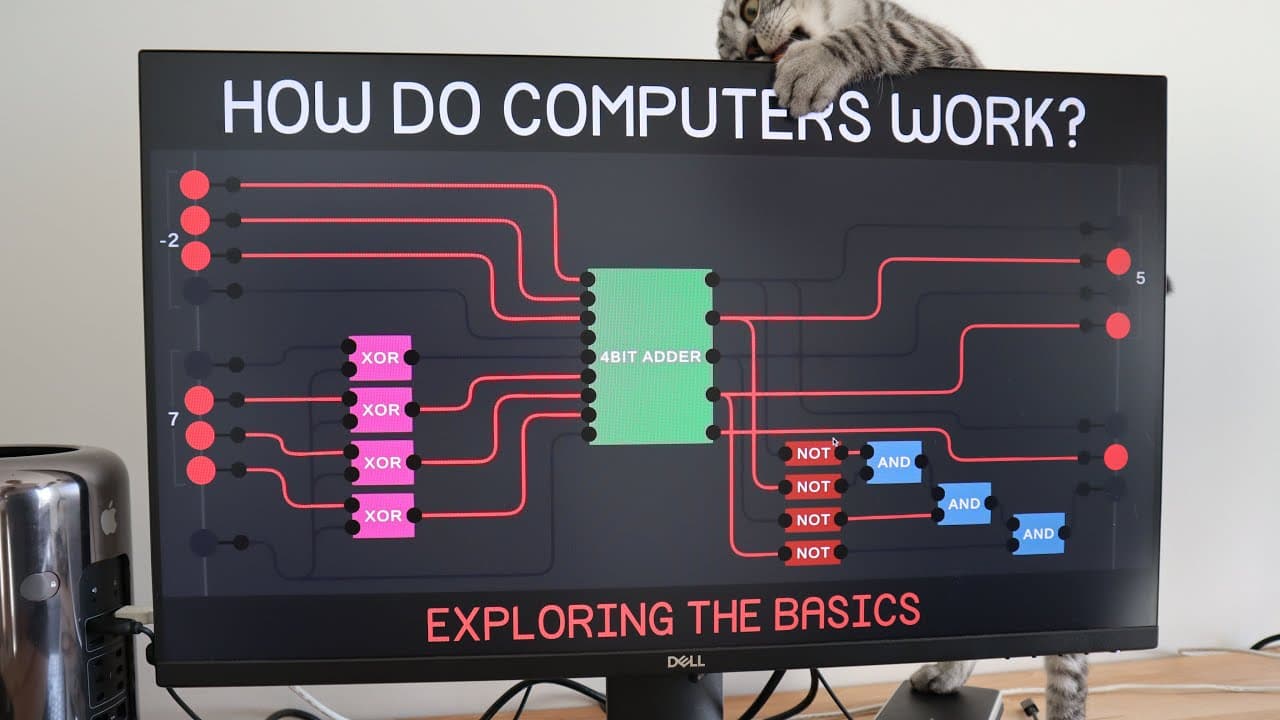
This content explains the basics of computer logic, including logic gates, transistors, and binary numbers, and demonstrates how to build an Arithmetic and Logic Unit (ALU) step by step on a breadboard.
Transcript
Hi everyone, I spend a lot of time mashing away at a keyboard, trying to tell the computer what I would like it to do. Even my oddly shaped computer (that constantly gets teased for looking like a trash can) is unbelievably good at following instructions. Unfortunately I’m not so good at giving them, so the results are inevitably a little... Read More
Key Insights
- ⚾ Computer logic is based on the concept of logic gates, which can perform logical operations and calculations.
- 🧑🏭 Logic gates can be constructed using transistors, which act as electronic switches to control the flow of current.
- ⚡ Binary numbers are used in computers because they can be easily represented using low and high voltage levels, simplifying electronic circuits.
- 🏛️ The combination of logic gates can be used to build complex circuits such as an ALU, which performs arithmetic and logic operations in a computer.
Install to Summarize YouTube Videos and Get Transcripts
Explore YouTube Video Summarizer or Get YouTube Transcript Extractor
Questions & Answers
Q: What is a logic gate and how does it work?
A logic gate is a fundamental building block of computer logic. It can take one or more inputs and produce an output based on predefined logic rules. For example, an AND gate outputs 1 only if all of its inputs are 1. This is achieved by combining transistors to create a circuit that allows or blocks the flow of current based on the input combinations.
Q: How are logic gates used to build an ALU?
An ALU (Arithmetic and Logic Unit) performs mathematical calculations and logical operations in a computer. It is built using combinations of logic gates like AND, OR, XOR, and NOT. By connecting these gates in specific configurations, an ALU can perform operations such as addition, subtraction, and logic operations on binary numbers.
Q: What is the purpose of using binary numbers in computers?
Binary numbers are used in computers because they can be easily represented using low and high voltage levels, which simplifies electronic circuits. Binary numbers work similar to decimal numbers, but instead of having 10 digits (0-9), binary has only 2 digits (0 and 1). Each digit's place value in binary is a power of 2, allowing computers to represent and process numbers efficiently.
Q: How can negative numbers be represented in binary?
Negative numbers in binary are represented using a system called two's complement. To represent a negative number, the bits of the positive number are inverted (flipped), and 1 is added to the result. For example, to represent -7 in 4-bit binary, start with the positive representation of 7 (0111), invert the bits (1000), and add 1 to get -7 (1001). This allows computers to perform addition and subtraction operations on both positive and negative numbers efficiently.
Key Insights:
- Computer logic is based on the concept of logic gates, which can perform logical operations and calculations.
- Logic gates can be constructed using transistors, which act as electronic switches to control the flow of current.
- Binary numbers are used in computers because they can be easily represented using low and high voltage levels, simplifying electronic circuits.
- The combination of logic gates can be used to build complex circuits such as an ALU, which performs arithmetic and logic operations in a computer.
- Two's complement representation is used to represent negative numbers in binary, allowing for efficient addition and subtraction operations on both positive and negative numbers.
Summary & Key Takeaways
-
The content introduces the concept of computer logic and explores how inanimate objects like computers can perform calculations and logic operations.
-
It explains the function of logic gates such as AND, NOT, NAND, and XOR, and how they can be constructed using transistors.
-
The content then demonstrates the step-by-step process of building a 4-bit adder, which adds and subtracts binary numbers, and packages it as an ALU for further use.
Read in Other Languages (beta)
Share This Summary 📚
Summarize YouTube Videos and Get Video Transcripts with 1-Click
Try YouTube Summary with ChatGPT & Claude or YouTube Transcript Generator
Explore More Summaries from Sebastian Lague 📚
Summarize YouTube Videos and Get Video Transcripts with 1-Click
Try YouTube Summary with ChatGPT & Claude or YouTube Transcript Generator