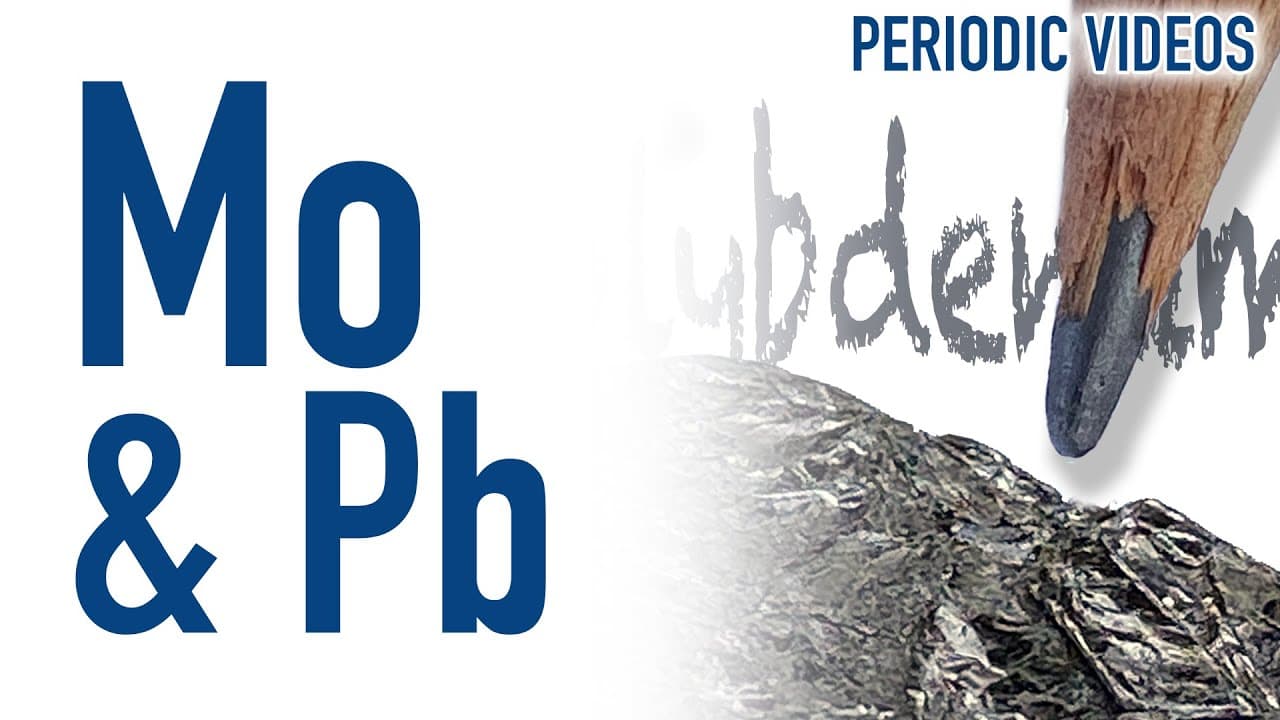
Why Molybdenum is named after Lead - Periodic Table of Videos
TL;DR
The naming of molybdenum is linked to the Greek word for lead due to historical connections and similar properties.
Transcript
when i was about 12 years old i was made to learn ancient greek at school so i can read the greek letters that i've forgotten most of the words and anyway modern greek is completely different from ancient greek but looking at this periodic table i was surprised to find that the word for lead which i would pronounce molybdos is almost the same as th... Read More
Key Insights
- 🥺 Historical connections led to the naming of molybdenum after the Greek word for lead.
- 📛 Graphite’s ability to write and conduct electricity influenced the choice of naming molybdenum.
- ❓ Molybdenum disulphide and graphite share structural similarities and are used as lubricants.
- 🖐️ The mineral molybdenite played a crucial role in naming molybdenum as an element.
- 📛 Naming conventions in the late 18th century favored classical Greek names for elements and minerals.
- 📛 The choice of names in chemistry reflects historical context and material properties.
- 🥺 Both molybdenum and lead have applications in writing and lubrication, albeit in different forms.
Install to Summarize YouTube Videos and Get Transcripts
Explore YouTube Video Summarizer or Get YouTube Transcript Extractor
Questions & Answers
Q: Why did the speaker find the similarity between the Greek words for lead and molybdenum intriguing?
The speaker was surprised by the resemblance between the Greek terms for lead and molybdenum due to their historical connections and shared usage in naming elements.
Q: What association between graphite and lead led to the naming of molybdenum?
Graphite’s ability to write and conduct electricity, similar to lead, influenced the choice to name molybdenum after molybdenite, which resembles graphite.
Q: How did the discovery of molybdenite lead to the naming of the mineral and subsequently the metal?
The mineral molybdenite, which resembled lead and graphite in terms of writing properties, was named after lead in Greek, leading to the element’s name molybdenum.
Q: What properties do molybdenum disulphide and graphite share, and how are they used as lubricants?
Both molybdenum disulphide and graphite have layered structures and serve as lubricants in various applications such as car engines and locks, respectively.
Summary & Key Takeaways
-
Ancient Greek and modern Greek differ, but the similarities between the word for lead and molybdenum intrigued the speaker.
-
The origins of the name molybdenum stem from graphite’s ability to write, leading to its association with lead.
-
Molybdenum and graphite share properties and are used as lubricants in different applications.
Read in Other Languages (beta)
Share This Summary 📚
Summarize YouTube Videos and Get Video Transcripts with 1-Click
Try YouTube Summary with ChatGPT & Claude or YouTube Transcript Generator
Explore More Summaries from Periodic Videos 📚





Summarize YouTube Videos and Get Video Transcripts with 1-Click
Try YouTube Summary with ChatGPT & Claude or YouTube Transcript Generator