The Invisible Barrier Keeping Two Worlds Apart
TL;DR
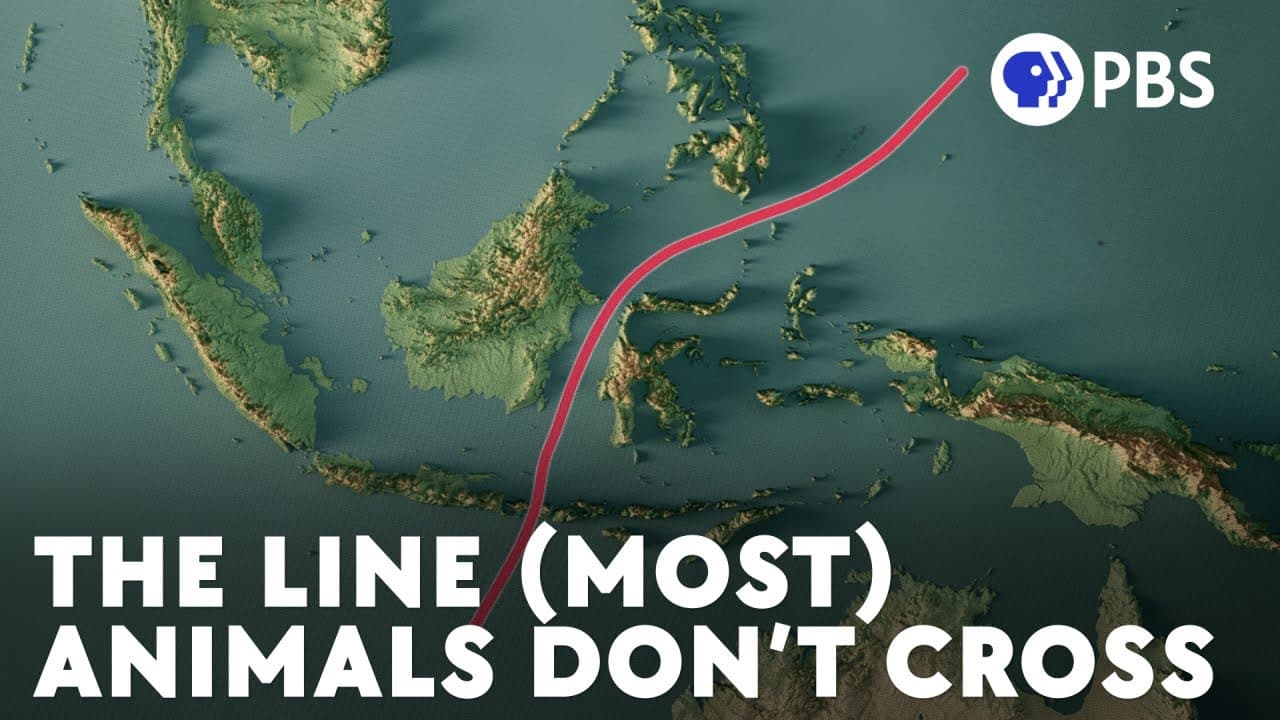
The Wallace Line, an invisible biogeographic boundary in Indonesia, separates distinct ecosystems due to plate tectonics and the history of landmass connections.
Transcript
In between two of the islands of Indonesia, there’s an ancient line that is both real, and not real. You can’t see it, but it’s there all the same. If you stood on the coast of Bali and looked east to the shores of Lombok, you’d be staring right at the line’s narrowest point: a 32 km stretch of water that seems pretty unassuming. This inv... Read More
Key Insights
- 🇮🇩 The Wallace Line separates distinct ecosystems in the Malay Archipelago of Indonesia.
- 🫥 The line was first identified by Alfred Russel Wallace during his travels.
- 💁 Plate tectonics and the separation of former land masses are responsible for the formation of the Wallace Line.
- 🫥 The line reflects the history of land connections and the movement of species over millions of years.
- 😵 The differences in species distribution across the Wallace Line are still evident due to the deep waters and strong currents that prevent species from crossing.
- 🫥 The line demonstrates how geological events can shape ecological diversity and distribution.
- 🍽️ Plate tectonics is a relatively recent concept that explains the movements of Earth's continents.
Install to Summarize YouTube Videos and Get Transcripts
Explore YouTube Video Summarizer or Get YouTube Transcript Extractor
Questions & Answers
Q: What is the Wallace Line and where is it located?
The Wallace Line is an invisible boundary that separates different ecosystems in the Malay Archipelago of Indonesia. It is located between Bali and Lombok.
Q: How did the Wallace Line come to be?
The Wallace Line was formed by plate tectonics and the separation of land masses. Former land masses, known as the paleocontinents of Sunda and Sahul, existed on either side of the line.
Q: What species can be found on each side of the Wallace Line?
On the western side, characteristic Asian species like rhinos and tigers can be found. On the eastern side, species like marsupials and Komodo dragons are prevalent.
Q: How does plate tectonics shape the distribution of species?
Plate tectonics affects the distribution of species by creating barriers and limiting the movement of organisms between land masses. This results in distinct ecosystems on either side of the Wallace Line.
Key Insights:
- The Wallace Line separates distinct ecosystems in the Malay Archipelago of Indonesia.
- The line was first identified by Alfred Russel Wallace during his travels.
- Plate tectonics and the separation of former land masses are responsible for the formation of the Wallace Line.
- The line reflects the history of land connections and the movement of species over millions of years.
- The differences in species distribution across the Wallace Line are still evident due to the deep waters and strong currents that prevent species from crossing.
- The line demonstrates how geological events can shape ecological diversity and distribution.
- Plate tectonics is a relatively recent concept that explains the movements of Earth's continents.
- Alfred Russel Wallace is recognized as a pioneer in biogeography and understanding species distribution.
Summary & Key Takeaways
-
The Wallace Line is an invisible barrier that separates different ecosystems in the Malay Archipelago of Indonesia.
-
The line was first identified by Alfred Russel Wallace, a British naturalist, during his travels in the 19th century.
-
The line is a result of plate tectonics and the separation of former land masses, creating distinct ecological regions.
Read in Other Languages (beta)
Share This Summary 📚
Summarize YouTube Videos and Get Video Transcripts with 1-Click
Try YouTube Summary with ChatGPT & Claude or YouTube Transcript Generator
Explore More Summaries from PBS Eons 📚
Summarize YouTube Videos and Get Video Transcripts with 1-Click
Try YouTube Summary with ChatGPT & Claude or YouTube Transcript Generator