Ep. 1: Introduction and Overview (RES.8-007 Cosmic Origin of the Chemical Elements)
TL;DR
Scientists explore the cosmic origin of chemical elements through nuclear physics, astrophysics, and the study of old stars.
Transcript
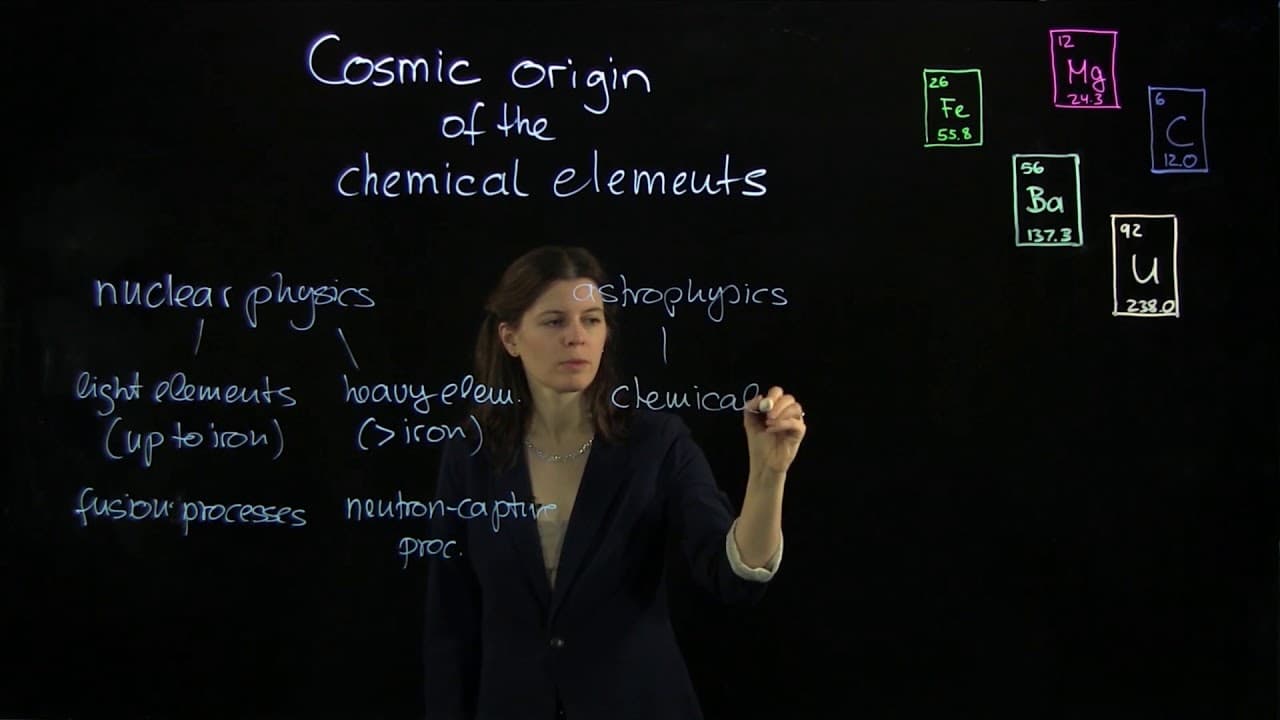
Have you ever wondered how all the chemical elements are made? Then join me as we are lifting all the star dust secrets to understand the cosmic origin of the chemical elements. We want to talk about the cosmic origin of the chemical elements today. In order to understand where the elements come from, we need to consider two different components. O... Read More
Key Insights
- 🚰 Nuclear physics and astrophysics combine to explain the origin of most elements in the periodic table.
- 💁 Observing chemical evolution helps scientists understand the processes behind element formation.
- 🤩 Old stars play a crucial role in studying the early universe and unraveling the secrets of element origins.
- 🤩 Spectroscopy is a scientific method used to study chemical evolution in old stars and observe their elemental compositions.
Install to Summarize YouTube Videos and Get Transcripts
Explore YouTube Video Summarizer or Get YouTube Transcript Extractor
Questions & Answers
Q: How are light elements formed in stars?
Light elements, up to iron, are formed through fusion processes in stars. This involves the combination of atomic nuclei to create heavier elements.
Q: How are heavy elements formed?
Heavy elements, heavier than iron, are formed through neutron capture processes. These processes involve the absorption of neutrons by atomic nuclei to create larger and heavier nuclei.
Q: What is chemical evolution?
Chemical evolution refers to the gradual buildup of heavy elements in the universe over cosmic time. By observing stars at different times, scientists can trace the signatures of nucleosynthesis processes and understand how nuclear physics operated.
Q: How do scientists study the early universe?
Scientists use old stars as tools for studying the early universe through a field called stellar archaeology. By analyzing these stars, researchers can gain insights into how elements were initially formed.
Summary & Key Takeaways
-
Chemical elements are formed through fusion processes in stars for lighter elements and neutron capture processes for heavier elements.
-
The study of chemical evolution in the universe helps trace the buildup of heavy elements over time.
-
Old stars provide valuable insights into the early universe and the processes behind element formation.
Read in Other Languages (beta)
Share This Summary 📚
Summarize YouTube Videos and Get Video Transcripts with 1-Click
Try YouTube Summary with ChatGPT & Claude or YouTube Transcript Generator
Explore More Summaries from MIT OpenCourseWare 📚



Summarize YouTube Videos and Get Video Transcripts with 1-Click
Try YouTube Summary with ChatGPT & Claude or YouTube Transcript Generator