What Is a Symbol Table in Compiler Design?
TL;DR
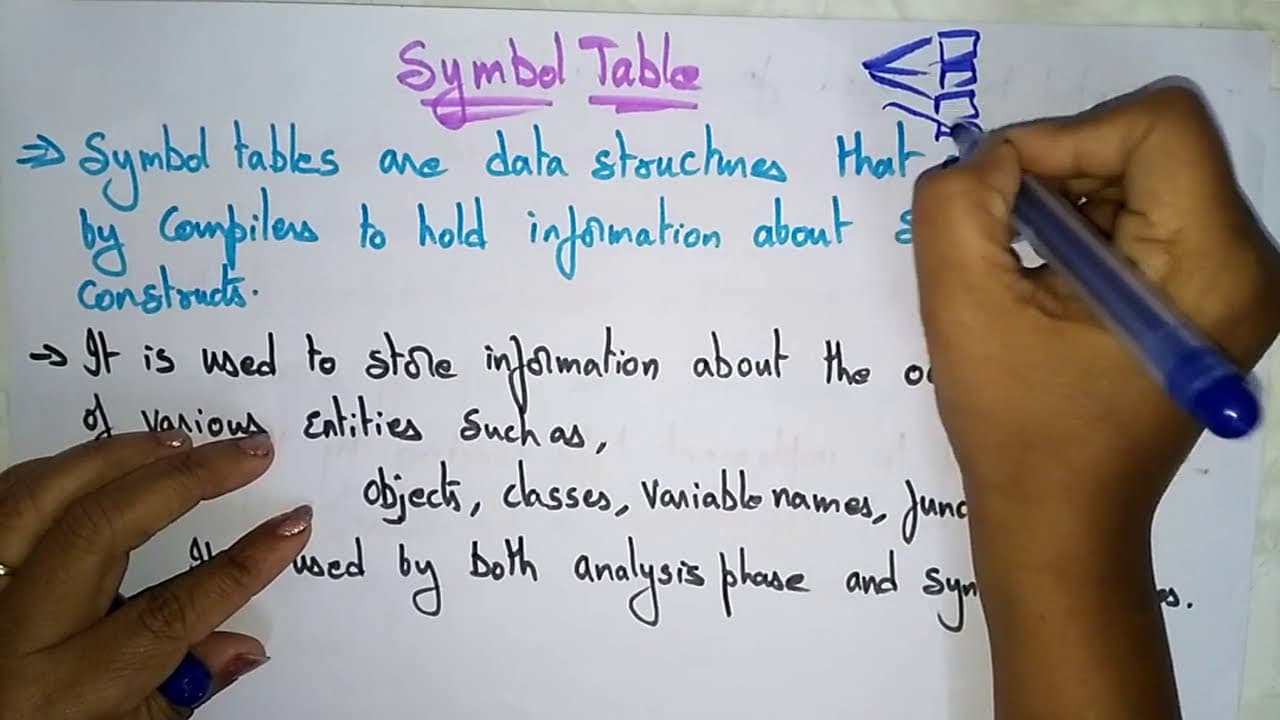
A symbol table is a crucial data structure in compiler design that stores information about program constructs, such as variables and functions, across different compilation phases. It facilitates type checking, scope resolution, and ensures that identifiers are declared appropriately, enhancing the reliability and correctness of the compiled code.
Transcript
hi students welcome back so coming to the next topic in the subject compiler designs was the symbol tables so the symbol table is one of the important concept in the compiler design so which is the acting as a mediator but supporting device not the mediator you can take the supporting device supporting module for all the phases so there are differe... Read More
Key Insights
- 🤬 Symbol tables are indispensable in compiler design, acting as central repositories for storing program-related information across various phases.
- 👨💻 They support error checks by validating variable declarations and ensuring identifiers are used according to their definitions, thus enhancing code reliability.
- 🤬 The management of scope—whether a variable is local or global—is another crucial function of symbol tables, assisting compilers in resolving references correctly.
- 😑 Type checking is facilitated through symbol tables, which store assignment operations and expressions, helping to confirm semantic correctness in the source code.
- 🚰 Symbol tables can be structured as either linear or hash tables, depending on the implementation needs for efficiency.
- ♿ The information format in symbol tables usually comprises the symbol name, type, and attributes, standardized for easier compiler access and entry management.
- 🤬 Analysis and synthesis phases of compilation both rely heavily on the data managed by the symbol table for various operations related to code verification and generation.
Install to Summarize YouTube Videos and Get Transcripts
Explore YouTube Video Summarizer or Get YouTube Transcript Extractor
Questions & Answers
Q: What is the primary function of a symbol table in compiler design?
A symbol table's primary function is to store information about the constructs in the source program. This includes details about variables, classes, functions, and their properties, enabling the compiler to effectively manage scope, verify declarations, and support type checking throughout its different phases.
Q: How does a symbol table facilitate error checking in compilers?
Symbol tables facilitate error checking by keeping track of declarations and definitions of identifiers within the source code. When the compiler encounters a new identifier, it checks the symbol table to ensure that the variable has been declared, thereby preventing multiple declarations and ensuring semantic correctness during type checking.
Q: What are the differences between the analysis phase and the synthesis phase in relation to the symbol table?
The analysis phase involves activities like lexical analysis and syntax checking where the symbol table helps in verifying that the identifiers used are declared. The synthesis phase includes generating intermediate or target code and performing optimization, where the symbol table assists in generating correct code representations while adhering to the properties defined during the analysis phase.
Q: What information does a symbol table typically store regarding a variable?
A symbol table typically stores the variable's name, its type, and its attributes in a structured format. For example, if a variable is declared as 'static int salary', the symbol table would store 'salary' as the name, 'int' as the type, and 'static' as an attribute, thus encapsulating all relevant information for further use during compilation.
Summary & Key Takeaways
-
Symbol tables serve as vital data structures in compiler design, supporting various phases such as lexical analysis, syntax checking, and code generation by storing crucial information about program elements.
-
They hold data about entities like variables, classes, functions, and their properties, ensuring effective type checking and scope resolution during compilation.
-
The format used in symbol tables allows for efficient entry storage of identifiers, types, and attributes, facilitating the compiler's operations during both the analysis and synthesis phases.
Read in Other Languages (beta)
Share This Summary 📚
Summarize YouTube Videos and Get Video Transcripts with 1-Click
Try YouTube Summary with ChatGPT & Claude or YouTube Transcript Generator