17.6 Velocity and Acceleration of the Center of Mass
TL;DR
The velocity and acceleration of the center of mass are important quantities for understanding the motion of a system of particles.
Transcript
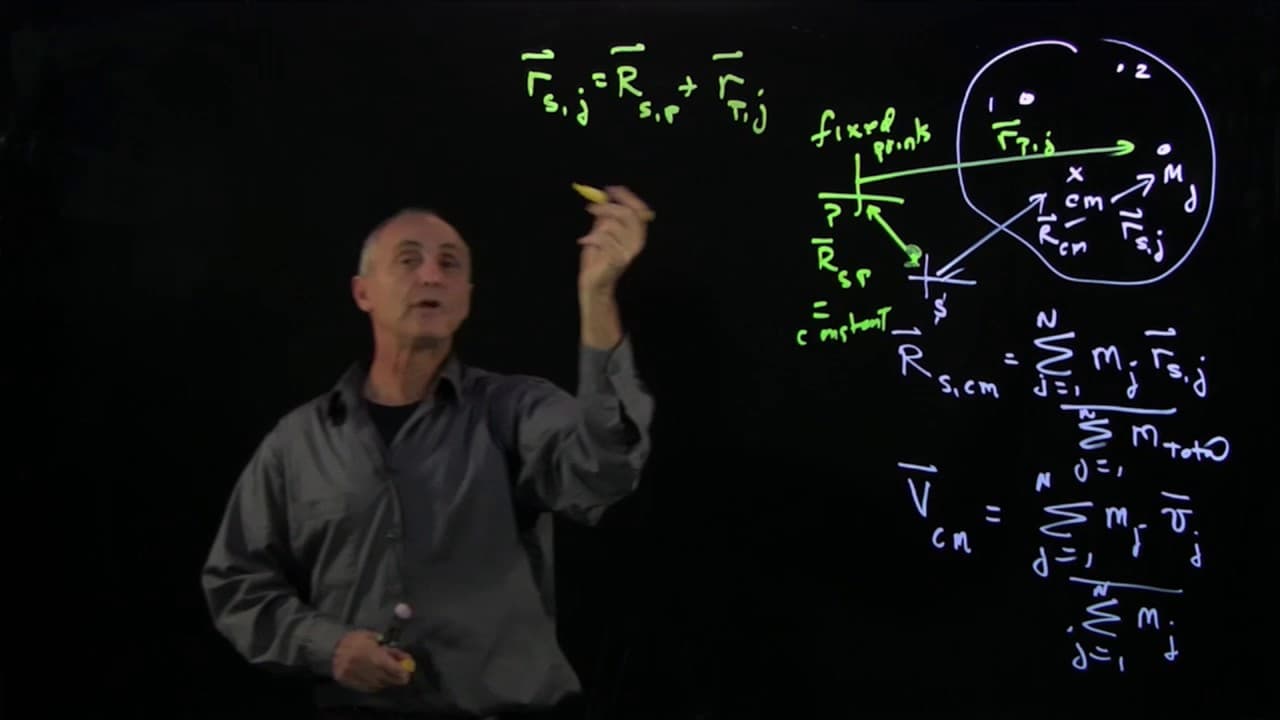
I'd now like to talk about the velocity of the center of mass for a system of particles. So let's take a system, which I'll just outline by this. And in that system, we have a bunch of particles, particle 1, particle 2-- let's refer to this as the j-th particle and some point xcm. And if I want to talk about the position of the center of mass, I ca... Read More
Key Insights
- 💆 The velocity of the center of mass is determined by summing the velocities of all particles in the system.
- 😥 The choice of reference point for calculating the velocity of the center of mass does not affect the result.
- 💆 The acceleration of the center of mass is calculated in a similar manner to the velocity, using the individual particle accelerations.
Install to Summarize YouTube Videos and Get Transcripts
Explore YouTube Video Summarizer or Get YouTube Transcript Extractor
Questions & Answers
Q: What is the velocity of the center of mass for a system of particles?
The velocity of the center of mass is determined by summing the velocities of all the particles in the system, weighted by their respective masses and divided by the total mass of the system. The choice of reference point does not affect the result.
Q: How is the velocity of the center of mass different from the velocity of individual particles?
Unlike the velocity of individual particles, the velocity of the center of mass represents the overall motion of the entire system. It is a single vector that describes the average motion of all the particles together.
Q: How does the choice of reference point affect the calculation of the velocity of the center of mass?
The choice of reference point does not affect the velocity of the center of mass. The result will be the same regardless of the fixed point chosen, as long as it is within the system.
Q: What is the significance of the acceleration of the center of mass for a system of particles?
The acceleration of the center of mass provides important information about the overall motion of the system. It is calculated in a similar manner to the velocity, by summing the individual particle accelerations divided by the total mass.
Summary & Key Takeaways
-
The velocity of the center of mass for a system of particles is the sum of the individual particle velocities divided by the total mass of the system.
-
The choice of reference point does not affect the velocity of the center of mass, as long as it is a fixed point in the system.
-
The acceleration of the center of mass is calculated in a similar way, by summing the individual particle accelerations divided by the total mass.
Read in Other Languages (beta)
Share This Summary 📚
Summarize YouTube Videos and Get Video Transcripts with 1-Click
Try YouTube Summary with ChatGPT & Claude or YouTube Transcript Generator
Explore More Summaries from MIT OpenCourseWare 📚


Summarize YouTube Videos and Get Video Transcripts with 1-Click
Try YouTube Summary with ChatGPT & Claude or YouTube Transcript Generator