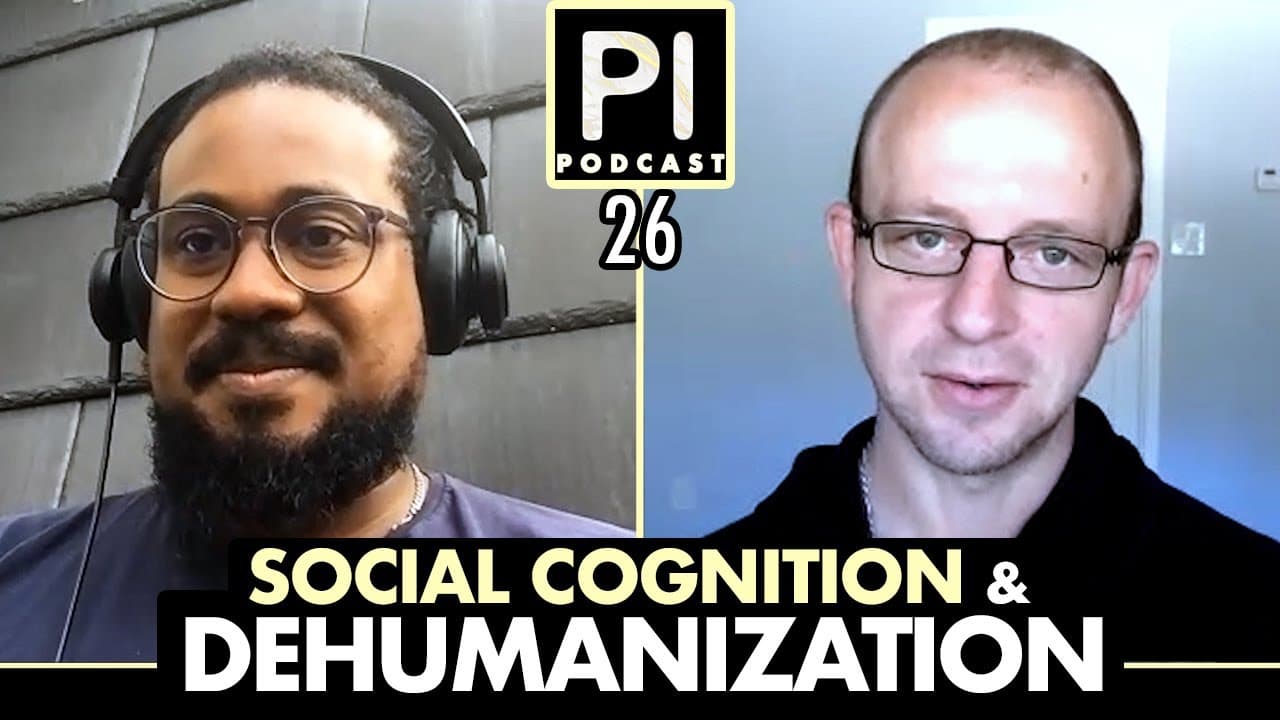
Lasana Harris | Social Cognition and Dehumanization | Psychology Is Podcast 26
TL;DR
The podcast discusses the concept of flexible social cognition and the role of stereotypes in shaping our perceptions of others.
Transcript
hello and thank you so much for tuning in to the psychology is podcast i'm nick fortino and i'm here today with dr lasana harris welcome asana how are you thanks for having me i'm doing well dr harris is a professor and researcher at university college london and has written a book that i found to be quite compelling called invisible mind flexible ... Read More
Key Insights
- 👻 Social cognition is the psychological skill that allows us to infer the thoughts and intentions of others during social interactions.
- ⚾ Flexible social cognition refers to the ability to engage or disengage social cognition based on context and goals, and to toggle between social cooperation and dehumanization.
- 👻 Dehumanization serves a justificatory purpose in situations of violence or conflict, allowing individuals to detach from the moral implications of their actions.
- 🎮 Dehumanization is not the sole cause of violence or atrocities, but it can help perpetuate and justify them.
- 💁 Stereotypes are overlearned associations that simplify our perceptions of others but are not more efficient or accurate than other forms of social cognition.
- ⌛ Stereotypes are influenced by historical and cultural narratives, and they can shift over time based on changing contexts.
- 🥺 The fundamental attribution error leads us to overlook the influence of the situational context and attribute behavior to innate traits, both in ourselves and others.
- 🤳 Individual differences in the propensity to dehumanize exist, and factors such as self-perception and awareness of biases can influence one's level of dehumanization. However, resisting dehumanization within certain social contexts remains challenging.
Install to Summarize YouTube Videos and Get Transcripts
Explore YouTube Video Summarizer or Get YouTube Transcript Extractor
Questions & Answers
Q: What is social cognition?
Social cognition refers to the psychological skills that enable us to understand and infer the thoughts and intentions of others during social interactions. It involves getting inside someone else's head and interpreting their behavior and verbal/non-verbal cues.
Q: How does flexible social cognition differ from social cognition?
Flexible social cognition refers to the ability to toggle on and off the process of social cognition. It allows us to engage in social cooperation or dehumanization based on the context and our goals. It also includes the ability to anthropomorphize objects or entities that aren't human.
Q: Are stereotypes inevitable and inherently dehumanizing?
Stereotypes are overlearned associations that our brains rely on as mental shortcuts. While they may be readily available, they are not more efficient or accurate than other forms of social cognition. Stereotyping limits our perception of others and excludes important information about individuals, making them dehumanizing to some extent.
Q: Can we become more accurate in our mind-reading abilities?
Accuracy in mind-reading depends on our goals and the context of the interaction. In some cases, accuracy may be important, such as when detecting someone's suffering or empathic responding. However, in many social interactions, accuracy is irrelevant, and what matters is the inferences and ideas we imagine about others, which guide our behavior.
Key Insights:
- Social cognition is the psychological skill that allows us to infer the thoughts and intentions of others during social interactions.
- Flexible social cognition refers to the ability to engage or disengage social cognition based on context and goals, and to toggle between social cooperation and dehumanization.
- Dehumanization serves a justificatory purpose in situations of violence or conflict, allowing individuals to detach from the moral implications of their actions.
- Dehumanization is not the sole cause of violence or atrocities, but it can help perpetuate and justify them.
- Stereotypes are overlearned associations that simplify our perceptions of others but are not more efficient or accurate than other forms of social cognition.
- Stereotypes are influenced by historical and cultural narratives, and they can shift over time based on changing contexts.
- The fundamental attribution error leads us to overlook the influence of the situational context and attribute behavior to innate traits, both in ourselves and others.
- Individual differences in the propensity to dehumanize exist, and factors such as self-perception and awareness of biases can influence one's level of dehumanization. However, resisting dehumanization within certain social contexts remains challenging.
- Changing social contexts and cultural narratives through policy interventions and education can be effective in minimizing dehumanization and stereotypes. Psychological research can provide insights into the mechanisms of dehumanization, but long-term solutions lie in broader societal change.
Summary & Key Takeaways
-
Dr. Lasana Harris discusses his book, "Invisible Mind: Flexible Social Cognition and Dehumanization," which explores the concept of flexible social cognition and its impact on human interactions.
-
Social cognition refers to the psychological skills that allow us to understand and infer the thoughts and intentions of others during social interactions.
-
Flexible social cognition refers to the ability to toggle on and off this process, and to engage in social cooperation or dehumanization based on context.
Read in Other Languages (beta)
Share This Summary 📚
Summarize YouTube Videos and Get Video Transcripts with 1-Click
Try YouTube Summary with ChatGPT & Claude or YouTube Transcript Generator