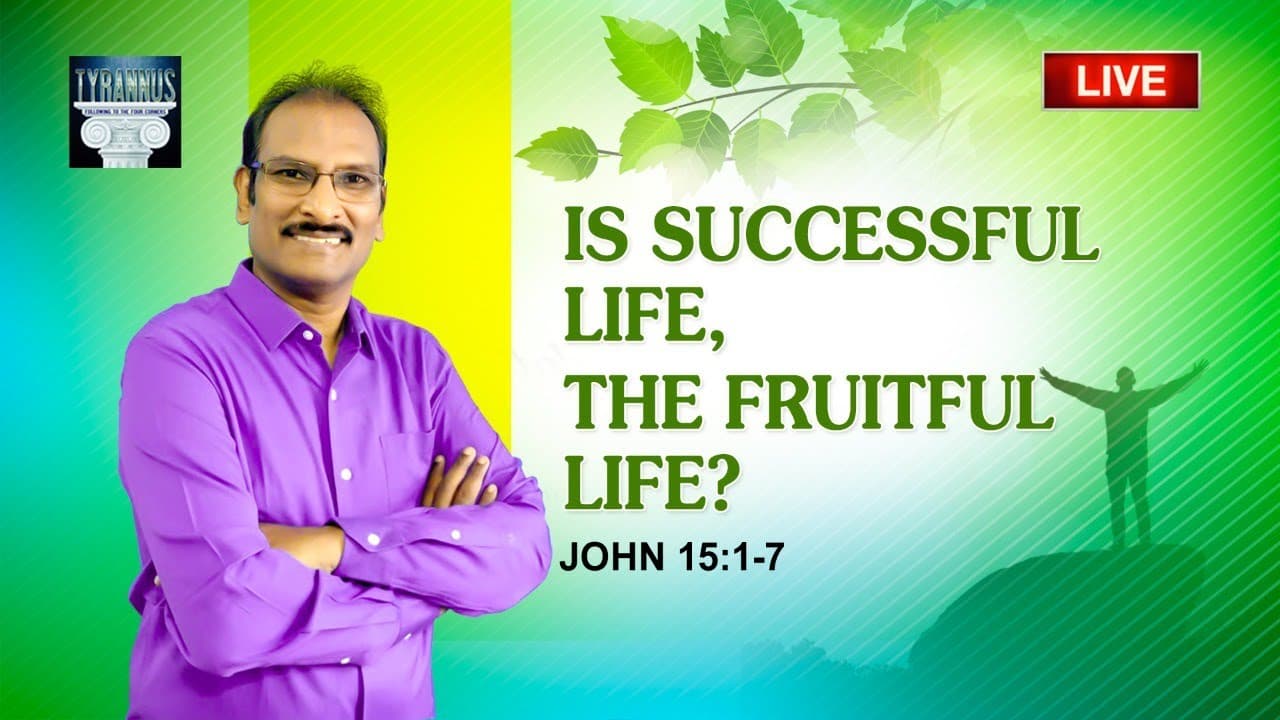
🔴 LIVE: Is Successful life, a fruitful life? || John 15:1-7 in English || Edward W Kuntam
TL;DR
Analyzing the challenges of understanding the Bible and the importance of fruitfulness in a Christian's life.
Transcript
thank you so much brother can you um hear me yes that's good we'll have a word of prayer and we'll go ahead father god we thank you so much for this privilege and opportunity you have given to us we may be far away from each other we may be in different continents separated by oceans but lord we are under your wings we are in your presence lord as ... Read More
Key Insights
- ❓ Understanding the Bible requires an awareness of its complex language, historical significance, and cultural context.
- 🍌 John 15 illustrates the essential relationship between Jesus and believers as one of dependence, where abiding is crucial for producing spiritual fruit.
- 🛟 Believers must recognize that pruning, although painful, is a necessary process for spiritual growth and fruitfulness in their lives.
- 😑 The expected 'fruit' of a Christian includes expressions of justice and righteousness, aligning daily living with God’s standards.
- 👻 Abiding in Christ involves engaging in consistent prayer, meditation on scripture, and allowing the Holy Spirit's guidance in all aspects of life.
- 🙈 Suffering can serve a divine purpose in the believer's journey, fostering growth and reliance on God, rather than merely being seen as negative experiences.
- 🛟 The impact of a believer's life extends beyond personal faith, influencing cultural contexts and serving as a testament to Christ’s transformative power in society.
Install to Summarize YouTube Videos and Get Transcripts
Explore YouTube Video Summarizer or Get YouTube Transcript Extractor
Questions & Answers
Q: Why is understanding the Bible considered difficult?
The Bible is challenging to comprehend primarily because it was written in ancient languages, during a significantly different historical context, and for audiences with diverse cultural backgrounds. This necessitates the use of dictionaries and cultural handbooks to find proper meanings and applications. Without contextual insight, the true message can be easily misinterpreted.
Q: What does John 15:1-8 teach about the relationship between Jesus and believers?
In John 15:1-8, Jesus describes Himself as the true vine and believers as branches. The primary teaching is that to bear fruit, believers must abide in Him, signifying a deep, continuous relationship. Without this connection, believers cannot achieve the spiritual fruitfulness God desires, illustrating the vital necessity of intimacy with Christ for spiritual growth.
Q: How does pruning relate to spiritual growth in a Christian context?
Pruning, as described in the context of John 15, involves removing aspects of a believer's life that hinder spiritual growth. This process can be painful but is essential for producing a fruitful life. It signifies God's love and His desire for believers to grow closer to Him, leading to maturity and a more abundant spiritual yield through challenges and trials.
Q: What two qualities does God expect from believers as signs of fruitfulness?
God expects believers to demonstrate both justice and righteousness. Justice refers to treating others fairly and reflecting God's character in social dealings, while righteousness denotes a right standing with God. These qualities are seen as fundamental evidence of a fruitful Christian life that appropriately represents Christ to the world.
Q: How can a believer practically abide in Christ?
Abiding in Christ involves maintaining a close, personal fellowship with Him through prayer, scripture reading, and meditation. It means allowing the Holy Spirit to guide one’s life and actions continuously. Practical steps include daily devotion, seeking God's presence throughout the day, and letting God's words shape thoughts and behaviors, ensuring alignment with His will.
Q: In what ways can suffering play a role in a believer’s life?
Suffering is portrayed as a crucial part of spiritual development, often used by God for pruning, shaping character, and deepening faith. It brings believers closer to Christ, helps remove impurities from their lives, and ultimately aligns them with God's purposes. Embracing suffering can lead to greater reliance on God and a more profound understanding of His love and grace.
Q: How does the author illustrate the importance of individual impact on society?
The author emphasizes that even one committed believer can significantly affect society, citing examples of missionaries who, though few in number, had transformative impacts on entire cultures. This illustrates that fruitfulness in a believer’s life can influence others and propagate the message of Christ effectively, regardless of the scale of their efforts.
Q: What does it mean to live a life bearing 'wild grapes' as opposed to the expected fruit?
Living a life bearing 'wild grapes' symbolizes failing to produce the righteous fruit that God expects, which is often intertwined with self-centered pursuits, moral deficiencies, or societal injustices. In contrast, God desires that believers produce fruit reflective of His character, such as love, justice, and righteousness, effectively showcasing His nature to the world.
Summary & Key Takeaways
-
The content addresses the difficulties in understanding the Bible due to language, culture, and historical context, emphasizing the need for proper interpretation.
-
It focuses on John 15:1-8, discussing the metaphor of Jesus as the true vine, the significance of pruning, and the implications of abiding in Him for spiritual fruitfulness.
-
The speaker highlights how justice and righteousness are essential fruits expected from believers, contrasting societal interpretations of success with biblical definitions.
Read in Other Languages (beta)
Share This Summary 📚
Summarize YouTube Videos and Get Video Transcripts with 1-Click
Try YouTube Summary with ChatGPT & Claude or YouTube Transcript Generator