Qualitative insights: Local de Broglie wavelength
TL;DR
Quantum mechanics provides insights on the relationship between total energy, potential energy, kinetic energy, and the wavelength of a particle's wave function.
Transcript
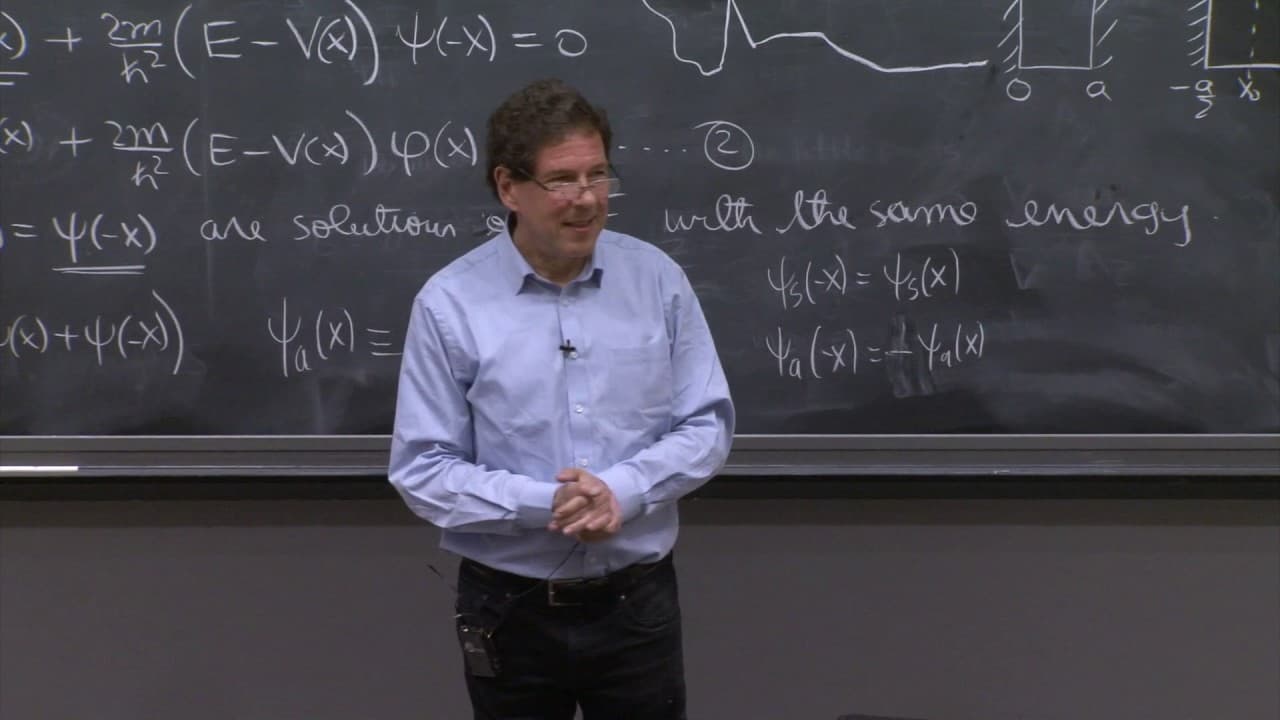
PROFESSOR: This will be qualitative insights on the wave function. It's qualitative, and it's partially quantitative of course, insights into, let's say, real energy eigenstates. So whenever you have a problem and a potential, we have what is called the total energy, the kinetic energy, and the potential energy. So you have the energy, which is tot... Read More
Key Insights
- 🍹 Total energy in classical physics is conserved and equals the sum of potential and kinetic energy.
- 🦾 In quantum mechanics, energy is an observable result of measurements using a permission operator.
- 👋 The Broglie wavelength of a particle's wave function is related to its momentum.
- 👋 The slowly varying potential contributes to changes in the wavelength of the wave function.
- 🛩️ The change in potential over the relevant distance must be much smaller than the potential itself for a slowly varying potential.
- 🫚 The Broglie wavelength can be approximated as the square root of 2mk in the case of a slowly varying potential.
- 👋 The wave function's wavelength becomes longer as the potential decreases in a slowly varying potential situation.
Install to Summarize YouTube Videos and Get Transcripts
Explore YouTube Video Summarizer or Get YouTube Transcript Extractor
Questions & Answers
Q: What is the relationship between total energy, potential energy, and kinetic energy in classical physics?
In classical physics, total energy is conserved and is equal to the sum of potential and kinetic energy. The potential energy depends on the position of the particle.
Q: How is energy measured and observed in quantum mechanics?
In quantum mechanics, energy is an observable and can be obtained through measurements using a permission operator. The energy of a particle may have uncertainty depending on the measurement.
Q: How does the Broglie wavelength relate to momentum and the wave function?
According to the Broglie wavelength, the wavelength of a particle's wave function is equal to Planck's constant divided by its momentum. This wavelength is a characteristic of energy eigenstates in quantum mechanics.
Q: How does the wavelength of a wave function change with a slowly varying potential?
In the case of a slowly varying potential, the wavelength of the wave function becomes larger as the potential decreases. This is because the momentum decreases, leading to a longer Broglie wavelength.
Summary & Key Takeaways
-
In classical physics, total energy is conserved and is equal to potential energy plus kinetic energy, which depends on the position of the particle.
-
In quantum mechanics, the energy is an observable and is a result of a measurement with a permission operator.
-
The Broglie wavelength of a particle is related to its momentum and can be used to derive the Schrodinger equation.
Read in Other Languages (beta)
Share This Summary 📚
Summarize YouTube Videos and Get Video Transcripts with 1-Click
Try YouTube Summary with ChatGPT & Claude or YouTube Transcript Generator
Explore More Summaries from MIT OpenCourseWare 📚



Summarize YouTube Videos and Get Video Transcripts with 1-Click
Try YouTube Summary with ChatGPT & Claude or YouTube Transcript Generator