Andrej Karpathy: Benefit of cameras for Tesla Autopilot
TL;DR
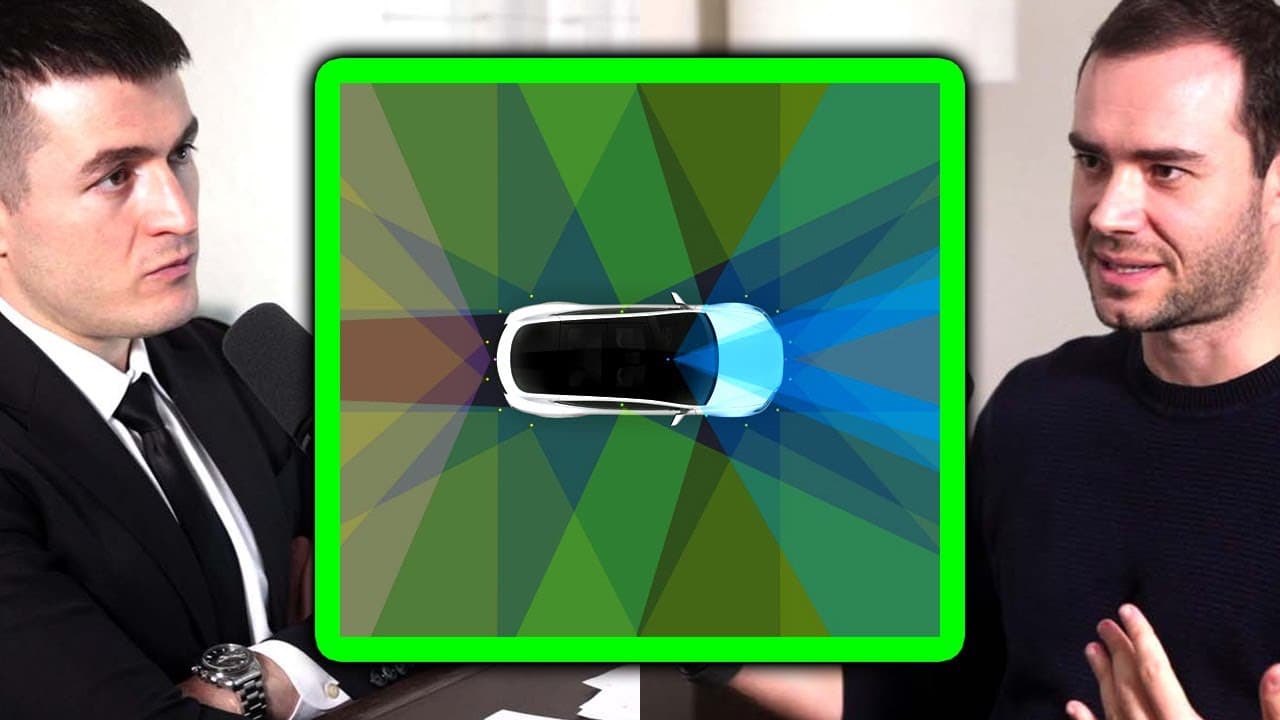
Cameras are a cheap and high-bandwidth sensor that provides valuable information for understanding the world, but processing and deploying the data can be challenging.
Transcript
what are strengths and limitations of cameras for the driving test in your understanding when you formulate the driving task as a vision task with eight cameras you've seen that the entire you know most of the history of the computer vision field when it has to do with neural networks what just if you step back what are the strengths and limitation... Read More
Key Insights
- ✋ Cameras are a cost-effective and high-bandwidth sensor that serves as a universal interface for humans.
- 📺 Human understanding combines vision, reasoning, predictions, and prior knowledge for successful navigation.
- 😌 The challenges of the vision problem in driving lie in processing pixel data and engineering the entire pipeline.
- 🖐️ Neural networks play a crucial role in converting pixel data to a three-dimensional world representation.
- 🚒 Execution, including data engine optimization and system deployment, is essential for scalable and efficient implementation.
- ✊ Constraints such as limited resources and computational power require careful optimization.
- 🪐 Engineering and optimization efforts are necessary to fit neural nets into limited resources and achieve performance targets.
Install to Summarize YouTube Videos and Get Transcripts
Explore YouTube Video Summarizer or Get YouTube Transcript Extractor
Questions & Answers
Q: What are the strengths of using cameras as sensors for driving tasks?
Cameras are cost-effective and provide a wealth of information, allowing for a high-bandwidth understanding of the world. They are designed as the primary sensor for humans, making them a widely available and compatible interface.
Q: What are the limitations of using pixels from camera sensors for driving?
Converting pixel data into a three-dimensional representation of the world is a complex task. It requires extensive engineering and processing to accurately interpret the information. Additionally, integrating neural networks into the data engine and deploying the system with low latency pose further challenges.
Q: How difficult is the driving task from a vision perspective?
Driving is challenging because it involves predicting the actions of other agents, understanding their intentions, and accounting for multiple factors. It requires the fusion of vision, theory of mind, and reasoning to navigate complex situations successfully.
Q: What are the toughest aspects of the vision problem in driving?
While cameras provide powerful sensory input, the difficulty lies in processing the vast amount of pixel data and accurately transforming it into a three-dimensional world. Engineering the entire pipeline and achieving low-latency performance to meet deployment constraints are critical challenges.
Summary & Key Takeaways
-
Cameras are an inexpensive sensor that offers a large amount of information and acts as a constraint for understanding the world.
-
Vision, powered by pixels, is the highest bandwidth sensor and is designed as a universal interface for humans.
-
While vision is crucial, human understanding also relies on reasoning, predictions, and prior knowledge.
Read in Other Languages (beta)
Share This Summary 📚
Summarize YouTube Videos and Get Video Transcripts with 1-Click
Try YouTube Summary with ChatGPT & Claude or YouTube Transcript Generator
Explore More Summaries from Lex Clips 📚



Summarize YouTube Videos and Get Video Transcripts with 1-Click
Try YouTube Summary with ChatGPT & Claude or YouTube Transcript Generator