Products
Features
YouTube Video Summarizer
Summarize YouTube videos
Web & PDF Highlighter
Highlight web pages & PDFs
Chat with PDF
Ask any PDF questions with AI
Ask AI Clone
Chat with your highlights & memories
Audio Transcriber
Transcribe audio files to text
Glasp Reader
Read and highlight articles
Kindle Highlight Export
Export your Kindle highlights
Idea Hatch
Hatch ideas from your highlights
Integrations
Obsidian Plugin
Notion Integration
Pocket Integration
Instapaper Integration
Medium Integration
Readwise Integration
Snipd Integration
Hypothesis Integration
Apps & Extensions
Chrome Extension
Safari Extension
Edge Add-ons
Firefox Add-ons
iOS App
Android App
Discover
Discover
Ideas
Discover new ideas and insights
Articles
Curated articles and insights
Books
Book recommendations by great minds
Posts
Essays and notes from readers
Quotes
Inspiring quotes collection
Videos
Curated videos and summaries
Explore Glasp
Glasp Story
How we grew from 0 to 3 million users
Glasp Newsletter
Weekly insights and updates
Glasp Talk
Interview series with great minds
Glasp Blog
Latest news and articles
Glasp Use Cases
Learn how others use Glasp
Build & Support
Glasp API
Access Glasp's API for developers
MCP Connector
Connect Glasp to Claude & ChatGPT
Community
Glasp Reddit Community
Students
Student discount and benefits
FAQs
Frequently Asked Questions
AboutPricing
DashboardLog inSign up

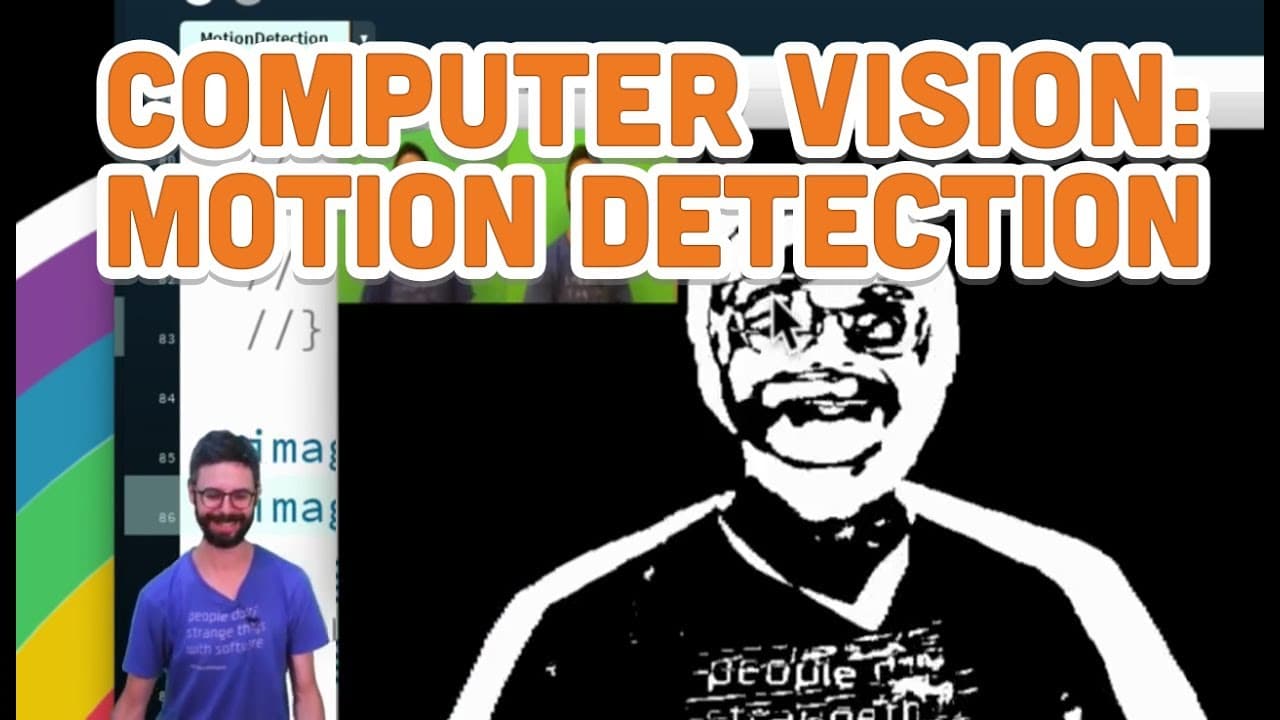
11.6: Computer Vision: Motion Detection - Processing Tutorial
101.5K views
•
July 6, 2016
by
The Coding Train
YouTube video player
11.6: Computer Vision: Motion Detection - Processing Tutorial

TL;DR

Enhancing motion detection by optimizing Euclidean distance calculation and implementing frame differencing for tracking object changes.

Transcript

hello welcome to another computer vision tutorial video in the previous video I looked at how to find of an object of a certain color and find the average location of all the pixels of that color which allows me to very easily track an object like this and you can see I can kind of move this around that I'm tracking it now what I want to do in this... Read More

Key Insights

  • 🐎 Euclidean distance optimization enhances speed in motion detection algorithms.
  • 🖼️ Frame differencing plays a crucial role in monitoring object changes by comparing consecutive frames.
  • 🌐 Utilizing global variables and interpolation ensures smoother and more precise object tracking.
  • 👨‍💻 The processing code enables real-time evaluation of pixel changes for efficient motion detection.
  • 🛃 Implementing custom functions for distance calculation enhances algorithm performance.
  • ❓ Motion tracking can be further improved by adjusting motion pixel threshold values.
  • 🤗 Tracking multiple objects individually opens up diverse possibilities for video monitoring applications.

Install to Summarize YouTube Videos and Get Transcripts

Explore YouTube Video Summarizer or Get YouTube Transcript Extractor

Questions & Answers

Q: How is Euclidean distance optimization achieved in motion tracking?

Euclidean distance is optimized by using a custom function to calculate squared distances between colors, improving speed without sacrificing accuracy.

Q: What is the significance of frame differencing in tracking object changes?

Frame differencing enables the comparison of current and previous frames to detect pixel changes, facilitating real-time monitoring of object movements.

Q: How does the code implement motion tracking using frame differencing?

The code captures and compares current and previous frames pixel by pixel, distinguishing motion pixels from static ones to highlight object changes effectively.

Q: How is average location tracking enhanced using global variables and interpolation?

By maintaining the average location of motion pixels and smoothing movements with linear interpolation, the code provides a consistent and accurate tracking experience.

Summary & Key Takeaways

  • Demonstrates motion detection optimization using Euclidean distance calculation.

  • Introduces frame differencing to track object changes in real-time.

  • Utilizes processing code to compare image frames and detect motion pixels.


Read in Other Languages (beta)

English

Share This Summary 📚

Summarize YouTube Videos and Get Video Transcripts with 1-Click

Download browser extensions on:

Try YouTube Summary with ChatGPT & Claude or YouTube Transcript Generator

Explore More Summaries from The Coding Train 📚
9.4: Genetic Algorithm: Looking at Code - The Nature of Code thumbnail
9.4: Genetic Algorithm: Looking at Code - The Nature of Code
The Coding Train
8.1: Fractals - The Nature of Code thumbnail
8.1: Fractals - The Nature of Code
The Coding Train
Classifying Poses with ml5.js Part 2 thumbnail
Classifying Poses with ml5.js Part 2
The Coding Train
How to Create Fractal Patterns with Toothpicks thumbnail
How to Create Fractal Patterns with Toothpicks
The Coding Train
ITP/IMA Winter Show 2018 thumbnail
ITP/IMA Winter Show 2018
The Coding Train
ITP/IMA Winter Show 2019 thumbnail
ITP/IMA Winter Show 2019
The Coding Train

Summarize YouTube Videos and Get Video Transcripts with 1-Click

Download browser extensions on:

Try YouTube Summary with ChatGPT & Claude or YouTube Transcript Generator

Apps & Extensions

  • Chrome Extension
  • Safari Extension
  • Edge Add-ons
  • Firefox Add-ons
  • iOS App
  • Android App

Key Features

  • YouTube Video Summarizer
  • Web & PDF Summarizer
  • Web & PDF Highlighter
  • Chat with PDF
  • Ask AI Clone
  • Audio Transcriber
  • Glasp Reader
  • Kindle Highlight Export
  • Idea Hatch

Integrations

  • Obsidian Plugin
  • Notion Integration
  • Pocket Integration
  • Instapaper Integration
  • Medium Integration
  • Readwise Integration
  • Snipd Integration
  • Hypothesis Integration

More Features

  • APIs
  • MCP Connector
  • Blog & Post
  • Embed Links
  • Image Highlight
  • Personality Test
  • Quote Shots
  • Open Graph Checker

Company

  • About us
  • Our Story
  • Blog
  • Community
  • FAQs
  • Job Board
  • Newsletter
  • Pricing
Terms

•

Privacy

•

Guidelines

© 2026 Glasp Inc. All rights reserved.