What Are the Basics of Deep Learning?
TL;DR
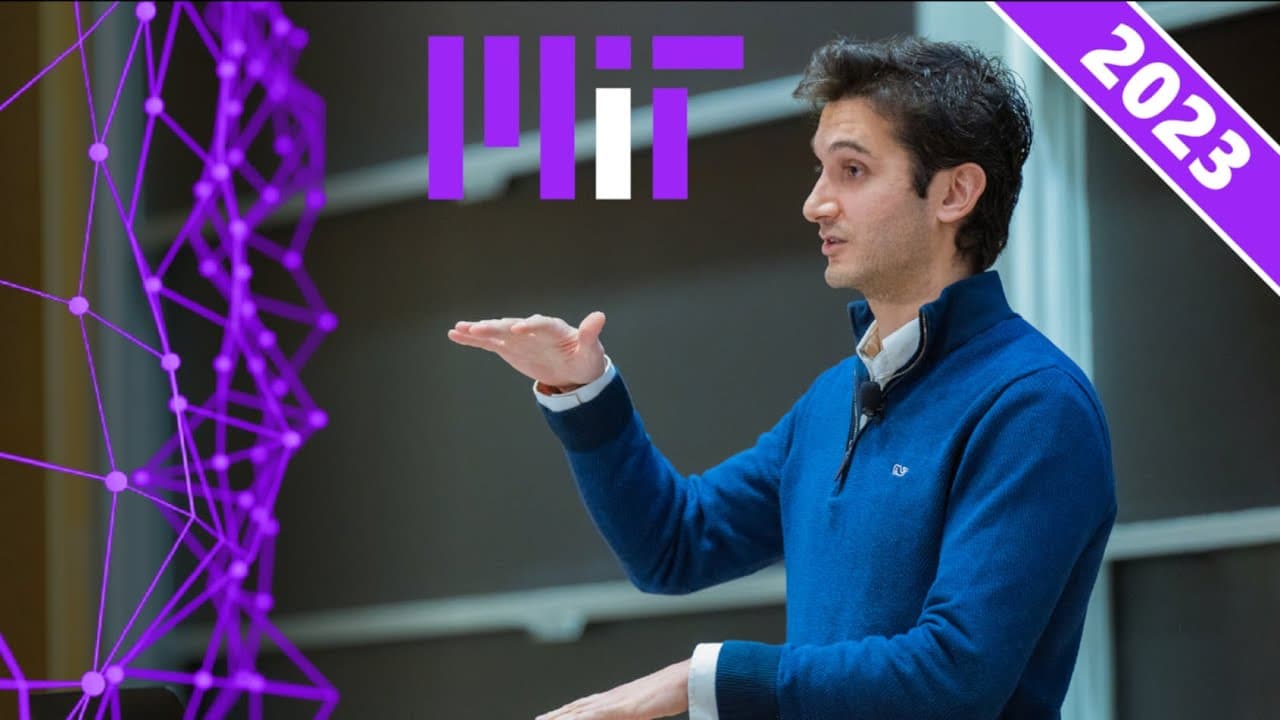
Deep learning is a transformative technology that enables machines to learn from data and make decisions. This course covers fundamental concepts, hands-on labs, and addresses challenges like overfitting, equipping learners with the tools to build neural networks and explore AI advancements.
Transcript
Good afternoon everyone! Thank you all for joining today. My name is Alexander Amini and I'll be one of your course organizers this year along with Ava -- and together we're super excited to introduce you all to Introduction to Deep Learning. Now MIT Intro to Deep Learning is a really really fun exciting and fast-paced program here at MIT ... Read More
Key Insights
- ❓ Deep learning has witnessed significant progress in recent years, enabling the generation of synthetic data and software.
- 🏋️ Training a neural network involves optimizing the weights using algorithms like gradient descent and backpropagation.
- ❓ Challenges in deep learning include overfitting, which can be addressed through regularization techniques like dropout and early stopping.
Install to Summarize YouTube Videos and Get Transcripts
Explore YouTube Video Summarizer or Get YouTube Transcript Extractor
Questions & Answers
Q: What is the purpose of the Introduction to Deep Learning course?
The course aims to teach the foundations of deep learning and provide hands-on experience with software labs to reinforce the concepts learned in lectures.
Q: How has deep learning evolved in recent years?
Deep learning has experienced significant progress, with the ability to generate synthetic data and software. It has become a powerful tool in various fields, including robotics, medicine, and autonomous vehicles.
Q: What is the role of gradient descent and backpropagation in training neural networks?
Gradient descent is used to optimize the weights of a neural network by iteratively updating them in the direction of the steepest descent of the loss function. Backpropagation is the algorithm used to compute the gradients for updating the weights.
Q: What challenges does deep learning face, and how can they be overcome?
Overfitting is a common challenge in deep learning, where the model becomes too complex and fits the training data too closely. Regularization techniques like dropout and early stopping can help overcome overfitting. Choosing an appropriate learning rate is also crucial for successful training.
Key Insights:
- Deep learning has witnessed significant progress in recent years, enabling the generation of synthetic data and software.
- Training a neural network involves optimizing the weights using algorithms like gradient descent and backpropagation.
- Challenges in deep learning include overfitting, which can be addressed through regularization techniques like dropout and early stopping.
- Choosing the right learning rate is essential for successful training and faster convergence of neural networks.
Summary & Key Takeaways
-
Introduction to Deep Learning is a course that covers the foundations of deep learning and artificial intelligence, providing hands-on experience with software labs.
-
Deep learning has seen significant progress in recent years, with the ability to generate new data and even software.
-
The course uses techniques like gradient descent and backpropagation to train neural networks, and addresses challenges like choosing the right learning rate and preventing overfitting.
Read in Other Languages (beta)
Share This Summary 📚
Summarize YouTube Videos and Get Video Transcripts with 1-Click
Try YouTube Summary with ChatGPT & Claude or YouTube Transcript Generator
Explore More Summaries from Alexander Amini 📚





Summarize YouTube Videos and Get Video Transcripts with 1-Click
Try YouTube Summary with ChatGPT & Claude or YouTube Transcript Generator