5.3 Flee, Pursue, Evade - The Nature of Code
TL;DR
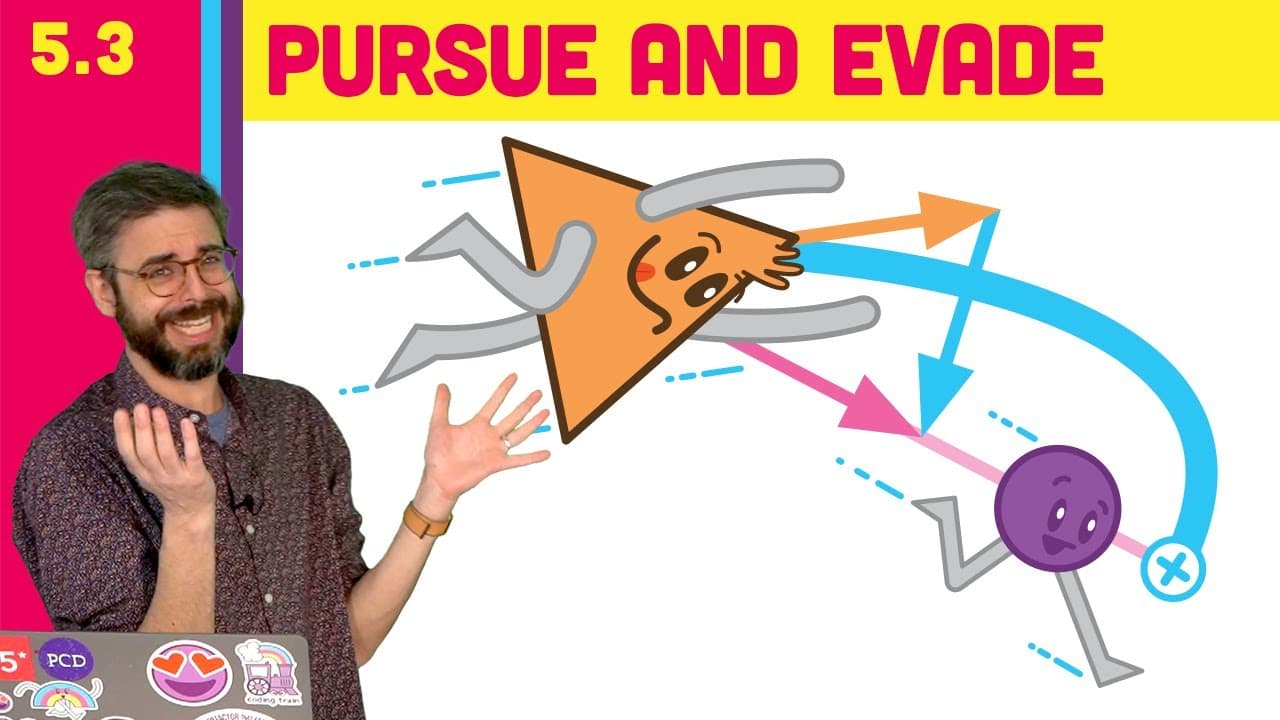
Implementing various steering behaviors for autonomous characters like seek, flee, pursue, and evade using a triangle and a circle.
Transcript
hello again where i last left off in the previous video i implemented the steering behavior seek this little triangle is seeking this red circle and i am on a quest i would like to implement every single one of these behaviors that craig reynolds outlines in the 1999 paper steering behaviors for autonomous characters so i haven't gotten very far i'... Read More
Key Insights
- ❓ Autonomous character steering behaviors include seek, flee, pursue, and evade for effective navigation.
- 🎯 Predicting a moving target's future location is crucial for implementing pursuit behavior successfully.
- 👨💻 Directly applying steering forces limits flexibility and reusability in code design.
- 🥺 Experimenting with parameters and behaviors can lead to more complex and engaging simulations.
- 🎮 Annotating and visualizing different parameters can enhance understanding and control of the system.
- 🪜 Implementing additional behaviors like wander can add complexity and realism to autonomous character movements.
- 🤩 Iterative development and exploration of steering behaviors are key to mastering their implementation.
Install to Summarize YouTube Videos and Get Transcripts
Explore YouTube Video Summarizer or Get YouTube Transcript Extractor
Questions & Answers
Q: What is the key concept of steering behaviors for autonomous characters?
Steering behaviors involve adjusting a character's direction towards or away from a target based on specific criteria like seek, flee, pursue, or evade.
Q: How does pursuit differ from seeking a target?
Pursuit involves predicting a moving target's future location and adjusting the character's direction towards that predicted position, while seeking is simply moving towards a static target.
Q: Why is it important to not directly apply forces in steering functions?
By returning the steering force from a function instead of directly applying it, the calling function can decide whether to apply the force, allowing for more flexibility and reusability.
Q: What additional enhancements can be made to the pursuit and evade behaviors?
Parameters like the prediction distance and the behavior of the target can be adjusted to create more dynamic and engaging scenarios for the pursuer and the target.
Summary & Key Takeaways
-
Implementing steering behaviors seek, flee, pursue, and evade based on Craig Reynolds' 1999 paper.
-
Each behavior involves adjusting the direction of the vehicle towards or away from a target.
-
The pursuer can predict the future location of a moving target using pursuit, while evade does the opposite.
Read in Other Languages (beta)
Share This Summary 📚
Summarize YouTube Videos and Get Video Transcripts with 1-Click
Try YouTube Summary with ChatGPT & Claude or YouTube Transcript Generator
Explore More Summaries from The Coding Train 📚




Summarize YouTube Videos and Get Video Transcripts with 1-Click
Try YouTube Summary with ChatGPT & Claude or YouTube Transcript Generator